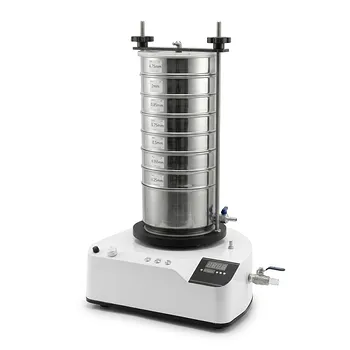
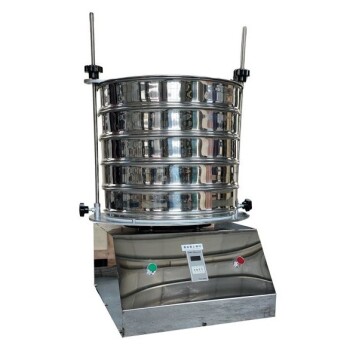
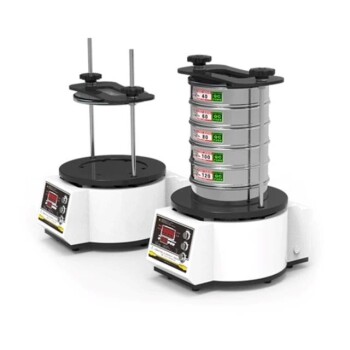
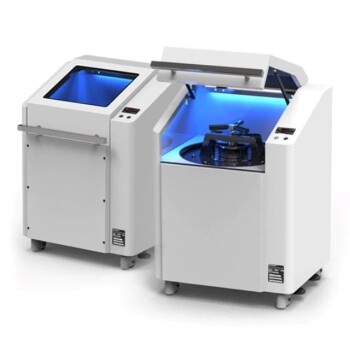
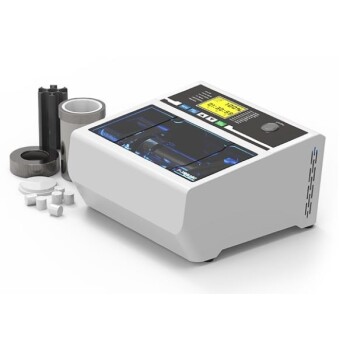
Standard sieving equipment serves a singular, decisive purpose in the fabrication of cellular CuAlMn alloys: it strictly controls the particle size range of the sodium chloride (NaCl) space holder. By filtering these particles typically between 355 and 800 micrometers, the equipment establishes the fundamental geometric baseline for the material's porous architecture.
In the preparation of cellular CuAlMn alloys, sieving is not merely a preparatory step; it is the primary determinant of the final pore size and the uniformity of pore distribution within the structural matrix.
The Mechanics of Structural Control
Defining the Space Holder
The manufacturing process relies on sodium chloride (NaCl) powder acting as a space holder.
These salt particles occupy the physical volume that will eventually become empty voids within the finished alloy.
Precision Particle Filtering
The critical function of the sieving equipment is to isolate a specific fraction of these NaCl particles.
According to standard protocols, the equipment targets a particle size range of 355 to 800 micrometers.
Dictating Pore Geometry
Because the salt particles define the void space, the sieving step is the essential first stage in engineering the material.
The size of the sieved salt granule directly correlates to the size of the final pore in the CuAlMn alloy.
Ensuring Uniformity
Beyond simple sizing, the equipment ensures the uniformity of pore distribution.
Consistent particle sizes lead to a consistent structural lattice, preventing areas of irregular density that could compromise the material's integrity.
Distinguishing Structure from Function
Structural Definition vs. Phase Transformation
It is vital to distinguish between creating the cellular structure and inducing the functional properties.
Sieving controls the physical architecture (porosity), but it does not generate the shape memory effect.
The Role of Heat Treatment
While sieving defines the shape of the pores, the martensitic phase transformation—which gives the alloy its shape memory and superelasticity—is achieved through a separate process.
This requires a solution treatment furnace heating the sintered samples to 800 degrees Celsius, followed by quenching.
Avoiding Process Conflation
Do not expect sieving adjustments to alter the alloy's functional memory capabilities.
Sieving dictates geometry; heat treatment dictates superelastic behavior.
Optimizing Your Manufacturing Process
To ensure you are adjusting the correct variable for your desired outcome, apply the following logic:
- If your primary focus is controlling pore size and distribution: Calibrate your standard sieving equipment to strictly maintain the NaCl particle range between 355 and 800 micrometers.
- If your primary focus is activating the shape memory effect: Focus on the solution treatment furnace parameters to ensure the material reaches 800°C before quenching.
Precision in the sieving stage provides the necessary structural consistency that allows the alloy's functional properties to perform reliably.
Summary Table:
| Parameter | Specification/Function |
|---|---|
| Space Holder Material | Sodium Chloride (NaCl) |
| Target Particle Size | 355 – 800 micrometers |
| Primary Role | Determines pore size and distribution uniformity |
| Structural Impact | Establishes the geometric baseline of the alloy matrix |
| Relationship to SMA | Defines physical architecture (not functional properties) |
Precision Engineering for Your Research Success
Unlock the full potential of your material fabrication with KINTEK. Whether you are defining the structural matrix of Shape Memory Alloys with our high-precision standard sieving equipment and crushing systems, or activating superelasticity in our advanced solution treatment furnaces, we provide the tools necessary for scientific excellence.
From muffle and vacuum furnaces to hydraulic pellet presses and crucibles, KINTEK specializes in laboratory equipment designed for the most demanding applications. Our experts are ready to help you optimize your process for consistent, reliable results.
Enhance your laboratory capabilities—contact us today to request a quote or consultation!
Related Products
- Three-dimensional electromagnetic sieving instrument
- Laboratory Vibratory Sieve Shaker Machine for Dry and Wet Three-Dimensional Sieving
- Laboratory Test Sieves and Sieving Machines
- Laboratory Wet Three-Dimensional Vibratory Sieve Shaker Machine
- Laboratory Test Sieves and Vibratory Sieve Shaker Machine
People Also Ask
- Why is sieving equipment essential for the classification of processed bio-activated carbon? Optimize Performance
- What are the limitations of sieving? Understanding the Constraints of Particle Size Analysis
- What are advantages and disadvantages of sieving method? A Guide to Reliable & Cost-Effective Particle Sizing
- How is sieving important? The Critical Role of Particle Size Analysis in Quality Control
- What is sieving and how does it work? A Guide to Accurate Particle Size Analysis