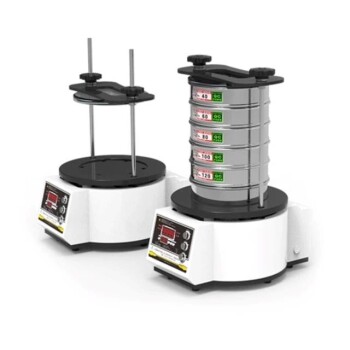
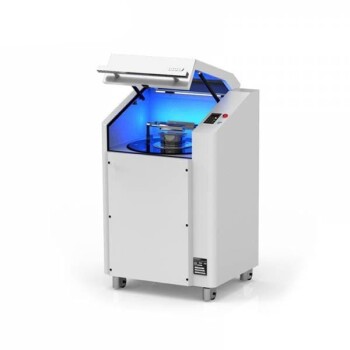
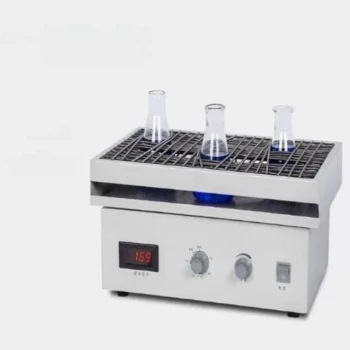
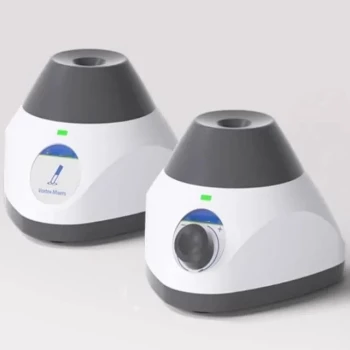
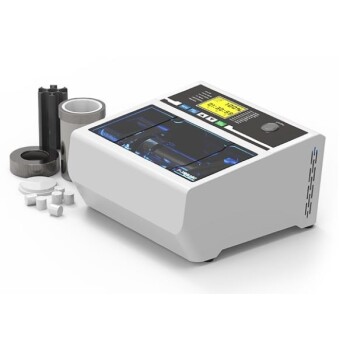
To establish a reliable baseline for metal leaching research, a precision vibrating sieve shaker is the fundamental tool for isolating specific particle size fractions from crushed mixed powders. By ensuring experimental materials fall within exact ranges—such as 90–180 μm or 180–350 μm—researchers can eliminate variables and accurately measure how surface area impacts the chemical extraction of metals.
Core Takeaway Leaching kinetics rely heavily on specific surface area. Without the strict consistency provided by a precision shaker, it is impossible to establish a quantitative relationship between particle size and recovery rates, compromising the optimization of gold and copper extraction processes.
Establishing Experimental Control
Accurate Separation of Fractions
Crushed ore naturally exists as a mixed powder containing a chaotic distribution of sizes.
A precision vibrating sieve shaker mechanically segregates this mix into distinct, controllable bands, such as d < 90 μm.
This mechanical separation is the first step in converting a raw sample into a scientifically usable test material.
Ensuring Material Consistency
To determine how a metal behaves during leaching, the input material must be uniform.
If the particle size varies within a single test batch, the reaction rates will fluctuate unpredictably.
The shaker ensures that every sample used in the experiment possesses a consistent physical profile.
Connecting Size to Reaction Speed
Defining Specific Surface Area
Leaching is a surface-dependent chemical reaction.
By isolating specific size ranges, researchers can accurately estimate the specific surface area available for the lixiviant (leaching solvent) to attack.
This creates a direct correlation between the physical geometry of the ore and its chemical reactivity.
Quantifying Leaching Kinetics
The ultimate goal of this research is to understand how fast the metal is extracted.
Precision sieving allows for the accurate evaluation of the quantitative relationship between particle size and leaching kinetics.
This data is essential for modeling how metals like gold and copper will behave under industrial conditions.
Common Pitfalls to Avoid
Overlooking Size Distribution Errors
A common mistake in leaching research is assuming an "average" particle size is sufficient for analysis.
If a sample labeled "150 μm" actually contains significant amounts of fine dust or coarse rocks, the kinetic data will be skewed.
This leads to erroneous conclusions regarding reaction speeds and reagent consumption.
The Risk of Poor Process Optimization
Process parameters are optimized based on laboratory data.
If the initial particle separation is flawed, the resulting process design will be inefficient.
This can result in lower recovery rates or excessive energy costs in downstream grinding circuits.
How to Apply This to Your Project
To maximize the value of your research into metal leaching rates, align your sieving strategy with your specific objectives:
- If your primary focus is Kinetic Modeling: Ensure you isolate narrow, non-overlapping size ranges (e.g., 90–180 μm) to generate precise data on reaction speeds.
- If your primary focus is Process Optimization: Use the shaker to identify the specific particle size "sweet spot" that balances recovery rates with grinding costs for gold or copper.
Accurate data begins with precise separation; without it, you are guessing rather than measuring.
Summary Table:
| Feature | Impact on Leaching Research | Benefit to Researchers |
|---|---|---|
| Fraction Isolation | Segregates mixed powders into distinct ranges (e.g., 90–180 μm) | Eliminates size variables for controlled experiments |
| Consistency Control | Ensures every sample in a test batch has a uniform physical profile | Prevents unpredictable fluctuations in reaction rates |
| Surface Area Analysis | Allows accurate estimation of specific surface area for solvents | Establishes a direct correlation with chemical reactivity |
| Kinetics Modeling | Enables quantitative measurement of extraction speeds | Provides reliable data for industrial process optimization |
Elevate Your Metallurgical Research with KINTEK Precision
Precise leaching kinetics start with the absolute accuracy of your sample preparation. At KINTEK, we specialize in high-performance crushing and milling systems and precision vibrating sieve shakers designed to deliver the exact particle size fractions your research demands.
Whether you are optimizing gold and copper recovery or developing advanced leaching models, our laboratory equipment—including hydraulic presses, high-temperature furnaces, and chemical reactors—is engineered to eliminate experimental variables and maximize efficiency.
Ready to achieve superior consistency in your lab? Contact our technical experts today to find the perfect sieving and processing solution for your project.
References
- Vera Serga, Vladimir Pankratov. Leaching of Gold and Copper from Printed Circuit Boards under the Alternating Current Action in Hydrochloric Acid Electrolytes. DOI: 10.3390/met12111953
This article is also based on technical information from Kintek Solution Knowledge Base .
Related Products
- Laboratory Test Sieves and Vibratory Sieve Shaker Machine
- Laboratory Vibratory Sieve Shaker Machine for Dry and Wet Three-Dimensional Sieving
- Vibratory Sieve Shaker Machine Dry Three-Dimensional Vibrating Sieve
- Laboratory Vibratory Sieve Shaker Machine Slap Vibrating Sieve
- Laboratory Wet Three-Dimensional Vibratory Sieve Shaker Machine
People Also Ask
- How does a laboratory vibratory sieve shaker facilitate the microstructural study of gas-atomized alloy powders?
- What role does a laboratory vibrating sieve shaker play in the LiFePO4 powder processing workflow? Ensure Batch Quality
- What is the use of vibratory sieve shaker? Achieve Precise Particle Size Analysis for Your Lab
- How is a vibratory sieve shaker used in the particle size analysis of mechanically alloyed powders? Expert Guide
- Why use a vibratory sieve shaker for PET powder? Achieve Precise Particle Size Control for Chemical Research