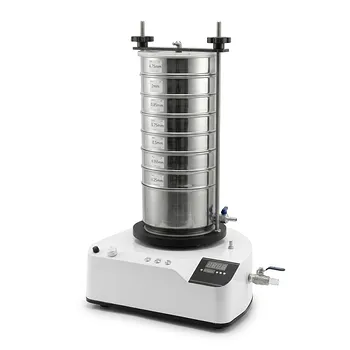
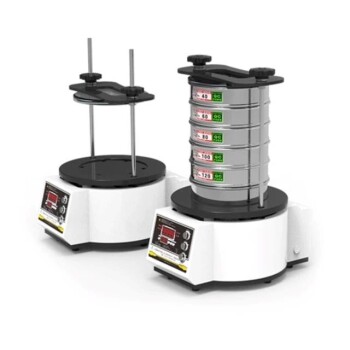
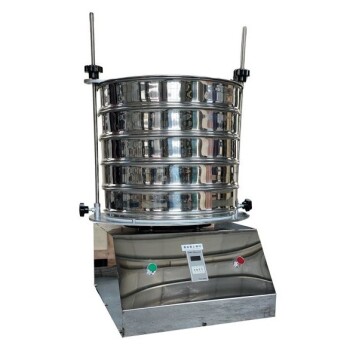
The primary function of a mechanical sieve shaker is to physically classify raw biomass material into specific size fractions. By applying rhythmic vibrational forces, the device forces Gmelina arborea sawdust or similar woody biomass through a stack of standard sieves with progressively smaller mesh sizes. This mechanical separation sorts the material into distinct categories—oversized, coarse, needle-like, and fine particles—providing the essential data needed to characterize the feedstock.
The particle size distribution data generated by the sieve shaker is the decisive factor in determining whether raw biomass requires further grinding, directly impacting the structural strength and quality of the final densified product.
The Mechanism of Classification
Utilizing Rhythmic Vibration
The core operation of the sieve shaker relies on rhythmic vibrational forces.
This continuous motion agitates the biomass sample, causing particles to orient themselves and pass through mesh openings if they are small enough.
This ensures that every particle is sorted based on its physical dimensions rather than its weight or density alone.
Defining Particle Categories
The separation process yields a clear stratification of the raw material.
The biomass is typically categorized into oversized, coarse, needle-like, and fine particles.
Understanding the proportions of these specific shapes and sizes is the first step in converting raw sawdust into a usable industrial product.
The Impact on Densification Quality
Guiding the Grinding Process
The immediate application of the sieve analysis is to dictate pre-processing requirements.
If the shaker reveals a high percentage of oversized particles, operators know that further grinding is necessary before the material can be used.
Without this insight, manufacturers might attempt to process raw material that is too large to bond effectively, leading to equipment jams or poor product formation.
Optimizing Structural Integrity
The ultimate goal of analyzing particle size is to ensure the quality of the final output.
The distribution of particles directly correlates to the structural strength of the biomass during densification or briquetting.
A specific balance of fines and coarse material is required to create a durable, high-quality briquette that will not crumble during handling or transport.
Understanding the Trade-offs
The Cost of Oversized Material
Identifying oversized particles through sieving introduces a trade-off between processing time and material quality.
While the presence of large particles necessitates an additional grinding step—increasing energy consumption and time—skipping this step often results in structural failure of the final product.
The sieve shaker essentially acts as a gatekeeper, forcing a decision between immediate processing efficiency and long-term product viability.
Balancing Particle Types
While "fine" particles are necessary for filling gaps, an excess of any single category can be detrimental.
The presence of needle-like particles, identified by the shaker, can behave differently than cubic coarse particles during compression.
Relying solely on visual inspection without mechanical sieving risks missing these subtle distribution imbalances that compromise the integrity of the densification process.
Making the Right Choice for Your Goal
To maximize the utility of your particle size analysis, you must align the data with your processing objectives:
- If your primary focus is process efficiency: Use the sieve data to identify the minimum amount of grinding required to reduce oversized particles, avoiding over-processing.
- If your primary focus is product durability: strict adherence to the optimal ratio of coarse to fine particles is essential to maximize the structural strength of your briquettes.
The mechanical sieve shaker is not just a measuring tool; it is the critical checkpoint that bridges the gap between raw waste and high-value fuel.
Summary Table:
| Particle Category | Physical Characteristics | Role in Densification |
|---|---|---|
| Oversized | Larger than top mesh | Requires further grinding; prevents jams |
| Coarse | Standard cubic particles | Provides the primary structural framework |
| Needle-like | Elongated dimensions | Influences binding and compression behavior |
| Fines | Smallest particles | Fills voids to increase briquette density |
Precision in particle size analysis is the foundation of high-quality biomass production. KINTEK provides industry-leading crushing and milling systems, sieving equipment, and hydraulic presses designed to transform raw Gmelina arborea sawdust into superior fuel products. Whether you need to optimize structural strength or streamline your grinding process, our laboratory solutions ensure your feedstock meets the highest standards. Contact KINTEK today to enhance your research and production efficiency with our comprehensive range of lab equipment and consumables.
References
- Segun Bello, Temidayo Emmanuel Omoniyi. Effect of Residence Time On Characteristics of Torrefied Sawdust Produced from Gmelina Arborea (Roxb) Wood. DOI: 10.3923/tasr.2022.168.179
This article is also based on technical information from Kintek Solution Knowledge Base .
Related Products
- Laboratory Vibratory Sieve Shaker Machine for Dry and Wet Three-Dimensional Sieving
- Laboratory Test Sieves and Vibratory Sieve Shaker Machine
- Laboratory Vibratory Sieve Shaker Machine Slap Vibrating Sieve
- Vibratory Sieve Shaker Machine Dry Three-Dimensional Vibrating Sieve
- Laboratory Wet Three-Dimensional Vibratory Sieve Shaker Machine
People Also Ask
- How does a laboratory vibratory sieve shaker facilitate the microstructural study of gas-atomized alloy powders?
- What role does a laboratory vibrating sieve shaker play in the LiFePO4 powder processing workflow? Ensure Batch Quality
- Why use a vibratory sieve shaker for PET powder? Achieve Precise Particle Size Control for Chemical Research
- What is the principle of vibratory sieve shaker? Achieve Accurate Particle Size Analysis
- What is the function of a vibratory sieve shaker? Achieve Precise Particle Size Analysis