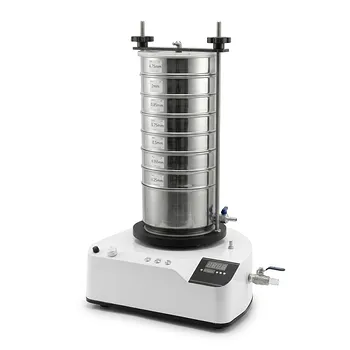
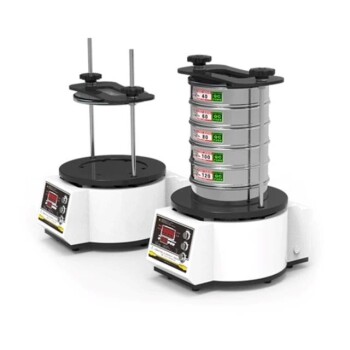
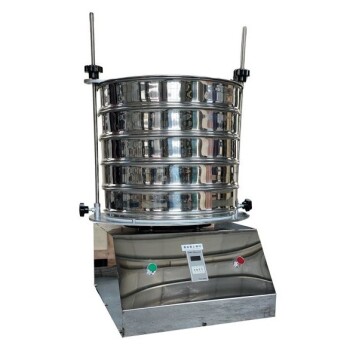
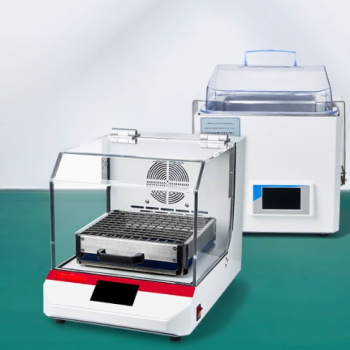
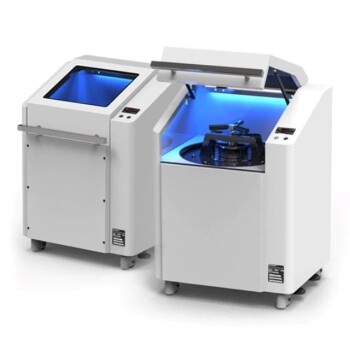
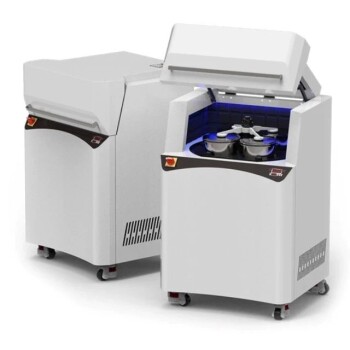
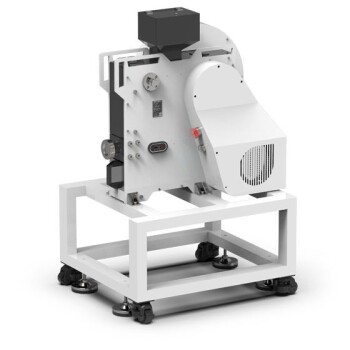
A laboratory vibratory sieve shaker acts as a precise classification engine, essential for breaking down gas-atomized alloy powders into discrete particle size fractions. By separating bulk powder into specific ranges—such as fractions smaller than 20 micrometers up to those exceeding 106 micrometers—the device allows researchers to isolate particles that have experienced distinct thermal histories.
The Core Insight: In gas atomization, particle size is a direct proxy for cooling rate. Therefore, the vibratory sieve shaker does not just separate by size; it effectively separates the material by cooling rate, enabling the quantitative analysis of how thermal history dictates phase selection and microstructural evolution.
The Relationship Between Size and Thermal History
Establishing Size Fractions
Gas-atomized powders are naturally heterogeneous in size. The vibratory sieve shaker uses mechanical vibration to pass these powders through a stack of screens with diminishing mesh sizes.
This creates isolated samples, or "cuts," of specific diameters (e.g., <20 µm, 20-53 µm, 53-106 µm). Without this step, analysis is performed on a bulk mixture, obscuring the behavior of individual particle groups.
The Physics of Cooling
The fundamental principle driving this analysis is the relationship between diameter and heat transfer. As the diameter of a powder particle decreases, its cooling rate increases significantly.
Small particles have a higher surface-area-to-volume ratio, allowing them to solidify much faster than their larger counterparts. Consequently, the sieve shaker is the tool used to segregate "fast-cooling" samples from "slow-cooling" samples.
Analyzing Microstructural Impact
Quantitative Phase Analysis
Once the powder is separated, researchers can perform quantitative analysis on the resulting microstructure. The cooling rate directly influences chemical phase selection.
For example, researchers can observe transitions between phases, such as the shift from austenite to ferrite, by comparing the fine fractions against the coarse fractions.
Morphology and Solidification
Beyond phase selection, the cooling rate dictates the physical morphology of the microstructure. Fast cooling often traps metastable phases or creates finer internal structures.
By analyzing the sieved fractions individually, scientists can map exactly how the solidification velocity—determined by the particle size—alters the final material properties.
Common Pitfalls in Powder Analysis
The Danger of Bulk Averaging
A common mistake in powder characterization is analyzing the "bulk" powder as a single homogeneous material. This results in averaged data that hides critical details.
If you analyze the bulk mixture, you average the properties of the slow-cooling large particles with the fast-cooling small ones. This obscures the phase transition thresholds and makes it impossible to understand the material's sensitivity to cooling rates.
Resolution Limitations
While a sieve shaker is a powerful tool, it is limited by the availability of standard mesh sizes. It provides data in discrete ranges rather than a continuous spectrum.
Researchers must select their sieve stack carefully to ensure they capture the critical size thresholds where phase transitions are likely to occur.
Making the Right Choice for Your Goal
To maximize the value of a vibratory sieve shaker in your research, tailor your approach to your specific analytical needs:
- If your primary focus is Phase Identification: Analyze the finest (<20 µm) and coarsest (>106 µm) fractions first to establish the boundary conditions of phase selection (e.g., pure austenite vs. ferrite).
- If your primary focus is Process Optimization: Use intermediate sieve sizes to determine the exact particle diameter where the microstructural transition occurs, allowing you to tune the atomization process for yield.
The sieve shaker is not merely a separation tool; it is the gateway to decoding the thermal history of your material.
Summary Table:
| Particle Size Range | Cooling Rate Proxy | Microstructural Focus |
|---|---|---|
| Fine (<20 µm) | Ultra-Fast Cooling | Metastable phases & fine structures |
| Medium (20-106 µm) | Moderate Cooling | Phase transition thresholds |
| Coarse (>106 µm) | Slow Cooling | Stable phases (e.g., equilibrium ferrite) |
| Bulk Powder | Averaged Result | Inaccurate; masks thermal history details |
Unlock Precision in Your Powder Metallurgy Research
Maximize the accuracy of your microstructural analysis with KINTEK’s high-performance vibratory sieve shakers and sieving equipment. Our precision tools enable you to isolate critical size fractions, ensuring you can map thermal histories and phase selections without the inaccuracies of bulk averaging.
From high-temperature furnaces and crushing systems to our specialized pellet presses, ceramics, and crucibles, KINTEK provides the comprehensive laboratory ecosystem required for advanced materials science.
Ready to optimize your atomization process? Contact KINTEK today to find the perfect sieving solution for your lab!
References
- M.J. Carrington, David Stewart. Microstructural characterisation of Tristelle 5183 (Fe-21%Cr-10%Ni-7.5%Nb-5%Si-2%C in wt%) alloy powder produced by gas atomisation. DOI: 10.1016/j.matdes.2018.107548
This article is also based on technical information from Kintek Solution Knowledge Base .
Related Products
- Laboratory Vibratory Sieve Shaker Machine for Dry and Wet Three-Dimensional Sieving
- Laboratory Wet Three-Dimensional Vibratory Sieve Shaker Machine
- Laboratory Vibratory Sieve Shaker Machine Slap Vibrating Sieve
- Vibratory Sieve Shaker Machine Dry Three-Dimensional Vibrating Sieve
- Laboratory Test Sieves and Vibratory Sieve Shaker Machine
People Also Ask
- What role does a laboratory vibrating sieve shaker play in the LiFePO4 powder processing workflow? Ensure Batch Quality
- Why use a vibratory sieve shaker for PET powder? Achieve Precise Particle Size Control for Chemical Research
- What is the principle of vibratory sieve shaker? Achieve Accurate Particle Size Analysis
- What is the function of a vibratory sieve shaker? Achieve Precise Particle Size Analysis
- What is the use of vibratory sieve shaker? Achieve Precise Particle Size Analysis for Your Lab