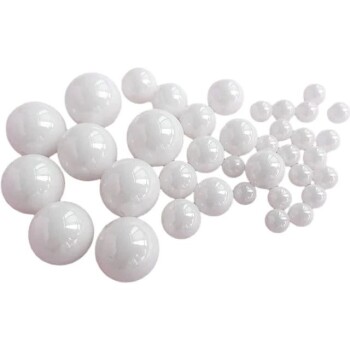
Zirconia grinding media, specifically Yttria-stabilized zirconia (YSZ), are preferred for mechanical alloying because they offer the critical combination of extreme hardness and chemical inertness. While other materials may provide high impact energy, zirconia allows for high grinding efficiency without introducing foreign metallic contaminants that would degrade the radiation resistance and mechanical properties of the final Oxide Dispersion Strengthened (ODS) alloy.
The decision to use zirconia over steel is fundamentally about purity control. In ODS alloy production, even trace amounts of metallic wear debris from standard grinding media can compromise the material's structural integrity and performance in high-radiation environments.
The Imperative of Purity
For ODS powders, such as Fe-Cr-Al-Ti-Y2O3, the chemical composition must be precisely maintained. The mechanical alloying process is aggressive, and the choice of media dictates the quality of the final output.
Eliminating Metallic Contaminants
The primary risk in mechanical alloying is the introduction of impurities from the grinding tool itself. Standard steel balls wear down over time, depositing iron, carbon, or other alloy elements into the powder. Zirconia is chemically distinct from the metallic powder, minimizing the introduction of foreign metallic contaminants.
Preserving Radiation Resistance
ODS alloys are often designed for nuclear or high-temperature applications where radiation resistance is paramount. Impurities introduced during milling can act as defect sites, weakening the material's resistance to radiation damage. Zirconia media ensure the powder maintains the high purity requisite for these extreme environments.
Durability Under High Energy
Mechanical alloying involves subjecting powders to high-frequency, high-energy impacts over extended durations. The grinding media must survive this environment without failing.
Extreme Wear Resistance
The milling process can last anywhere from 24 to 200 hours. Zirconia possesses excellent wear resistance, meaning it degrades much slower than softer alternatives. This ensures that the geometry of the grinding balls remains consistent, providing uniform energy transfer throughout the entire milling duration.
Withstanding Impact
Despite being a ceramic, Yttria-stabilized zirconia possesses extreme hardness and toughness. It can withstand the high-energy impacts generated by planetary motion without fracturing. This durability prevents catastrophic failure of the media, which would ruin the powder batch.
Understanding the Trade-offs
While zirconia is the superior choice for purity, it is important to understand how it differs from other media like stainless steel.
Density and Kinetic Energy
Stainless steel balls have a high density, which translates to very high kinetic energy during collisions. This can be beneficial for rapid fracturing. Zirconia is generally lighter than steel; however, its hardness compensates for this, allowing it to achieve high grinding efficiency without the contamination penalty associated with steel.
Cost vs. Performance
Zirconia media are typically more expensive than high-strength steel. However, in the context of ODS alloys, this cost is justified. The "cheaper" option of steel balls effectively becomes the most expensive option if the introduced impurities render the final alloy unusable for its intended nuclear or high-performance application.
Making the Right Choice for Your Goal
The selection of grinding media should be dictated by the specific tolerances of your final application.
- If your primary focus is Nuclear or High-Temp Applications: Prioritize zirconia (YSZ) media to guarantee the absolute elimination of foreign metallic contaminants and preserve radiation resistance.
- If your primary focus is Basic Powder Refinement: You may consider high-strength stainless steel, provided that trace iron or carbon contamination does not compromise your material's final mechanical properties.
Ultimately, for high-performance ODS alloys, zirconia provides the necessary assurance that the material's chemistry remains exactly as designed.
Summary Table:
| Feature | Zirconia (YSZ) Media | Stainless Steel Media |
|---|---|---|
| Contamination Risk | Extremely Low (Ceramic) | High (Metallic debris) |
| Hardness | Very High | High |
| Wear Resistance | Excellent (Long duration) | Moderate |
| Primary Application | Nuclear/High-Temp ODS Alloys | Basic Powder Refinement |
| Impact Energy | Efficient / High Hardness | High Density / High Kinetic |
Elevate Your ODS Alloy Production with KINTEK
Don't compromise the integrity of your high-performance materials. KINTEK specializes in premium laboratory equipment designed for precision, including high-density zirconia grinding jars and balls, crushing and milling systems, and high-temperature furnaces. Whether you are developing radiation-resistant ODS alloys or advanced ceramics, our range of YSZ media, planetary ball mills, and hydraulic presses ensures your powders remain pure and your results reproducible.
Ready to achieve superior purity in your mechanical alloying process? Contact KINTEK experts today to find the perfect grinding solutions for your laboratory needs.
References
- Markus Benjamin Wilms, Bilal Gökce. Manufacturing oxide-dispersion-strengthened steels using the advanced directed energy deposition process of high-speed laser cladding. DOI: 10.1007/s40964-022-00319-1
This article is also based on technical information from Kintek Solution Knowledge Base .
Related Products
- Laboratory Jar Ball Mill with Alumina Zirconia Grinding Jar and Balls
- Precision Machined Zirconia Ceramic Ball for Engineering Advanced Fine Ceramics
- Laboratory Jar Mill with Agate Grinding Jar and Balls
- Laboratory Ball Mill Jar Mill with Metal Alloy Grinding Jar and Balls
- Nature Agate Mortar and Pestle for Grinding and Mixing
People Also Ask
- What are the primary functions of using a ball mill for BZCY72 powder? Achieve High Purity and Enhanced Sintering
- In what way does a laboratory ball mill affect material properties when modifying PHBV/pulp fiber composites?
- Why is a laboratory ball mill required for ultra-fine fly ash? Unlock Nano-Scale Adsorption Power
- What is the function of a laboratory ball mill in the preparation of AMMCs? Optimize Dispersion & Grain Refinement
- What is the function of a laboratory ball mill in the pretreatment of waste tire char (WTC)? Optimize Material Reactivity