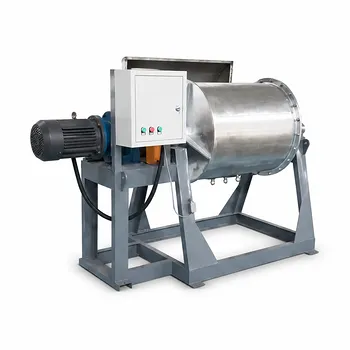
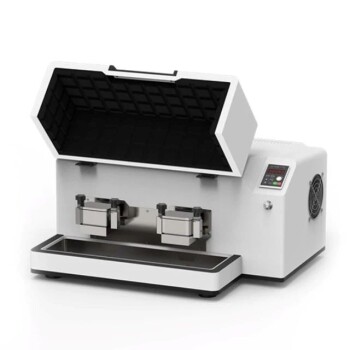
The primary function of a planetary ball mill in this context is to facilitate high-energy mechanical alloying. Through intense cycles of cold welding, fracturing, and dynamic recrystallization, the mill refines the grain size of the stainless steel powder from the micrometer scale down to the nanometer scale (typically 20-25 nm).
Core Takeaway The planetary ball mill does not simply mix ingredients; it fundamentally alters the microstructure of the steel. By inducing significant plastic strain and high-density dislocations, it creates the essential structural foundation required for the uniform precipitation of oxide nanoparticles during the subsequent sintering phase.
The Mechanics of Microstructural Transformation
Achieving Nanoscale Refinement
The central mechanical goal is extreme grain refinement.
Raw 304L stainless steel powder typically begins at the micrometer scale. The planetary ball mill utilizes high-energy impacts to drastically reduce this size.
According to the primary data, this process successfully refines grains to approximately 20-25 nm. This nanostructure is critical for the enhanced properties of ODS steel.
The Cycle of Cold Welding and Fracturing
Mechanical alloying is not a passive mixing process; it is a violent, repetitive cycle.
Powder particles are repeatedly flattened, cold-welded together, and then fractured. This constant restructuring ensures that the material is processed homogeneously.
This cycle facilitates dynamic recrystallization, a process where new, strain-free grains form within the deformed material, further contributing to grain refinement.
Mechanically Activated Diffusion
Beyond physical crushing, the mill enables atomic-level changes.
The high kinetic energy promotes mechanically activated diffusion. This allows for the forced mixing of elements that might not mix easily under standard equilibrium conditions.
This results in a uniform distribution of components, effectively creating a supersaturated solid solution within the iron matrix.
Establishing the Foundation for Oxide Dispersion
Creating High-Density Dislocations
The effectiveness of ODS steel relies on how well the oxide particles are distributed.
The milling process induces intense plastic strain within the powder particles. This strain generates a high density of dislocations (defects in the crystal lattice).
These dislocations serve as nucleation sites and transport paths for atoms, which is vital for the final material structure.
Enabling Uniform Precipitation
The ultimate goal of this preparation is successful sintering.
The structural changes introduced by the ball mill—specifically the refined grain size and internal defects—provide the "structural foundation."
This foundation ensures that during the subsequent sintering process, oxide nanoparticles precipitate uniformly throughout the matrix rather than clumping together, which is the key to high-temperature strength.
Understanding the Process Dynamics
The Necessity of High Energy
It is important to recognize that standard mixing is insufficient for ODS steel preparation.
Low-energy mixing cannot achieve the necessary grain refinement or induce the required plastic strain. The specific high-energy impact provided by a planetary configuration is non-negotiable for achieving the nanometer scale (20-25 nm).
Structural Integrity vs. Particle Size
The process relies on a delicate balance of forces.
The impacts must be strong enough to fracture the particles and refine the grains, yet the cold welding phase is equally necessary to re-bond materials and trap the oxide dispersoids inside the metal matrix.
If the balance between fracturing and welding is lost, the material will not achieve the required microstructural homogeneity.
Making the Right Choice for Your Goal
To optimize your ODS 304L preparation, align your milling parameters with your specific microstructural targets:
- If your primary focus is Grain Refinement: Ensure the milling duration and energy are sufficient to drive the powder size down to the 20-25 nm range, as this defines the final material's resolution.
- If your primary focus is Oxide Distribution: Prioritize the intensity of the "cold welding and fracturing" cycles, as this mechanical action is what physically traps and disperses the oxide elements within the steel matrix.
The planetary ball mill is the architect of your material's potential, converting raw powder into a highly strained, nanostructured precursor ready for high-performance sintering.
Summary Table:
| Feature | Mechanical Impact on ODS 304L Powder |
|---|---|
| Primary Process | High-energy mechanical alloying via cold welding & fracturing |
| Grain Size Reduction | From micrometer scale down to 20-25 nm |
| Microstructural Change | Induces high-density dislocations and plastic strain |
| Chemical Effect | Mechanically activated diffusion for supersaturated solid solutions |
| Final Outcome | Uniform precipitation of oxide nanoparticles during sintering |
Elevate Your Material Research with KINTEK Precision
Unlock the full potential of your ODS steel and advanced alloy preparation with KINTEK’s high-energy crushing and milling systems. As specialists in laboratory equipment, we provide the robust planetary ball mills, high-temperature furnaces (vacuum, tube, and atmosphere), and hydraulic presses necessary to transform raw powders into high-performance nanostructured materials.
Whether you are focusing on nanoscale grain refinement or homogeneous oxide dispersion, our comprehensive portfolio—ranging from sintering solutions to essential ceramic consumables—is designed to meet the rigorous demands of material science.
Ready to optimize your powder metallurgy workflow?
Contact KINTEK Experts Today to find the perfect equipment for your laboratory.
References
- Sambaraj Sravan Kumar, Swapan Kumar Karak. Development of nano-oxide dispersed 304L steels by mechanical milling and conventional sintering. DOI: 10.1590/1980-5373-mr-2015-0593
This article is also based on technical information from Kintek Solution Knowledge Base .
Related Products
- High Energy Planetary Ball Mill for Laboratory Horizontal Tank Type Milling Machine
- Laboratory Planetary Ball Mill Rotating Ball Milling Machine
- High-Energy Omnidirectional Planetary Ball Mill Milling Machine for Laboratory
- High Energy Planetary Ball Mill Milling Machine for Laboratory
- Laboratory Horizontal Planetary Ball Mill Milling Machine
People Also Ask
- What is the role of a planetary ball mill in sulfide-based solid-state batteries? Engineer High-Performance Cathodes
- What are the parameters of a planetary ball mill? Master Speed, Time, and Media for Perfect Grinding
- What is the function of a planetary ball mill for nanostructured eutectic steel? Essential Prep for High-Strength Alloys
- What role does a planetary ball mill play in the preparation of NASICON-type solid electrolytes like LATP and LAGP?
- What is the function of a planetary ball mill in solid-state electrolyte prep? Milling vs. SDS Methods Explained