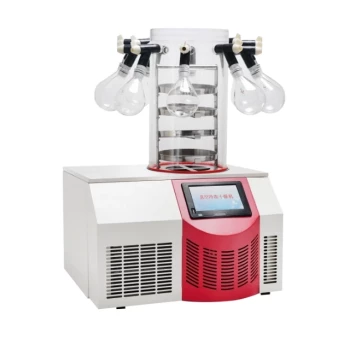
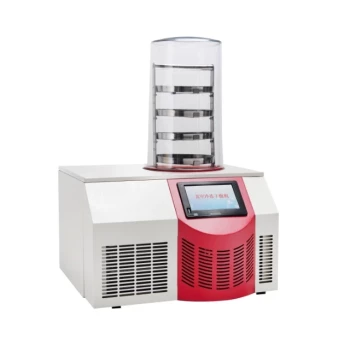
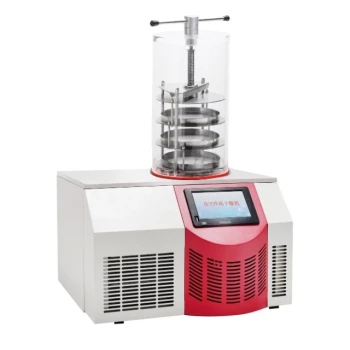
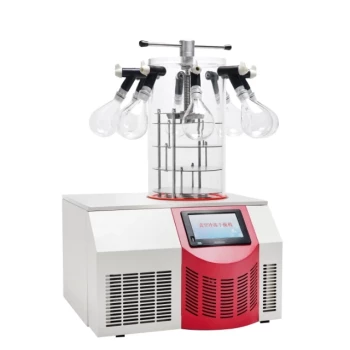
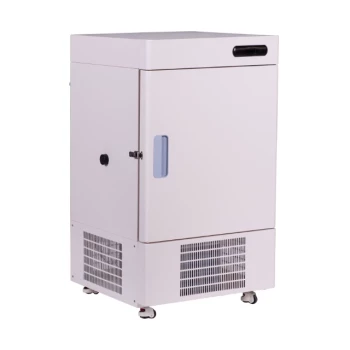
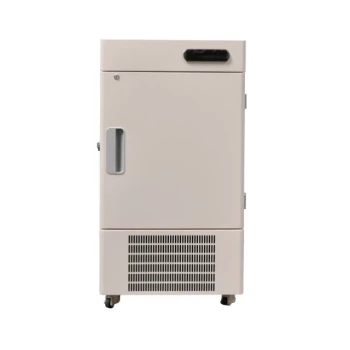
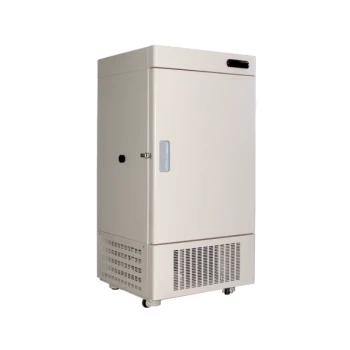
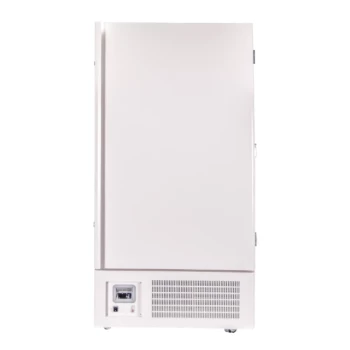
The essential role of a freeze dryer in processing reduced ZIF-8/67/GO hydrogels is to preserve the material's delicate three-dimensional architecture. By utilizing sublimation under low-temperature vacuum conditions, a freeze dryer removes moisture without the destructive capillary forces associated with liquid evaporation. This process ensures the composite maintains the high specific surface area and efficient ion transport channels required for advanced material performance.
A freeze dryer is critical because it bypasses the liquid phase via sublimation, preventing the surface-tension-induced collapse of the microporous structure. This preservation is vital for maintaining the structural integrity and high porosity necessary for subsequent conversion into high-performance carbon materials.
The Physics of Preservation: Sublimation vs. Evaporation
Eliminating Surface Tension and Capillary Forces
Traditional thermal drying relies on the evaporation of liquid water, which creates significant surface tension at the gas-liquid interface. In a ZIF-8/67/GO hydrogel, these capillary forces are strong enough to pull the delicate pore walls together. This often results in the total collapse of the framework or severe agglomeration of the nanoparticles.
The Sublimation Advantage
A freeze dryer operates on the principle of sublimation, where ice converts directly into vapor under a vacuum. Because the solvent never enters a liquid state during removal, the destructive forces of surface tension are entirely avoided. This allows the material to retain its original volume and intricate internal geometry.
Maintaining the Three-Dimensional Network
The combination of Zeolitic Imidazolate Frameworks (ZIFs) and Graphene Oxide (GO) creates a complex 3D interconnected network. Freeze drying locks this structure in place during the frozen state and maintains it as the ice disappears. This results in a "cryogel" or sponge-like precursor that is essential for high-quality final products.
Impact on Material Performance
Optimization of Specific Surface Area
Preserving the microporous structure directly translates to a high specific surface area. This is a critical metric for ZIF-8/67/GO composites, as it determines the number of active sites available for chemical reactions or adsorption. Thermal drying would yield a dense, low-surface-area material with significantly reduced utility.
Facilitating Efficient Ion Transport
Freeze drying ensures that the microporous channels within the composite remain open and unobstructed. These channels are vital for efficient ion transport and electrolyte infiltration in electrochemical applications. Without these pathways, the internal surfaces of the material become inaccessible, crippling its performance.
Foundation for Carbonization
For researchers using these hydrogels to create nitrogen-doped carbon materials, freeze drying is a mandatory preparation step. It provides a stable foundation of loose, non-agglomerated particles. This structural arrangement is necessary to achieve a high-performance porous carbon nanosheet framework during subsequent pyrolysis.
Understanding the Trade-offs
Time and Energy Intensity
Freeze drying is a significantly more time-consuming process than conventional oven drying, often requiring 24 to 72 hours to complete. The equipment also consumes more energy to maintain the necessary ultra-low temperatures (often -60°C or lower) and high vacuum levels.
Complexity of Pre-freezing
The success of the process depends heavily on the initial freezing stage. If the hydrogel is frozen too slowly, large ice crystals can form, which may physically rupture the pore walls. Achieving a fine, uniform micro-pore layout requires precise control over the cooling rate before the vacuum is applied.
How to Apply This to Your Project
Making the Right Choice for Your Goal
- If your primary focus is structural integrity: Use a freeze dryer with a high-performance vacuum pump to ensure the material stays well below the glass transition temperature during the entire cycle.
- If your primary focus is electrochemical performance: Prioritize freeze drying to maintain the interconnected 3D fiber network, which is essential for rapid ion diffusion.
- If your primary focus is scalability and cost: Assess whether the performance gains of the porous framework justify the increased processing time and equipment overhead compared to alternative drying methods.
By successfully navigating the sublimation process, you ensure that the complex architecture of your ZIF-8/67/GO hydrogel remains a functional asset rather than a collapsed liability.
Summary Table:
| Feature | Freeze Drying (Sublimation) | Thermal Drying (Evaporation) |
|---|---|---|
| Mechanism | Solid to Vapor (Direct) | Liquid to Vapor |
| Structural Impact | Preserves 3D micropores | Causes framework collapse |
| Surface Area | High (Maximizes active sites) | Low (Severe agglomeration) |
| Ion Transport | Efficient open channels | Obstructed pathways |
| Final Product | High-performance cryogel | Dense, inactive mass |
Elevate Your Material Synthesis with KINTEK
Preserving the delicate 3D architecture of ZIF-8/67/GO hydrogels requires precision cooling and vacuum technology. KINTEK specializes in professional laboratory equipment designed to meet the rigorous demands of advanced material research.
Our comprehensive portfolio supports your entire workflow:
- Precision Cooling: High-performance freeze dryers, ULT freezers, and cold traps to ensure perfect sublimation and structural integrity.
- Advanced Thermal Processing: A wide range of high-temperature furnaces (muffle, tube, vacuum, CVD, and PECVD) for precise carbonization and pyrolysis.
- Sample Preparation: Crushing and milling systems, hydraulic presses (pellet, isostatic), and essential consumables like PTFE products and ceramics.
- Electrochemical Research: Specialized electrolytic cells, electrodes, and battery research tools.
Don't let surface tension compromise your research outcomes. Partner with KINTEK for reliable, high-quality solutions that guarantee consistency from hydrogel to high-performance carbon framework.
Ready to optimize your lab's efficiency? Contact our technical experts today!
References
- Miao Jia, Mengqiu Jia. ZnS/CoS@C Derived from ZIF-8/67 Rhombohedral Dodecahedron Dispersed on Graphene as High-Performance Anode for Sodium-Ion Batteries. DOI: 10.3390/molecules28196914
This article is also based on technical information from Kintek Solution Knowledge Base .
Related Products
- High Performance Laboratory Freeze Dryer
- Benchtop Laboratory Vacuum Freeze Dryer
- High Performance Laboratory Freeze Dryer for Research and Development
- Benchtop Laboratory Freeze Dryer for Lab Use
- 108L Vertical Ultra Low Temperature ULT Freezer
People Also Ask
- What role does a laboratory freeze dryer play in the synthesis of graphene-based electrocatalysts? Preserve 3D Structures
- What are the technical advantages of using a laboratory freeze dryer for porous carbon precursors? Preserve 3D Networks
- What types of liquid samples can be processed using a laboratory freeze dryer? Preserve Your Sensitive Materials
- How do laboratory freeze dryers support scientific research? Preserve Sample Integrity for Reproducible Results
- Why is a laboratory freeze dryer preferred over traditional heating? Preserve Biochar Structure & Maximize Porosity