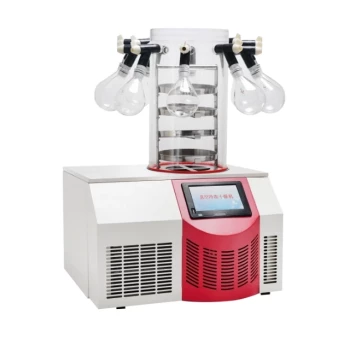
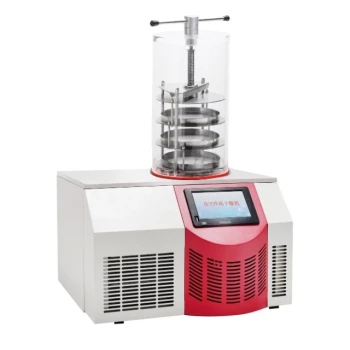
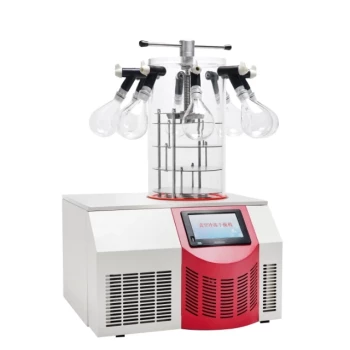
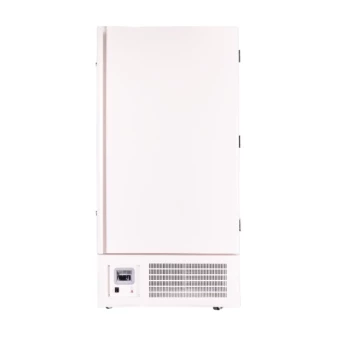
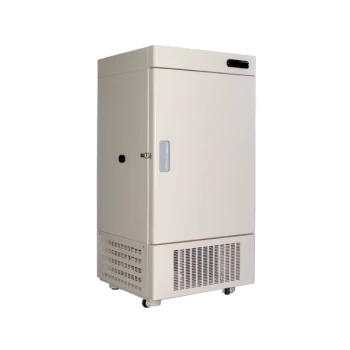
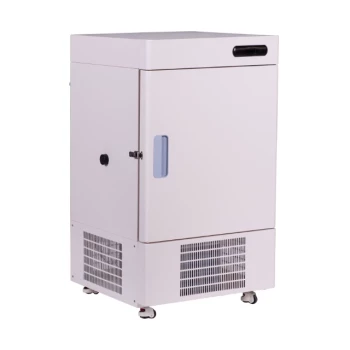
A laboratory freeze dryer is indispensable for CMC and MgCl2 aerogel synthesis because it preserves the material's delicate structural integrity through sublimation. By removing moisture under vacuum and extremely low temperatures (typically around -50°C), the freeze dryer prevents the liquid-phase evaporation that would otherwise cause the microscopic porous network to fail. This ensures the final composite retains the high specific surface area and mechanical flexibility required for advanced applications.
To create a functional CMC/MgCl2 aerogel, one must bypass the liquid phase of water entirely. Freeze drying utilizes sublimation to remove solvents, preventing capillary-induced structural collapse and maintaining the anisotropic porosity essential for high-performance carbonized products.
Preventing Structural Collapse via Sublimation
The Role of Low Temperature and Vacuum
A laboratory freeze dryer operates by creating an environment where ice can transition directly from a solid to a gas. By maintaining temperatures as low as -50°C and applying a deep vacuum, the equipment ensures that water molecules leave the CMC/MgCl2 matrix without ever returning to a liquid state.
Eliminating Capillary Forces
In conventional thermal drying, liquid water evaporates from the pores, creating significant surface tension. This tension generates "capillary pressure" that pulls the walls of the hydrogel together, causing the entire sponge-like network to collapse into a dense mass.
Locking the Microscopic Framework
Freeze drying "locks" the hydrogel's architecture in place before the moisture is removed. This preservation is critical for maintaining the anisotropic porous structure that is often formed during the initial directional freezing of the composite.
Impact on Aerogel Performance and Quality
Maintaining High Specific Surface Area
The primary value of a CMC/MgCl2 composite lies in its porosity and large surface area. Freeze drying ensures these nanometer-scale pores remains open and accessible, which is vital for the material’s performance in electrochemical or filtration applications.
Preservation of Mechanical Flexibility
When the pore structure is preserved, the resulting aerogel maintains its characteristic low density and mechanical resilience. Without freeze drying, the material would become brittle and lose the flexible properties necessary for 3D-printed electrodes or structural components.
Facilitating Successful Carbonization
These composite aerogels often serve as precursors for carbonized materials. If the initial drying process fails to protect the layered porous network, the final carbonized product will lack the structural integrity needed to function as an effective electrode.
Understanding the Technical Trade-offs
Processing Time and Energy Intensity
Freeze drying is a significantly slower process than atmospheric heating, often requiring 24 to 72 hours to complete a single batch. This results in higher energy consumption and a slower production cycle compared to traditional thermal methods.
Risk of "Melt-Back"
If the vacuum level is inconsistent or the sample is not fully frozen, the ice can melt during the process. This "melt-back" causes localized structural collapse and ruins the uniformity of the CMC/MgCl2 composite.
Equipment Maintenance and Cost
High-performance freeze dryers require regular maintenance of vacuum pumps and condenser coils to handle the sublimated vapors. The capital investment for a laboratory-grade unit is significantly higher than that of a standard drying oven.
Optimizing Your Aerogel Preparation
To achieve the best results with your CMC and MgCl2 composite aerogels, consider your specific research or production requirements.
- If your primary focus is maximum surface area: Ensure the freeze dryer can reach temperatures below -50°C to prevent any micro-melting of the salt-loaded CMC matrix.
- If your primary focus is mechanical flexibility: Use directional freezing prior to the freeze-drying step to create a reinforced anisotropic structure that the sublimation process will preserve.
- If your primary focus is scalability: Optimize the thickness of your hydrogel samples to allow for faster sublimation rates without compromising the vacuum integrity of the chamber.
By leveraging the precise control of a laboratory freeze dryer, you can transform a fragile hydrogel into a robust, high-porosity aerogel ready for advanced technical use.
Summary Table:
| Feature | Mechanism | Impact on CMC/MgCl2 Aerogel |
|---|---|---|
| Sublimation | Solid-to-gas transition | Prevents capillary-induced structural collapse |
| Low Temp (-50°C) | Freeze-locking | Maintains anisotropic porous architecture |
| High Vacuum | Deep moisture removal | Preserves high specific surface area |
| Controlled Drying | Zero surface tension | Ensures mechanical flexibility & resilience |
Elevate Your Aerogel Research with KINTEK Precision
At KINTEK, we understand that the integrity of your CMC and MgCl2 composite aerogels depends on the precision of your drying process. Our high-performance laboratory freeze dryers and cold traps are engineered to reach the deep vacuums and ultra-low temperatures necessary to prevent melt-back and ensure superior porosity for your materials.
Beyond drying solutions, KINTEK specializes in a comprehensive range of advanced laboratory equipment tailored for high-tech research:
- Thermal Processing: Muffle, tube, rotary, vacuum, and CVD/PECVD furnaces.
- Material Preparation: Crushing and milling systems, sieving equipment, and hydraulic presses (pellet, hot, isostatic).
- Specialized Systems: High-temperature high-pressure reactors, electrolytic cells, and battery research tools.
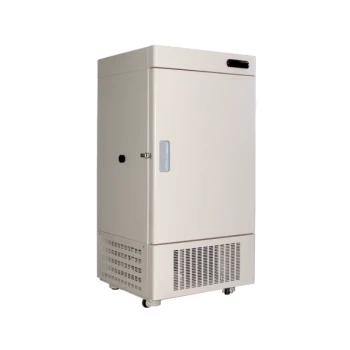
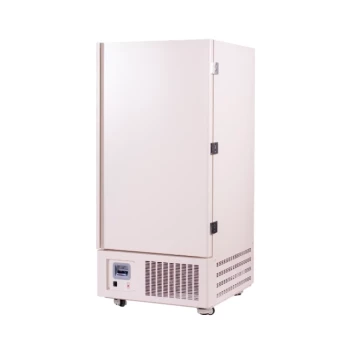
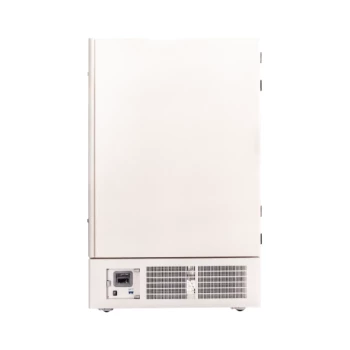
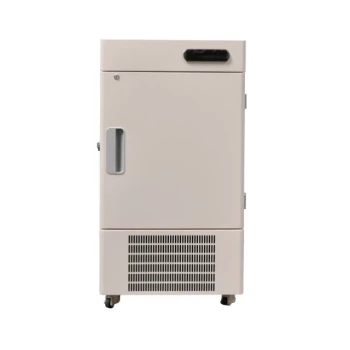
- Cooling & Lab Essentials: ULT freezers, freeze dryers, homogenizers, and high-quality ceramic/PTFE consumables.
Whether you are developing next-generation electrodes or advanced structural components, KINTEK provides the reliable tools needed to transform fragile hydrogels into robust, high-performance aerogels.
Ready to optimize your lab's performance? Contact KINTEK today to find the perfect equipment for your research!
References
- Ahmad Solehin Ab Sabar, Sugarbomb Worldwide Sdn. Bhd., 9, Lorong Astana 1A/KU2, Bandar Bukit Raja, 41050 Klang, Selangor, Malaysia. Synthesis and Characterisation of Carbon Aerogel Derived from Carboxymethyl Cellulose as Hydrogen Storage Material. DOI: 10.21315/jps2023.34.2.2
This article is also based on technical information from Kintek Solution Knowledge Base .
Related Products
- High Performance Laboratory Freeze Dryer
- High Performance Laboratory Freeze Dryer for Research and Development
- Benchtop Laboratory Freeze Dryer for Lab Use
- Benchtop Laboratory Vacuum Freeze Dryer
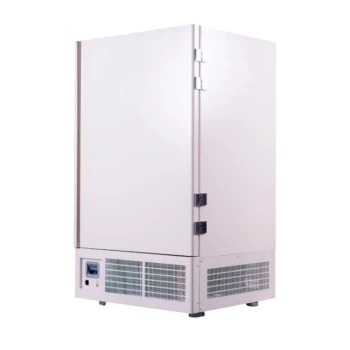
- 808L Precision Laboratory Vertical Ultra Low Temperature Freezer
People Also Ask
- What role does a laboratory freeze dryer play in the synthesis of graphene-based electrocatalysts? Preserve 3D Structures
- What are the technical advantages of using a laboratory freeze dryer for porous carbon precursors? Preserve 3D Networks
- What types of liquid samples can be processed using a laboratory freeze dryer? Preserve Your Sensitive Materials
- How do laboratory freeze dryers support scientific research? Preserve Sample Integrity for Reproducible Results
- Why is a laboratory freeze dryer preferred over traditional heating? Preserve Biochar Structure & Maximize Porosity