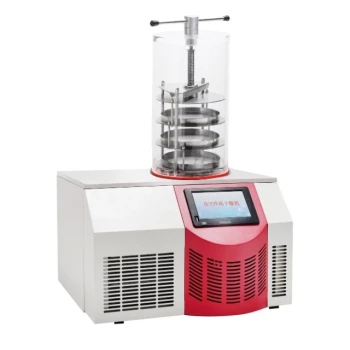
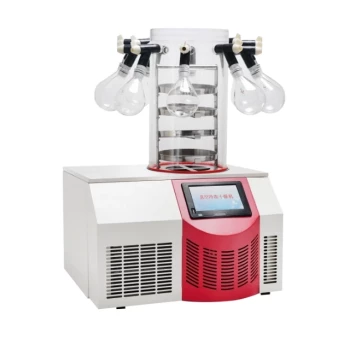
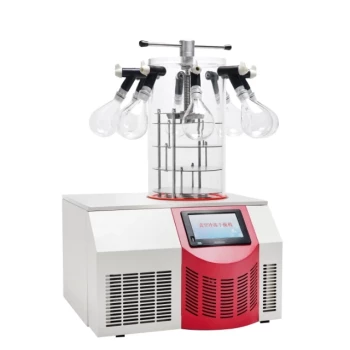
The primary reason a laboratory vacuum freeze dryer is recommended for Pd/C catalyst precursors is its ability to remove moisture through sublimation, which prevents the collapse of the material's delicate pore structure. By bypassing the liquid phase, this process eliminates the surface tension and capillary forces that typically cause gel beads to shrink or deform during traditional drying. Maintaining this highly porous architecture is essential for ensuring a high specific surface area and providing sufficient reaction space during the subsequent carbonization process.
Central Takeaway: Vacuum freeze drying preserves the structural integrity and uniform dispersion of catalyst precursors by using sublimation to avoid the destructive physical forces associated with liquid evaporation.
The Physics of Sublimation vs. Evaporation
Eliminating Surface Tension
Traditional drying methods involve a liquid-to-gas phase change that creates surface tension at the interface of the drying front. This tension exerts immense pressure on the walls of nanopores, often leading to a total collapse of the internal structure.
Avoiding Capillary Forces
As liquid evaporates from a porous material, capillary forces act like a vacuum, pulling the pore walls toward each other. A vacuum freeze dryer operates under conditions where moisture sublimates directly from a solid (ice) to a gas, completely bypassing these destructive liquid-phase forces.
Maintaining Microstructure
By keeping the precursor in a frozen, solid state during the removal of the solvent, the equipment "locks" the original morphology in place. This ensures that the fine network of micropores and mesopores remains open and intact throughout the entire dehydration stage.
Impact on Catalyst Performance and Morphology
Preventing Active Component Agglomeration
In traditional heating, the movement of liquid can cause the migration and agglomeration of palladium nanoparticles. Freeze drying prevents this movement, ensuring that the active metal sites remain uniformly dispersed across the carbon support.
Maximizing Specific Surface Area
The efficiency of a Pd/C catalyst is directly tied to its specific surface area, which determines how many active sites are exposed to reactants. Preserving the precursor's porosity ensures that the final product has the maximum possible surface area for catalytic activity.
Providing a Foundation for Carbonization
The drying stage sets the "scaffold" for the subsequent high-temperature pyrolysis or carbonization. If the precursor structure is compromised during drying, the final catalyst will lack the necessary internal architecture for efficient mass transport and ion storage.
Understanding the Trade-offs
Processing Time and Cost
Compared to standard vacuum ovens, freeze drying is a slower and more energy-intensive process. It requires specialized equipment capable of maintaining deep vacuums and precise temperature control over extended periods.
Pre-Freezing Requirements
The success of the process depends heavily on the initial freezing rate. If the sample is frozen too slowly, large ice crystals can form, which may mechanically rupture the very pores the process is intended to protect.
Complexity of Operation
Operators must carefully manage the sublimation interface to prevent "melt-back." If the temperature rises too high before all moisture is removed, the ice will melt into liquid water, immediately triggering the pore collapse the user was trying to avoid.
How to Apply This to Your Project
When choosing a drying method for catalyst development, consider the specific structural requirements of your final material.
- If your primary focus is maximizing active sites: Utilize vacuum freeze drying to ensure your metal nanoparticles remain highly dispersed and your pore structure remains fully open.
- If your primary focus is high-throughput production of robust materials: Consider a vacuum drying oven if the catalyst support is not highly porous or if the structural integrity does not significantly impact the final reaction rate.
- If your primary focus is single-atom catalysis: Always choose freeze drying to prevent the component segregation and aggregation that occurs during conventional thermal dehydration.
By prioritizing the structural integrity of your precursor, you ensure that the final Pd/C catalyst achieves its full theoretical potential for activity and longevity.
Summary Table:
| Feature | Vacuum Freeze Drying (Sublimation) | Traditional Drying (Evaporation) |
|---|---|---|
| Phase Change | Solid to Gas (Ice to Vapor) | Liquid to Gas |
| Physical Forces | Zero capillary forces/surface tension | High surface tension and capillary pull |
| Pore Structure | Preserved/Intact architecture | Often collapsed or deformed |
| Pd Dispersion | High (prevents agglomeration) | Lower (migration during liquid movement) |
| Surface Area | Maximized for catalytic activity | Reduced due to structural shrinkage |
Optimize Your Catalyst Synthesis with KINTEK Precision
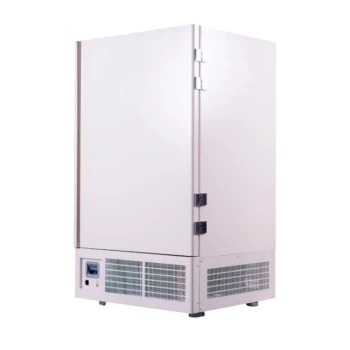
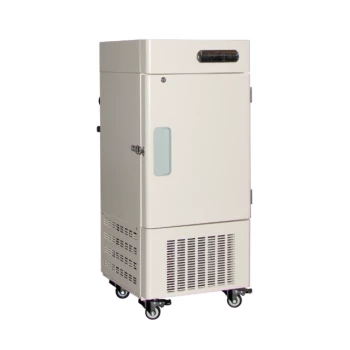
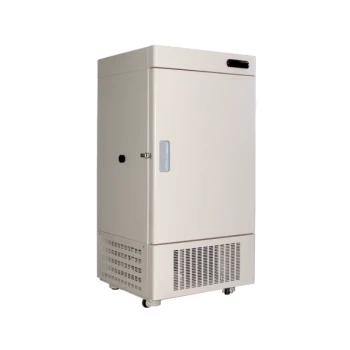
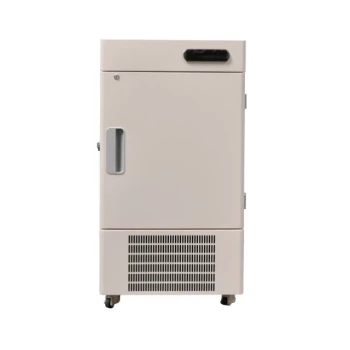
Achieving the highest catalytic activity requires absolute control over your material's microstructure. KINTEK provides the advanced laboratory equipment necessary to ensure your Pd/C precursors maintain their integrity from drying to carbonization. Our specialized vacuum freeze dryers and cooling solutions (ULT freezers, cold traps) are engineered to prevent pore collapse and nanoparticle agglomeration, ensuring your catalysts reach their full theoretical potential.
Beyond drying, KINTEK offers a comprehensive range of tools for material science, including:
- High-temperature furnaces (muffle, tube, and vacuum) for precise carbonization.
- Crushing, milling, and sieving systems for uniform support preparation.
- Hydraulic presses and high-pressure reactors for advanced material forming.
Ready to enhance your lab's research efficiency?
Contact KINTEK today to find the perfect solution for your project!
References
- Lin jun Tong, Xiaoting Deng. Effect of calcium ion concentration on the ORR performance of Pd/C catalysts. DOI: 10.1039/d3ra07553b
This article is also based on technical information from Kintek Solution Knowledge Base .
Related Products
- Benchtop Laboratory Vacuum Freeze Dryer
- High Performance Laboratory Freeze Dryer for Research and Development
- High Performance Laboratory Freeze Dryer
- Benchtop Laboratory Freeze Dryer for Lab Use
- 56L Vertical Laboratory Vacuum Drying Oven
People Also Ask
- What are the technical advantages of using a laboratory freeze dryer for porous carbon precursors? Preserve 3D Networks
- How do laboratory freeze dryers support scientific research? Preserve Sample Integrity for Reproducible Results
- Why is a laboratory freeze dryer preferred over traditional heating? Preserve Biochar Structure & Maximize Porosity
- What types of liquid samples can be processed using a laboratory freeze dryer? Preserve Your Sensitive Materials
- What role do laboratory freeze dryers play in the food industry? Unlock Superior Food Preservation