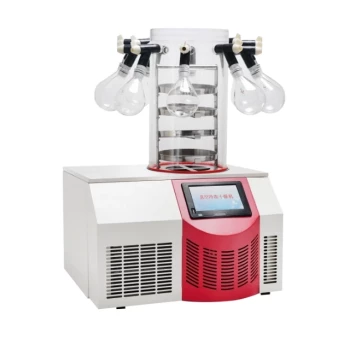
Vacuum freeze drying is the critical safeguard for structural integrity. It is essential because it removes moisture through sublimation, transitioning directly from a solid to a gas to bypass the liquid phase entirely. This process prevents the destructive capillary forces associated with liquid evaporation, ensuring the 2D material framework does not collapse and remains highly accessible for catalytic reactions.
The core value of a vacuum freeze dryer lies in its ability to transition solvents from solid to gas, effectively neutralizing the surface tension that would otherwise destroy a material's microscopic architecture. By preserving this 3D interconnected network, the equipment ensures that noble metal catalysts remain exposed and functional rather than becoming buried within a collapsed mass.
The Physics of Preservation: Sublimation vs. Evaporation
Overcoming Capillary Forces
In traditional atmospheric or thermal drying, the transition from liquid to gas creates a liquid-gas interface within the material's pores. This interface generates immense capillary forces that exert inward pressure on the delicate 2D material walls.
For noble metal-loaded aerogels, these forces are often strong enough to cause a total structural collapse. Vacuum freeze drying eliminates this risk by freezing the solvent into a solid matrix before removing it via vacuum-induced sublimation.
Maintaining the 3D Framework
By bypassing the liquid state, the aerogel retains the exact three-dimensional interconnected skeleton established during its hydrogel or precursor phase. This prevents the individual 2D sheets from restacking, a common failure mode that drastically reduces the material's effectiveness.
The result is a stable, ultra-lightweight framework that maintains the specific geometric orientation required for advanced applications like 3D-printed electrodes or electromagnetic shielding.
Impact on Material Performance
Optimizing Noble Metal Loading
Noble metals are expensive and must be used efficiently to be commercially viable. The preserved 3D network provides a massive specific surface area, allowing for a high and uniform distribution of noble metal nanoparticles across the 2D material substrate.
If the structure were to collapse during drying, these expensive particles would become aggregated or shielded. This structural preservation ensures that every milligram of noble metal is positioned to contribute to the material's overall function.
Enhancing Catalytic and Electrochemical Efficiency
A preserved, porous structure is vital for mass transport. It creates open contact channels that allow reactants and electrolytes to penetrate deep into the material's interior.
Without the uniform pore size distribution provided by freeze drying, the internal active sites of the noble metals would be inaccessible. The vacuum freeze dryer essentially ensures that the material’s "internal plumbing" remains open for business.
Understanding the Trade-offs
Process Time and Energy Consumption
While technically superior for structural preservation, vacuum freeze drying is a time-intensive process. Sublimation occurs much more slowly than evaporation, often requiring 24 to 72 hours depending on the volume and solvent type.
The equipment also requires significant energy to maintain ultra-low temperatures and high vacuum levels simultaneously. For large-scale industrial production, these operational costs must be weighed against the performance gains of the aerogel.
Equipment Complexity and Maintenance
Vacuum freeze dryers are more complex than standard thermal ovens or desiccators. They require precise control over temperature-pressure parameters to ensure the solvent stays below its triple point.
Failure to maintain the vacuum can lead to partial melting, which reintroduces the very surface tension the process was meant to avoid. This makes the process less "forgiving" than traditional drying methods.
How to Apply This to Your Project
To achieve the best results when preparing noble metal-loaded 2D aerogels, consider your primary performance metric:
- If your primary focus is maximum catalytic activity: Utilize vacuum freeze drying to ensure a high specific surface area and prevent the burial of active noble metal sites.
- If your primary focus is mechanical strength and lightweight properties: Use freeze drying to preserve the 3D porous skeleton, as this architecture is the foundation of the aerogel's structural integrity.
- If your primary focus is electrochemical sensing or battery electrodes: Prioritize freeze drying to maintain the nanometer-scale pores necessary for rapid electrolyte infiltration and ion transport.
The vacuum freeze dryer is not merely a drying tool, but a foundational piece of equipment that dictates the final architectural and functional success of a 2D material aerogel.
Summary Table:
| Feature | Mechanism | Impact on Aerogel Performance |
|---|---|---|
| Structural Integrity | Sublimation (Solid to Gas) | Prevents capillary forces and framework collapse. |
| Surface Area | Neutralizes surface tension | Maximizes exposure of noble metal catalyst sites. |
| Porosity | Open-channel preservation | Ensures efficient mass transport and ion infiltration. |
| Loading Efficiency | Prevents sheet restacking | Uniform distribution of nanoparticles across the substrate. |
Elevate Your Advanced Material Research with KINTEK
Precision is the foundation of high-performance material science. At KINTEK, we understand that preserving the delicate architecture of 2D aerogels requires reliable, high-specification equipment.
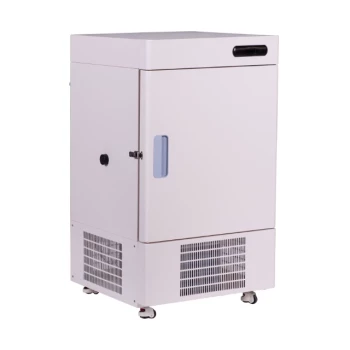
Whether you need advanced cooling solutions (ULT freezers, cold traps, freeze dryers) to ensure structural integrity, or high-temperature high-pressure reactors and autoclaves for precursor synthesis, our comprehensive portfolio is designed to meet the rigorous demands of modern laboratories. We also offer essential consumables, including PTFE products, ceramics, and crucibles, alongside our signature high-temperature furnaces and hydraulic presses.
Don't let structural collapse compromise your catalytic efficiency. Contact us today to discover how KINTEK’s specialized laboratory equipment can optimize your workflow and drive your next breakthrough.
References
- Joshua M. Little, Po‐Yen Chen. Noble Metal Ion‐Directed Assembly of 2D Materials for Heterostructured Catalysts and Metallic Micro‐Texturing. DOI: 10.1002/adfm.202215222
This article is also based on technical information from Kintek Solution Knowledge Base .
Related Products
- Benchtop Laboratory Vacuum Freeze Dryer
- High Performance Laboratory Freeze Dryer
- High Performance Laboratory Freeze Dryer for Research and Development
- Benchtop Laboratory Freeze Dryer for Lab Use
- Vacuum Cold Mounting Machine for Sample Preparation
People Also Ask
- What are the technical advantages of using a laboratory freeze dryer for porous carbon precursors? Preserve 3D Networks
- How do laboratory freeze dryers support scientific research? Preserve Sample Integrity for Reproducible Results
- Why is a laboratory freeze dryer preferred over traditional heating? Preserve Biochar Structure & Maximize Porosity
- What types of liquid samples can be processed using a laboratory freeze dryer? Preserve Your Sensitive Materials
- What role do laboratory freeze dryers play in the food industry? Unlock Superior Food Preservation