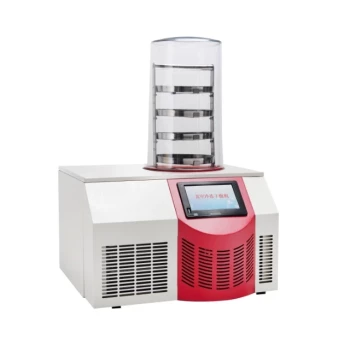
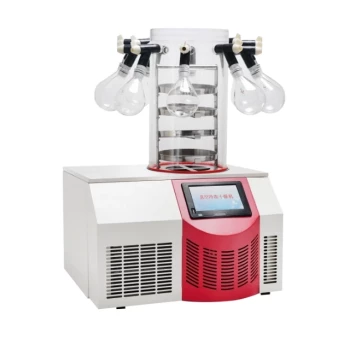
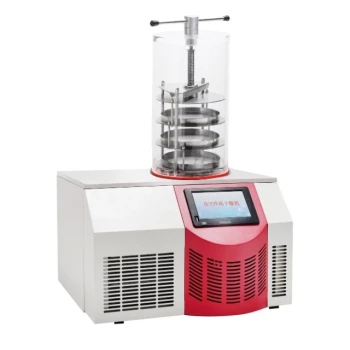
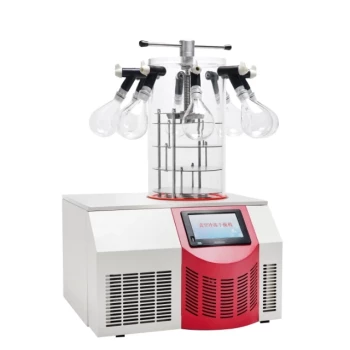
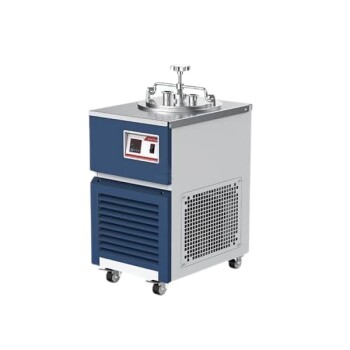
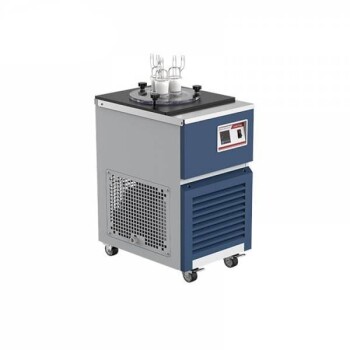
Vacuum freeze drying is the superior method for processing hybrid electrode materials because it eliminates the destructive effects of surface tension. By transitioning solvents directly from a solid frozen state to a gas through sublimation, this process prevents the collapse of delicate microstructures. This preservation of the material’s three-dimensional architecture ensures a high specific surface area and an open porous network, both of which are critical for maximizing active sites and electrolyte diffusion in advanced sensing and energy storage applications.
Core Takeaway: Conventional oven drying relies on liquid evaporation, which creates capillary forces that collapse pores and aggregate particles; vacuum freeze drying bypasses these forces through sublimation, maintaining the structural integrity and electrochemical performance of hybrid materials.
The Pitfalls of Conventional Thermal Drying
The Impact of Capillary Collapse
In a conventional blast drying oven, solvents are removed via liquid evaporation at room temperature or higher. As the liquid evaporates from within the pores of the electrode material, it generates significant surface tension.
This tension creates a "capillary collapse" effect, where the walls of the porous structure are pulled inward. This often leads to the permanent loss of the material's internal architecture, rendering it less effective for its intended application.
Aggregation and Stacking Issues
Beyond structural collapse, thermal drying often causes tight layer stacking or severe aggregation of solid particles. For materials like graphene-based composites or nanorods, this aggregation drastically reduces the accessible surface area.
When layers stack tightly, the "active sites"—the areas where electrochemical reactions occur—become buried and inaccessible. This directly translates to lower sensitivity in sensors and reduced capacity in batteries or supercapacitors.
How Vacuum Freeze Drying Preserves Performance
The Power of Sublimation
Vacuum freeze drying operates by freezing the material and then reducing the surrounding pressure to allow the frozen solvent to sublimate directly into vapor. Because the solvent never enters a liquid phase during removal, the destructive forces of surface tension are completely bypassed.
This allows the material to retain its original volume and morphology. For delicate structures like CuO@Cu2O/PNrGO composites or hollow nickel-cobalt nanorods, this is essential for maintaining their specialized shapes.
Maintaining Three-Dimensional Networks
Preserving the three-dimensional porous network of a material is vital for the movement of ions. A freeze-dried material maintains an "open" structure, which acts as a highway for electrolyte ions to diffuse quickly and efficiently.
This high porosity ensures that the electrode has a massive specific surface area. A higher surface area means more contact points between the electrode and the electrolyte, which is the primary driver of high-performance electrochemical detection.
Uniform Distribution of Precursors
During the drying process, freeze drying prevents the agglomeration of solute molecules and metal salts. In hybrid materials, this ensures that catalysts or nanoparticles remain highly dispersed across the support structure.
This microscopic uniformity is a prerequisite for subsequent processing steps, such as high-temperature annealing. It ensures that the final product consists of high-quality, highly dispersed nanoparticles rather than large, inactive clumps.
Efficiency and Environmental Benefits
Speed and Energy Consumption
Contrary to common perception, modern laboratory freeze dryers can offer significantly faster drying speeds than traditional ovens for certain materials. Some systems can shorten process times by 3 to 10 times.
Additionally, these systems can be more energy-efficient, sometimes consuming 2 to 3 times less energy than conventional vacuum ovens. This makes the technology not only technically superior but also operationally viable for scaled-up research.
Protection from Oxidation and Solvent Recovery
The freeze-drying process occurs in an oxygen-free vacuum chamber, which protects sensitive electrode materials from oxidation during the drying phase. This is critical for maintaining the purity of metallic or low-valence oxide components.
Furthermore, vacuum freeze dryers allow for the recycling of organic solvents. This capability reduces production costs and minimizes the environmental footprint of the manufacturing process, making it a "greener" alternative to open-air blast ovens.
Understanding the Trade-offs
Equipment Complexity and Cost
While the technical benefits are clear, vacuum freeze drying requires a higher initial investment in equipment compared to a standard blast oven. The systems include complex components like vacuum pumps, condensers, and refrigeration units that require regular maintenance.
Process Sensitivity and Preparation
The material must be thoroughly pre-frozen—often to temperatures as low as -70 °C—before the vacuum is applied. If the material is not completely frozen or if the vacuum is insufficient, "melt-back" can occur, leading to the very structural collapse the process is intended to avoid.
Making the Right Choice for Your Goal
How to Apply This to Your Project
The decision to use a vacuum freeze dryer should be driven by your material's structural requirements and your performance targets.
- If your primary focus is maximizing electrochemical sensitivity: Use vacuum freeze drying to preserve the high specific surface area and ensure the maximum exposure of active contact sites.
- If your primary focus is preserving delicate nanostructures: Choose freeze drying to avoid capillary collapse and maintain complex morphologies like hollow nanorods or 3D hydrogel templates.
- If your primary focus is high-throughput processing of stable bulk materials: A conventional blast drying oven may be sufficient and more cost-effective if structural porosity is not a critical performance factor.
- If your primary focus is working with oxygen-sensitive materials: Prioritize the vacuum freeze dryer for its oxygen-free environment to prevent unwanted material degradation.
By prioritizing structural preservation through sublimation, you ensure that your hybrid electrode materials achieve their full theoretical potential in sensing and energy applications.
Summary Table:
| Feature | Vacuum Freeze Drying | Conventional Blast Drying |
|---|---|---|
| Mechanism | Sublimation (Solid to Gas) | Evaporation (Liquid to Gas) |
| Structural Impact | Preserves 3D Porous Network | Capillary Collapse & Aggregation |
| Surface Area | High (Maximizes Active Sites) | Low (Due to Layer Stacking) |
| Oxidation Risk | Minimal (Oxygen-Free Vacuum) | High (Atmospheric Exposure) |
| Solvent Recovery | Efficient and Recyclable | Generally Not Supported |
Elevate Your Material Research with KINTEK
Don't let capillary collapse compromise your electrochemical performance. KINTEK specializes in high-precision laboratory equipment designed to preserve the delicate microstructures of advanced materials. From our high-efficiency vacuum freeze dryers and cold traps to our comprehensive range of high-temperature furnaces (CVD, vacuum, atmosphere) and hydraulic pellet presses, we provide the tools you need for superior material synthesis and post-processing.
Whether you are developing next-generation batteries, supercapacitors, or high-sensitivity sensors, our team is ready to support your lab with reliable equipment and essential consumables like PTFE products, ceramics, and crucibles.
Contact KINTEK today to optimize your laboratory workflow!
References
- Qing Wei, Mingxi Wang. Porous nitrogen-doped reduced graphene oxide-supported CuO@Cu2O hybrid electrodes for highly sensitive enzyme-free glucose biosensor. DOI: 10.1016/j.isci.2023.106155
This article is also based on technical information from Kintek Solution Knowledge Base .
Related Products
- Benchtop Laboratory Vacuum Freeze Dryer
- High Performance Laboratory Freeze Dryer
- High Performance Laboratory Freeze Dryer for Research and Development
- Benchtop Laboratory Freeze Dryer for Lab Use
- Vacuum Cold Mounting Machine for Sample Preparation
People Also Ask
- What are the technical advantages of using a laboratory freeze dryer for porous carbon precursors? Preserve 3D Networks
- How do laboratory freeze dryers support scientific research? Preserve Sample Integrity for Reproducible Results
- Why is a laboratory freeze dryer preferred over traditional heating? Preserve Biochar Structure & Maximize Porosity
- What types of liquid samples can be processed using a laboratory freeze dryer? Preserve Your Sensitive Materials
- What role do laboratory freeze dryers play in the food industry? Unlock Superior Food Preservation