The primary advantage of vacuum freeze drying for In(OH)3@GO composites is the preservation of their delicate three-dimensional architecture. By utilizing sublimation rather than evaporation, this process prevents the restacking of graphene layers and eliminates the capillary forces that cause pore collapse in conventional drying. This results in a composite with a significantly higher specific surface area and a loose, porous structure essential for high-performance applications.
Vacuum freeze drying bypasses the destructive surface tension of liquid-phase drying by transitioning solvent ice directly into vapor. This technical distinction is the key to maintaining the structural integrity, porosity, and functional surface sites of sensitive nanomaterials like Indium Hydroxide and Graphene Oxide.
The Mechanics of Structural Preservation
Eliminating Surface Tension and Capillary Forces
Conventional thermal drying relies on liquid evaporation, which creates intense surface tension at the gas-liquid interface within the material's pores. These capillary forces act like a vacuum, pulling the walls of the nanopores together and causing the overall structure to shrink or collapse.
Vacuum freeze drying operates through sublimation, where pre-frozen ice crystals transition directly to gas under low-temperature vacuum conditions. Because the solvent never enters a liquid state during removal, the destructive physical forces of evaporation are entirely bypassed.
Preventing Graphene Layer Restacking
Graphene Oxide (GO) nanosheets have a natural tendency to undergo restacking due to van der Waals forces when dried in a liquid medium. This restacking significantly reduces the effective surface area and buries the Indium Hydroxide particles within a dense, non-reactive mass.
The freeze-drying process locks the GO sheets in a fixed, three-dimensional spatial arrangement during the initial freezing phase. As the ice disappears via sublimation, the sheets remain "propped open," maintaining the original dispersed state of the composite.
Maximizing Specific Surface Area
The preservation of a loose, porous morphology is critical for the chemical and physical performance of In(OH)3@GO. By preventing the collapse of the internal framework, freeze drying ensures that more active sites are exposed on the surface of the Indium Hydroxide and Graphene Oxide.
Operational and Performance Benefits
Protection Against Oxidation and Degradation
Vacuum freeze dryers operate in an oxygen-free environment and at significantly lower temperatures than conventional ovens. This protects sensitive chemical species within the composite from thermal degradation or unwanted oxidation during the drying cycle.
For many laboratory-scale applications, this method also offers superior drying speeds, potentially shortening process times by 3 to 10 times compared to traditional vacuum drying. The low-temperature range (0°C to 50°C) is particularly efficient for removing moisture without altering the material's chemistry.
Enhancing Material Functionality
By maintaining a three-dimensional network, freeze-dried composites exhibit better performance in applications like photocatalysis, adsorption, and electrochemical detection. The high porosity ensures that reactants or ions can easily penetrate the material to reach the active Indium Hydroxide sites.
Understanding the Trade-offs
Equipment and Operational Costs
While freeze drying offers superior material quality, it generally requires a higher initial capital investment than simple thermal ovens. The equipment involves sophisticated vacuum systems and refrigeration units that must be maintained for consistent performance.
Process Complexity and Pre-freezing
Unlike conventional drying, freeze drying requires a pre-freezing step to ensure the solvent is completely crystallized before the vacuum is applied. If the material is not frozen correctly, "melt-back" can occur during the vacuum stage, leading to the same structural collapse the process is intended to avoid.
Choosing the Right Method for Your Goal
How to Apply This to Your Project
- If your primary focus is maximizing catalytic or adsorption activity: Choose vacuum freeze drying to ensure the highest possible specific surface area and accessible active sites.
- If your primary focus is preventing material aggregation: Utilize freeze drying to bypass the capillary forces that lead to particle clumping and graphene restacking.
- If your primary focus is high-volume, low-cost moisture removal where structure is irrelevant: Conventional thermal drying may be sufficient, provided the loss of porosity does not impact the end-use of the material.
- If your primary focus is drying materials containing organic solvents: Opt for a laboratory freeze dryer capable of solvent recovery to reduce costs and meet environmental safety standards.
By prioritizing the preservation of the material's nanostructure through sublimation, you ensure that the In(OH)3@GO composite retains the unique properties for which it was designed.
Summary Table:
| Feature | Vacuum Freeze Drying | Conventional Thermal Drying |
|---|---|---|
| Mechanism | Sublimation (Solid to Gas) | Evaporation (Liquid to Gas) |
| Structural Integrity | Preserves 3D architecture | Causes pore collapse & shrinkage |
| Graphene Layers | Prevents restacking | Promotes restacking |
| Surface Area | Maximized / High Porosity | Reduced due to aggregation |
| Thermal Protection | Low-temp; prevents oxidation | High-temp; risk of degradation |
Elevate Your Material Research with KINTEK Precision
Unlock the full potential of your In(OH)3@GO composites and advanced nanomaterials with KINTEK’s high-performance laboratory solutions. As specialists in laboratory equipment, we provide the cutting-edge vacuum freeze dryers, cold traps, and cooling solutions necessary to preserve delicate three-dimensional architectures and maximize specific surface area.
From high-temperature furnaces and hydraulic presses to specialized freeze dryers and ULT freezers, KINTEK offers a comprehensive portfolio designed for reliability and scientific excellence. Don't let conventional drying compromise your material's performance.
Ready to optimize your drying process? Contact our experts today to find the perfect equipment for your lab!
References
- Yun Zhao, Zongping Shao. Synergistic γ‐In<sub>2</sub>Se<sub>3</sub>@rGO Nanocomposites with Beneficial Crystal Transformation Behavior for High‐Performance Sodium‐Ion Batteries. DOI: 10.1002/advs.202303108
This article is also based on technical information from Kintek Solution Knowledge Base .
Related Products
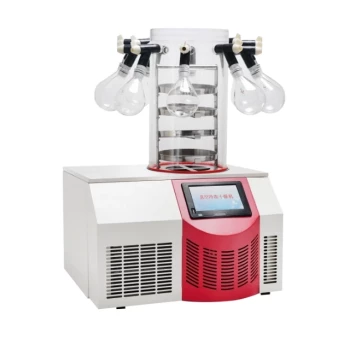
- Benchtop Laboratory Vacuum Freeze Dryer
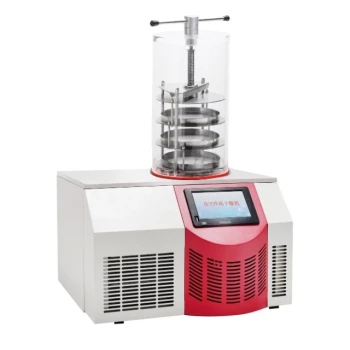
- High Performance Laboratory Freeze Dryer
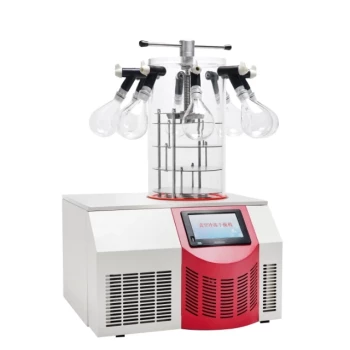
- High Performance Laboratory Freeze Dryer for Research and Development
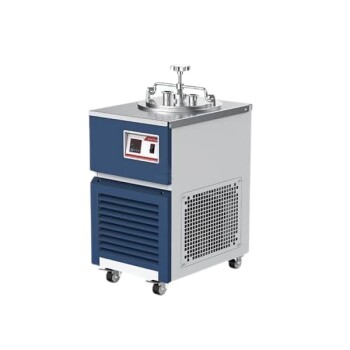
- Benchtop Laboratory Freeze Dryer for Lab Use
- Vacuum Cold Mounting Machine for Sample Preparation
People Also Ask
- What are the technical advantages of using a laboratory freeze dryer for porous carbon precursors? Preserve 3D Networks
- How do laboratory freeze dryers support scientific research? Preserve Sample Integrity for Reproducible Results
- Why is a laboratory freeze dryer preferred over traditional heating? Preserve Biochar Structure & Maximize Porosity
- What types of liquid samples can be processed using a laboratory freeze dryer? Preserve Your Sensitive Materials
- What role do laboratory freeze dryers play in the food industry? Unlock Superior Food Preservation