In the energy sector, carbon nanotubes (CNTs) are primarily valued for their exceptional electrical conductivity, mechanical strength, and unique nanoscale structure. Their most significant commercial application today is as a conductive additive in lithium-ion batteries. They are also being developed for use in structural composites for energy infrastructure, advanced electronics, and next-generation solar cells to improve efficiency and durability.
The core value of carbon nanotubes is not as a primary material, but as a high-performance additive. By creating electrically conductive and mechanically strong networks at the nanoscale, CNTs solve fundamental performance bottlenecks in existing energy technologies.
The Core Application: Enhancing Lithium-Ion Batteries
The most mature and impactful application of CNTs in the energy sector is within the electrodes of lithium-ion batteries. They serve as a superior replacement for traditional carbon black additives.
Why CNTs are Critical for Electrodes
Many active materials used in battery cathodes (like LFP) and anodes (like silicon) have inherently poor electrical conductivity. This limits how quickly a battery can be charged and discharged and reduces its overall efficiency.
How CNTs Create Conductive Pathways
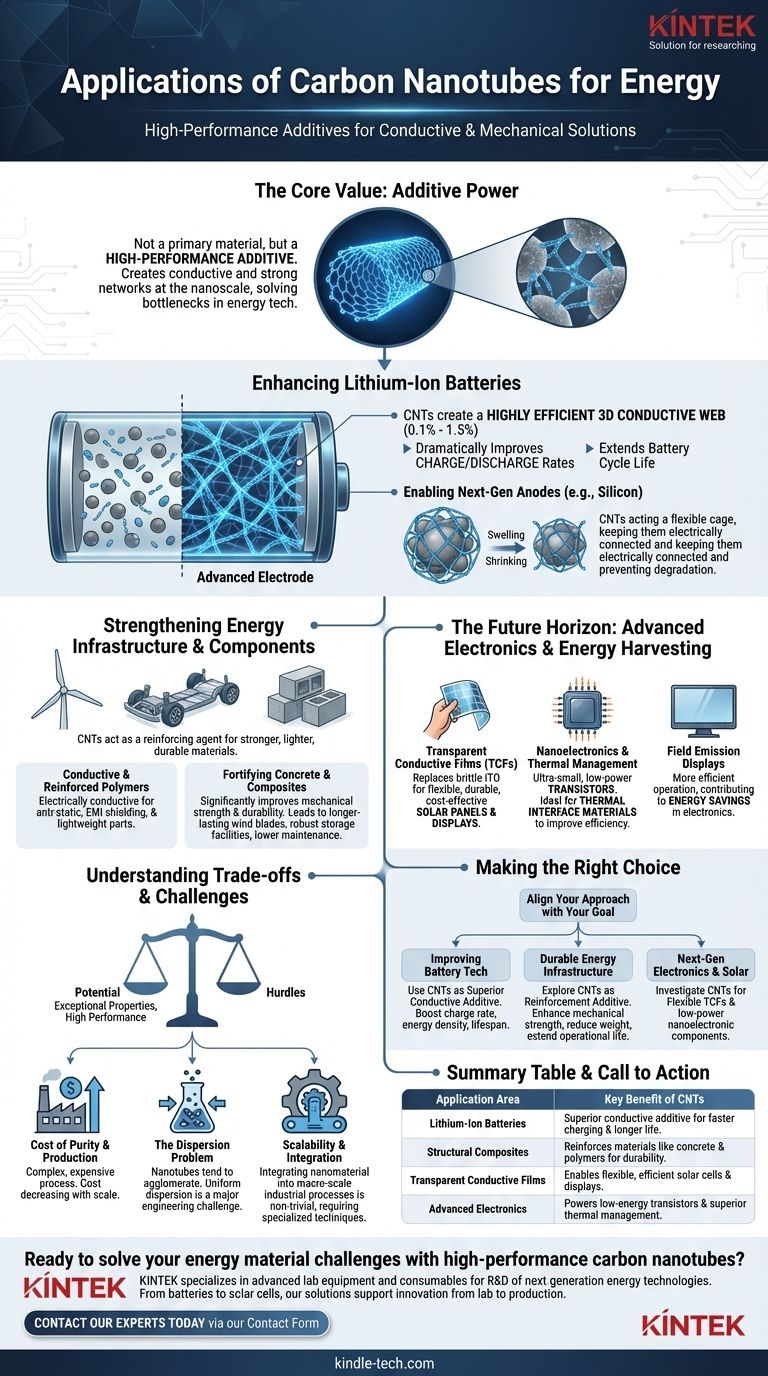
Even at very low concentrations (0.1% to 1.5%), CNTs form a highly efficient, three-dimensional conductive web throughout the electrode. This network provides a superhighway for electrons, ensuring they can reach every active material particle.
This dramatically improves charge/discharge rates, increases energy density, and extends the battery's cycle life by ensuring more uniform electrochemical reactions.
Enabling Next-Generation Anodes
CNTs are crucial for enabling high-capacity silicon anodes. Silicon can store much more energy than traditional graphite, but it swells and shrinks dramatically during cycling, causing the electrode to degrade. The strong and flexible CNT network helps hold the silicon particles together and maintains electrical contact, solving this critical failure point.
Strengthening Energy Infrastructure and Components
CNTs act as a reinforcing agent in composites, creating materials that are stronger, lighter, and more durable for demanding energy applications.
Conductive and Reinforced Polymers
Adding CNTs to polymers can make them electrically conductive. This is essential for applications like anti-static or EMI-shielding enclosures for sensitive electronics and lightweight conductive parts used in vehicles or machinery.
Fortifying Concrete and Composites
In infrastructure, CNTs can significantly improve the mechanical strength and durability of materials like concrete or fiber-reinforced polymers. This could lead to longer-lasting wind turbine blades, more robust energy storage facilities, and more resilient infrastructure with lower lifetime maintenance costs.
The Future Horizon: Advanced Electronics and Energy Harvesting
The unique electronic properties of CNTs position them as a key material for next-generation, low-power devices and energy harvesting systems.
Transparent Conductive Films (TCFs)
CNTs can be used to create films that are both transparent and electrically conductive. These films are a potential replacement for the brittle and expensive indium tin oxide (ITO) used today in solar cells and displays, enabling more flexible, durable, and cost-effective solar panels.
Nanoelectronics and Thermal Management
The exceptional properties of CNTs allow for the creation of ultra-small, highly efficient transistors that consume less power. Their high thermal conductivity also makes them ideal for thermal interface materials, which help dissipate waste heat from high-power electronics, improving overall energy efficiency.
Field Emission Displays
CNTs can be deposited on glass to create highly efficient field emission displays. These devices require less energy to operate compared to conventional display technologies, contributing to energy savings in consumer and industrial electronics.
Understanding the Trade-offs and Challenges
Despite their immense potential, the widespread adoption of carbon nanotubes faces several practical hurdles that are critical to understand.
The Cost of Purity and Production
Manufacturing high-purity, defect-free CNTs remains a complex and relatively expensive process. The cost has been a significant barrier to their use in bulk applications, though it is steadily decreasing as production scales.
The Dispersion Problem
By their nature, nanotubes tend to clump together (or agglomerate) due to powerful van der Waals forces. Poor dispersion in a host material (like a polymer or battery slurry) can negate their benefits and even create defects. Achieving uniform dispersion is a major engineering challenge.
Scalability and Integration
Integrating a nanoscale material into macro-scale industrial manufacturing processes is not trivial. It often requires specialized equipment and new processing techniques, which can slow down adoption and increase initial implementation costs.
Making the Right Choice for Your Goal
To effectively leverage CNTs, you must align your approach with the specific performance goal you are trying to achieve.
- If your primary focus is improving existing battery technology: Use CNTs as a superior conductive additive to boost the charge rate, energy density, and lifespan of both current and next-generation electrode materials.
- If your primary focus is durable energy infrastructure: Explore CNTs as a reinforcement additive in composites and concrete to enhance mechanical strength, reduce weight, and extend the operational life of critical assets.
- If your primary focus is next-generation electronics and solar: Investigate CNTs for their potential in creating flexible transparent conductive films and ultra-efficient, low-power nanoelectronic components.
Ultimately, leveraging carbon nanotubes is about using their unique nanoscale properties to solve macro-level energy challenges.
Summary Table:
| Application Area | Key Benefit of CNTs |
|---|---|
| Lithium-Ion Batteries | Superior conductive additive for faster charging & longer life |
| Structural Composites | Reinforces materials like concrete & polymers for durability |
| Transparent Conductive Films | Enables flexible, efficient solar cells & displays |
| Advanced Electronics | Powers low-energy transistors & superior thermal management |
Ready to solve your energy material challenges with high-performance carbon nanotubes?
KINTEK specializes in providing advanced lab equipment and consumables for the research and development of next-generation energy technologies. Whether you are developing higher-capacity batteries, more durable composites, or efficient solar cells, our solutions support your innovation from lab to production.
Contact our experts today via our Contact Form to discuss how we can help you integrate carbon nanotubes into your energy applications.
Visual Guide
Related Products
- Carbon Graphite Boat -Laboratory Tube Furnace with Cover
- Boron Nitride (BN) Ceramic Tube
- Hexagonal Boron Nitride HBN Thermocouple Protection Tube
People Also Ask
- Why is graphite used in furnaces? For Extreme Heat, Purity, and Efficiency
- What is the technical value of using graphite crucibles with graphite paper liners? Optimize Zr3(Al1-xSi)C2 Synthesis
- Does a graphite crucible need to be seasoned? The Critical First-Use Safety Guide
- What is the use of graphite furnace? Achieve Extreme-Temperature Processing for Advanced Materials
- Why graphite is used as a crucible to melt metal? Unlock Superior High-Temperature Performance