The primary function of a liquid nitrogen-cooled cold trap in graphite expansion analysis is the selective condensation and isolation of condensable degradation products. By operating at approximately -196 °C (77 K), the trap instantly captures substances such as water vapor, sulfur dioxide ($SO_2$), and nitrogen dioxide ($NO_2$), while allowing non-condensable gases like carbon monoxide ($CO$) to pass through. This process enables a preliminary physical classification of complex gaseous mixtures released during the expansion of Graphite Intercalation Compounds (GICs).
A liquid nitrogen cold trap acts as a cryogenic filter that separates gaseous products based on their specific condensation characteristics. This isolation is critical for accurate quantitative analysis, protecting sensitive vacuum equipment, and enhancing the detection sensitivity of trace chemical species.
Achieving Selective Separation Through Cryogenic Temperatures
The Role of the -196°C Thermal Gradient
A liquid nitrogen cold trap utilizes extreme thermal gradients to force phase changes in moving gas streams. At -196 °C, the vapor pressure of most condensable degradation products drops significantly, causing them to solidify or liquefy instantly upon contact with the trap's surface.
Differentiating Condensable vs. Non-Condensable Species
The trap facilitates a clear division between chemical species released during graphite expansion. Substances like water vapor and sulfur dioxide are physically trapped, while gases with much lower boiling points, such as carbon monoxide, remain in the gaseous phase.
Enabling Preliminary Classification
By isolating these components, researchers can perform a preliminary classification of the complex products released. This physical separation simplifies subsequent analysis, as the non-condensable stream can be routed to specific detectors without interference from heavier vapors.
Enhancing Analytical Precision and System Health
Improving Detection Sensitivity in Mass Spectrometry
The trap functions effectively as a cryopump, condensing residual gases and stray vapors that would otherwise create background noise. This reduction in "signal clutter" significantly enhances the detection sensitivity of mass spectrometers, making it easier to identify trace ion species like dimers or trimers.
Protecting Vacuum Systems and Preventing Contamination
Cold traps prevent degradation products from migrating into the vacuum pump, where they could contaminate or break down the pump fluid. By capturing these volatiles, the trap maintains high vacuum levels—often in the $10^{-6}$ Torr range or better—and prevents the backstreaming of oil vapors into the sample chamber.
Ensuring Accuracy in Quantitative Analysis
In gas-phase reactions, capturing condensable products ensures that light components are not lost through volatilization. This is vital for calculating conversion rates and selectivity, as it allows for the accurate hourly collection and measurement of the liquid-phase products versus the gaseous effluent.
Understanding the Trade-offs and Limitations
Risk of Saturation and Pressure Spikes
While highly effective, a cold trap has a finite capacity; once the cold surface is heavily coated in frozen condensate, its pumping speed and efficiency decrease. If the trap warms up unexpectedly, the captured products will rapidly sublime, causing a dangerous pressure spike in the system.
Cryogenic Handling and Maintenance
Operating at liquid nitrogen temperatures requires specialized equipment and safety protocols. Continuous monitoring of liquid nitrogen levels is necessary to ensure the trap does not run dry, which would lead to the immediate release of captured contaminants back into the analytical stream.
Making the Right Choice for Your Goal
How to Apply This to Your Project
The utility of a cold trap depends on your specific analytical requirements and the nature of the graphite compounds you are testing.
- If your primary focus is isolating carbon-based gases: Use the liquid nitrogen trap to solidify background $CO_2$ and moisture, ensuring that the carbon measured later originates exclusively from the sample's $CO$ or methane components.
- If your primary focus is maximizing instrument sensitivity: Ensure the cold trap is positioned immediately before the mass spectrometer inlet to minimize background noise and protect the detector from condensable residues.
- If your primary focus is vacuum system longevity: Utilize a "cold thimble" design to prevent acidic degradation products like $SO_2$ and $NO_2$ from reaching and corroding the internal components of your vacuum pumps.
Integrating a liquid nitrogen cold trap provides the thermal precision necessary to transform a chaotic mixture of expanding graphite products into a structured, measurable data set.
Summary Table:
| Feature | Mechanism at -196°C | Primary Benefit |
|---|---|---|
| Selective Condensation | Instant solidification of $H_2O$, $SO_2$, and $NO_2$ | Isolates condensable vs. non-condensable gases |
| Cryopumping | Capturing residual vapors and stray gases | Enhances mass spectrometry detection sensitivity |
| Vacuum Shielding | Preventing volatile migration to pump fluid | Extends pump life and prevents oil backstreaming |
| Quantitative Accuracy | Capturing all condensable degradation products | Enables precise calculation of conversion rates |
Optimize Your Analytical Precision with KINTEK
Elevate your research accuracy with KINTEK’s advanced laboratory solutions. Our high-performance liquid nitrogen cold traps and cooling solutions (including ULT freezers and freeze dryers) are engineered to provide the thermal precision necessary for isolating complex gaseous products and safeguarding your vacuum equipment.
Beyond cooling, KINTEK specializes in a comprehensive range of material science tools, including high-temperature furnaces (CVD, PECVD, vacuum, and muffle), crushing and milling systems, and high-pressure reactors. Whether you are analyzing Graphite Intercalation Compounds or developing next-generation battery materials, our equipment ensures maximum sensitivity and system longevity.
Ready to enhance your lab's performance? Contact KINTEK today for expert guidance and tailored equipment solutions.
References
- Kellie Muir, Luke O’Keeffe. Thermal volatilisation analysis of graphite intercalation compound fire retardants. DOI: 10.1007/s10973-022-11804-8
This article is also based on technical information from Kintek Solution Knowledge Base .
Related Products
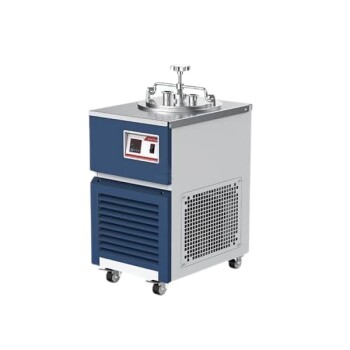
- Vacuum Cold Trap Direct Cold Trap Chiller
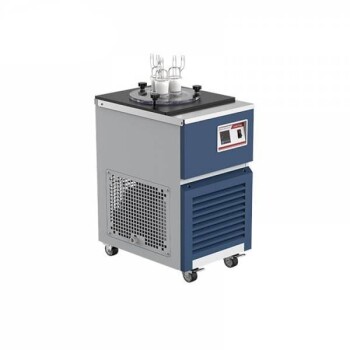
- Vacuum Cold Trap Chiller Indirect Cold Trap Chiller
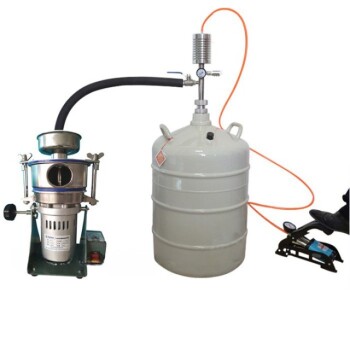
- Small Cryogenic Grinder Cryomill Cryogrinder with Liquid Nitrogen for Laboratory Use
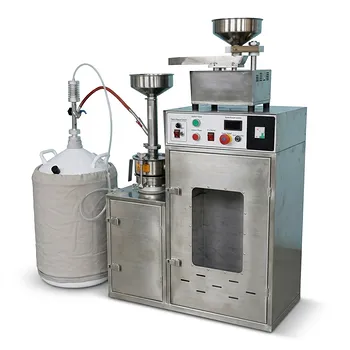
- Liquid Nitrogen Cryogenic Grinder Mill Cryomill with Screw Feeder
- Liquid Nitrogen Cryogenic Grinder Mill Cryomill Airflow Ultrafine Pulverizer
People Also Ask
- What is the role of glass condensation components in arsenic collection? Optimize Niccolite Roasting & Kinetics
- Why is it necessary to configure efficient cold traps in membrane distillation? Ensure Flux Stability & Data Accuracy
- What is the purpose of connecting a cold trap at the reactor outlet? Protect Equipment and Analyze Liquid Products
- What is the primary purpose of a cold trap at a reactor outlet? Protect Analyzers & Ensure Data Integrity
- What is the function of a cold trap in bio-ethanol and methane reforming experiments? Optimize Purity & Protect Systems