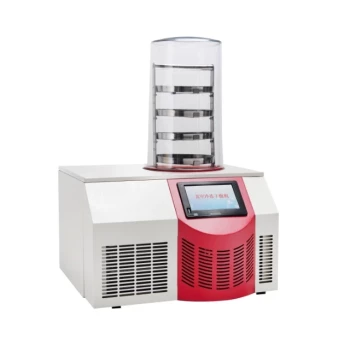
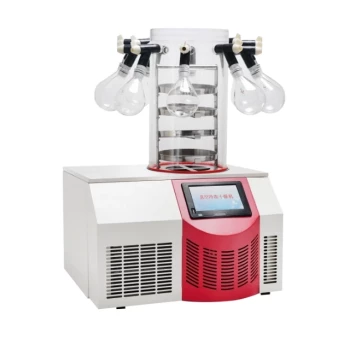
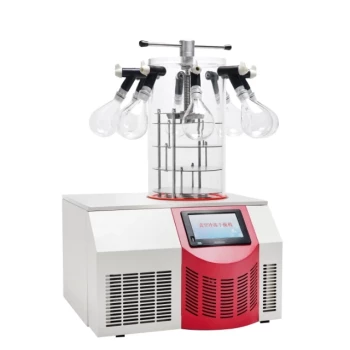
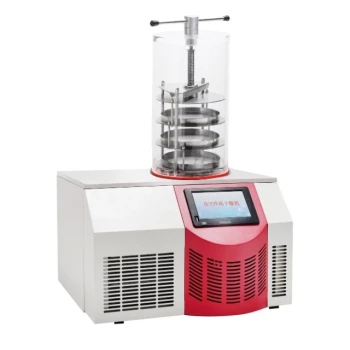
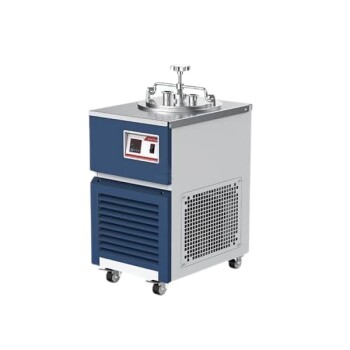
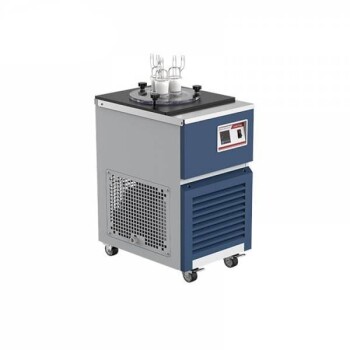
The primary function of a vacuum freeze dryer in the preparation of Bacterial Cellulose Membrane (BCM) precursors is to remove moisture through sublimation while preserving the material's intricate three-dimensional nanofiber network. By operating in a low-temperature vacuum environment, the process bypasses the liquid phase of water entirely. This prevents the capillary forces and surface tension associated with traditional evaporation, which would otherwise cause the delicate nanopores to collapse and the cellulose fibers to agglomerate.
A vacuum freeze dryer serves as a structural stabilizer, utilizing sublimation to "lock" the BCM's 3D interconnected porous architecture into a solid state. This preservation is critical for creating high-surface-area aerogels that act as the ideal foundation for subsequent carbonization, material compositing, or microscopic analysis.
The Mechanics of Sublimation in BCM Processing
Bypassing Liquid Surface Tension
Conventional thermal drying removes water through evaporation, a process where liquid water transitions to vapor. As the liquid recedes from the pores of the Bacterial Cellulose, the resulting surface tension exerts massive pressure on the nanofibers. This pressure often leads to structural shrinkage and the permanent merging of fiber bundles.
The Role of the Low-Temperature Vacuum
A vacuum freeze dryer circumvents this damage by first freezing the moisture within the BCM. Under extreme low temperatures and high vacuum, the ice transforms directly into gas (sublimation). Because no liquid phase occurs, the physical forces that cause pore collapse are eliminated, leaving the original nanofiber morphology intact.
Formation of the BC Aerogel
The result of this process is often a Bacterial Cellulose aerogel. This state is characterized by extreme lightness and a high specific surface area. It provides the necessary physical space and structural integrity required for the BCM to function as a precursor in advanced manufacturing.
Strategic Benefits for Downstream Applications
Optimizing the Foundation for Carbonization
For BCM precursors intended for carbonization, preserving the interconnected network is vital. A freeze-dried structure ensures that the resulting carbon framework maintains high porosity. This open architecture is essential for applications like battery electrodes or supercapacitors where ion transport is a priority.
Facilitating Material Impregnation and Loading
When BCM is used as a scaffold for nanoparticles or catalysts, the nanoporous structure must remain open. Freeze drying prevents the recrystallization of active components and maintains an accessible surface for impregnation with metal ions or other functional reagents. This is particularly critical in the synthesis of lithium-ion sieves or supported catalysts.
Enabling Accurate Microscopic Imaging
To study the distribution of protein nanoparticles or the internal grid structure, researchers rely on Scanning Electron Microscopy (SEM). Freeze drying provides an accurate sample state that reflects the material's natural hydrated geometry. This allows for high-fidelity observation of the fiber surfaces without the distortions caused by heat-induced shrinkage.
Understanding the Trade-offs
Time and Energy Requirements
While vacuum freeze drying is superior for structural preservation, it is significantly slower and more energy-intensive than conventional oven drying. The sublimation process can take dozens of hours to complete, which may limit throughput in large-scale industrial precursor production.
Equipment and Operational Costs
The necessity of maintaining a stable, deep vacuum and cryogenic temperatures requires specialized, high-cost equipment. This increases the initial capital investment and requires skilled operators to manage the drying cycles and prevent "melt-back" (accidental melting during the vacuum stage), which would ruin the BCM's morphology.
Applying This Technology to Your Project
Recommendations Based on Your Objectives
The decision to utilize a vacuum freeze dryer depends on your final material requirements and the specific properties you need to retain in the BCM precursor.
- If your primary focus is structural analysis or SEM imaging: Use vacuum freeze drying exclusively to prevent the collapse of fiber bundles and ensure the most accurate representation of the 3D grid.
- If your primary focus is preparing precursors for high-performance carbonization: Prioritize freeze drying to maximize the specific surface area and maintain the interconnected porous network necessary for ion diffusion.
- If your primary focus is the loading of bioactive substances or catalysts: Employ freeze drying to prevent the migration and agglomeration of active components, ensuring a uniform distribution across the cellulose scaffold.
By leveraging sublimation, you transform a fragile biological membrane into a stable, high-performance structural foundation ready for advanced chemical and thermal processing.
Summary Table:
| Feature | Mechanism | Impact on BCM Precursors |
|---|---|---|
| Structural Preservation | Sublimation (Ice to Gas) | Prevents pore collapse and fiber agglomeration |
| Morphology Retention | Low-temp vacuum environment | Eliminates surface tension and structural shrinkage |
| Aerogel Formation | Solid-state moisture removal | Creates high-surface-area, lightweight scaffolds |
| Application Readiness | Open-pore maintenance | Optimizes carbonization and material impregnation |
Elevate Your Material Research with KINTEK
Precision is the key to unlocking the full potential of Bacterial Cellulose Membrane (BCM) precursors. KINTEK provides the advanced laboratory equipment you need to ensure structural integrity and high-performance results. From our specialized vacuum freeze dryers and cold traps that preserve delicate nanofiber networks to high-temperature furnaces (muffle, vacuum, and CVD) for subsequent carbonization, we offer a comprehensive suite of solutions for modern material science.
Our portfolio is designed for researchers and industrial developers who demand reliability. We offer:
- Thermal Processing: Muffle, tube, and atmosphere furnaces.
- Sample Preparation: Crushing, milling, and hydraulic pellet presses.
- Cooling & Drying: Freeze dryers, ULT freezers, and homogenizers.
- Consumables: High-purity ceramics, crucibles, and PTFE products.
Ready to optimize your BCM preparation and downstream applications? Contact KINTEK today to discover how our high-performance tools can enhance your laboratory's efficiency and innovation.
References
- Weigang Zhao, Xu Yin. MoSe2 Complex with N and B Dual-Doped 3D Carbon Nanofibers for Sodium Batteries. DOI: 10.3390/met13030518
This article is also based on technical information from Kintek Solution Knowledge Base .
Related Products
- Benchtop Laboratory Vacuum Freeze Dryer
- High Performance Laboratory Freeze Dryer
- Benchtop Laboratory Freeze Dryer for Lab Use
- High Performance Laboratory Freeze Dryer for Research and Development
- 56L Vertical Laboratory Vacuum Drying Oven
People Also Ask
- What are the technical advantages of using a laboratory freeze dryer for porous carbon precursors? Preserve 3D Networks
- How do laboratory freeze dryers support scientific research? Preserve Sample Integrity for Reproducible Results
- Why is a laboratory freeze dryer preferred over traditional heating? Preserve Biochar Structure & Maximize Porosity
- What types of liquid samples can be processed using a laboratory freeze dryer? Preserve Your Sensitive Materials
- What role do laboratory freeze dryers play in the food industry? Unlock Superior Food Preservation