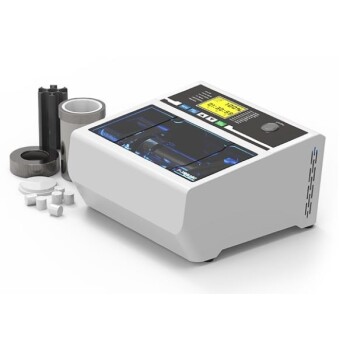
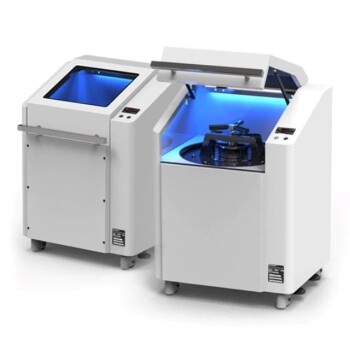
Attrition milling is a high-energy mechanical process used to refine particle size and ensure chemical homogeneity in Strontium Titanate ($SrTiO_3$) powders. By utilizing a high-speed stirring device to drive grinding media, it provides the powerful impact and shear forces necessary to crush raw materials like Strontium Carbonate and Titanium Dioxide. This process maximizes the surface area and reactivity of the powders, ensuring that subsequent high-temperature reactions produce a pure, uniform ceramic structure.
Attrition milling serves as a critical bridge between raw material mixing and final sintering. It facilitates efficient solid-state reactions by increasing contact area and ensures the final powder is free of the hard agglomerates that compromise ceramic density and performance.
Enhancing Solid-State Reaction Efficiency
Increasing Reaction Contact Area
In the initial preparation of Strontium Titanate, the milling process provides powerful mechanical crushing of Strontium Carbonate ($SrCO_3$) and Titanium Dioxide ($TiO_2$). By refining these particles to a smaller scale, the process significantly increases the contact area between the two precursors. This increased surface contact is essential for the chemical elements to migrate and react during the heating phase.
Inducing Mechanical Activation
The high-frequency collisions within an attrition mill do more than just break particles; they introduce high energy into the material. This mechanical activation increases the surface energy and reactivity of the powder. Consequently, the temperature required for subsequent solid-state reactions may be lowered, and the overall reaction rate is enhanced.
Achieving Structural and Chemical Homogeneity
Microscopic Distribution of Precursors
Attrition milling ensures a highly uniform distribution of raw materials at a microscopic level. This uniformity is vital for preventing "pockets" of unreacted material or secondary phases within the Strontium Titanate matrix. A well-mixed powder base leads to a more consistent perovskite crystal structure after calcination.
Facilitating Uniform Sintering
The mill is often used to incorporate sintering additives or dopants into the powder mixture. Similar to its use in other advanced ceramics, the attrition mill ensures these micron-sized additives are evenly distributed throughout the matrix. This leads to a continuous liquid phase during sintering, which is a prerequisite for achieving high densification in the final ceramic body.
Post-Calcination Refinement and De-agglomeration
Breaking Hard Agglomerates
During high-temperature calcination, individual particles often fuse together to form hard agglomerates. Attrition milling is employed after these thermal steps to efficiently break down these clusters. This secondary refinement ensures the powder returns to a fine, manageable state for final shaping.
Achieving Narrow Particle Size Distribution
High-quality applications, such as the production of screen-printing pastes, require powders with a high degree of fineness and a narrow size distribution. Attrition milling allows for precise control over the final particle size. This consistency improves the flowability of the powder and the rheological properties of the resulting pastes.
Understanding the Trade-offs
Media Wear and Contamination
The high-energy nature of attrition milling involves intense friction between the grinding media and the raw materials. Over time, the grinding balls or the mill lining can wear down, potentially introducing impurities into the Strontium Titanate powder. Selecting wear-resistant media, such as zirconia, is often necessary to maintain high chemical purity.
Processing Time and Heat Generation
While attrition mills are faster than traditional ball mills, the high-speed stirring generates significant thermal energy. In some chemical systems, this heat can trigger premature reactions or affect the stability of liquid processing mediums like isopropyl alcohol. Cooling jackets are frequently required to stabilize the temperature during extended milling sessions.
How to Apply This to Your Project
Recommendations for Powder Preparation
- If your primary focus is maximizing chemical purity: Use high-purity zirconia grinding media and linings to minimize contamination during the high-energy stirring process.
- If your primary focus is achieving high sintering density: Prioritize the de-agglomeration step after calcination to ensure a uniform particle size that promotes even shrinkage.
- If your primary focus is preparing screen-printing pastes: Utilize attrition milling to achieve a sub-micron particle size with a narrow distribution for optimal paste consistency.
Properly executed attrition milling transforms raw chemical precursors into a highly reactive and uniform powder, which is the fundamental requirement for high-performance Strontium Titanate ceramics.
Summary Table:
| Key Function | Mechanism | Impact on SrTiO3 Ceramic |
|---|---|---|
| Particle Refinement | High-energy impact and shear | Increases surface area and reactivity |
| Chemical Homogeneity | Microscopic precursor distribution | Ensures pure, uniform crystal structure |
| Mechanical Activation | Energy input via collisions | Lowers required reaction temperatures |
| De-agglomeration | Breaking post-calcination clusters | Improves sintering density and flowability |
| Additive Incorporation | Uniform dopant distribution | Facilitates consistent liquid-phase sintering |
Elevate Your Ceramic Research with KINTEK Precision
Achieving the perfect Strontium Titanate powder requires more than just mixing—it requires precision engineering. KINTEK specializes in high-performance laboratory equipment designed to optimize every stage of your material synthesis. Our advanced crushing and milling systems, combined with high-purity zirconia media, ensure maximum chemical homogeneity while minimizing contamination.
From refining raw precursors to the final sintering stage, KINTEK provides a comprehensive range of tools, including:
- High-Temperature Furnaces: Muffle, vacuum, and atmosphere furnaces for precise calcination and sintering.
- Milling & Sieving: High-energy attrition mills and precision sieving for narrow particle size distribution.
- Hydraulic Presses: Pellet and isostatic presses for high-density ceramic body shaping.
- Premium Consumables: High-purity ceramics, crucibles, and PTFE products to maintain sample integrity.
Ready to enhance your lab's efficiency and material performance? Contact us today to discuss your specific project needs and discover how KINTEK’s expertise can streamline your ceramic production workflow.
References
- Jan‐Helmut Preusker, Wolfgang Rheinheimer. Impact of AC and DC Electric Fields on the Microstructure Evolution in Strontium Titanate. DOI: 10.1002/adem.202201848
This article is also based on technical information from Kintek Solution Knowledge Base .
Related Products
- Laboratory Micro Horizontal Jar Mill for Precision Sample Preparation in Research and Analysis
- Laboratory Jar Mill with Agate Grinding Jar and Balls
- Laboratory Four-Body Horizontal Jar Mill
- Laboratory Disc Cup Vibratory Mill for Sample Grinding
People Also Ask
- What are the different types of laboratory mills? Choose the Right Grinder for Your Sample Material
- What is use for grinding in the laboratory? Select the Right Mill for Accurate Sample Prep
- What is the function of laboratory mills? Achieve Precise Particle Size Control for Accurate Analysis
- What is the use of a laboratory mill? Achieve Accurate Sample Homogenization for Reliable Results
- What is the purpose of sample preparation? Ensure Accurate & Reliable Analytical Results