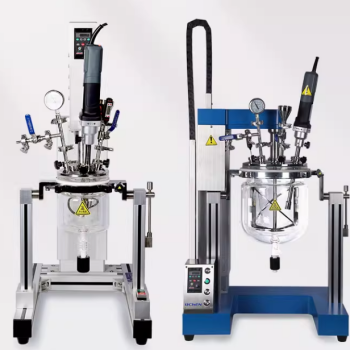
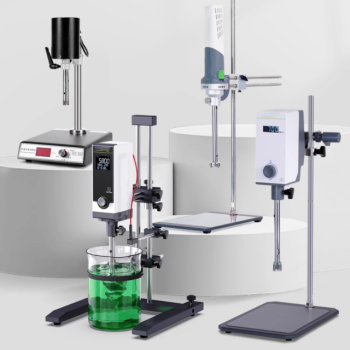
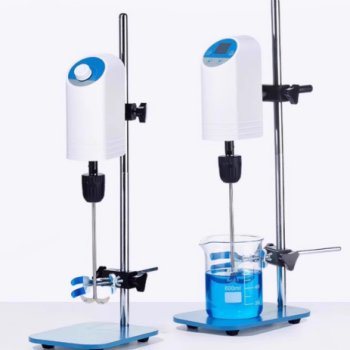
The mechanism of a high-power probe ultrasonic homogenizer is driven by acoustic cavitation. This process converts high-frequency electrical energy into mechanical vibrations, creating microscopic vacuum bubbles within the liquid medium. When these bubbles implosively collapse, they release intense localized shear forces and shock waves that physically break down dicyandiamide (DCDA) particles and eliminate agglomeration.
This mechanical energy achieves a highly uniform, molecular-level dispersion of the precursor within the solvent. By reducing particle size and disrupting inter-particle forces, the process ensures that the resulting graphitic carbon nitride develops specific nanoscale morphologies, such as wrinkled structures or high surface areas, during the subsequent polymerization stage.
The Physics of Acoustic Cavitation
Generation of High-Frequency Mechanical Vibrations
The process begins with an internal transducer that converts electrical energy into mechanical movement. This causes the titanium probe (or horn) to oscillate at ultrasonic frequencies, typically above 20 kHz.
The Formation and Implosion of Micro-bubbles
As the probe vibrates, it creates alternating high-pressure and low-pressure cycles in the solvent. During the low-pressure cycle, small vacuum bubbles or voids form; during the high-pressure cycle, these bubbles implode violently.
Localized Release of Extreme Shear Forces
The collapse of these bubbles generates "micro-jets" and intense localized shear forces. These forces are powerful enough to overcome the Van der Waals forces that hold precursor clusters together, effectively milling the particles in situ.
Impact on Precursor Morphology and Distribution
De-agglomeration of DCDA Particles
Dicyandiamide (DCDA) naturally tends to form large clusters or agglomerates in solution. High-power ultrasonication utilizes mechanical shock waves to shatter these clusters, reducing the material to a more uniform, finer particle size.
Molecular-Level Dispersion and Solvation
Beyond simple physical breaking, the energy promotes a molecular-level distribution of the precursor. This ensures that the DCDA is perfectly integrated with the solvent and any other additives, creating a stable, homogeneous suspension.
Influence on Post-Polymerization Structures
The uniformity of the suspension directly dictates the quality of the final product. A well-homogenized precursor leads to nanoscale morphologies with high surface areas and increased active sites, which are essential for high-performance photocatalytic applications.
Understanding the Trade-offs and Pitfalls
Heat Management and Precursor Stability
The intense energy released during cavitation is partially converted into heat. Without proper temperature control (such as pulse modes or cooling jackets), the localized heat can cause solvent evaporation or premature chemical changes in the precursor.
Probe Erosion and Sample Contamination
Operating at high power for extended periods causes the titanium tip of the probe to erode. This can introduce metallic contaminants into the suspension, which may inadvertently dope the graphitic carbon nitride and alter its electronic properties.
The Law of Diminishing Returns in Processing Time
There is a limit to how much particle size can be reduced. Beyond a certain "saturation point," additional sonication time does not improve dispersion but increases the risk of re-agglomeration or material degradation.
Applying This to Your Material Synthesis
Making the Right Choice for Your Goal
To achieve the best results in your g-C3N4 synthesis, tailor your homogenization strategy to the specific requirements of your final application:
- If your primary focus is Maximum Surface Area: Use high-intensity continuous sonication with active cooling to ensure the smallest possible precursor particle size before polymerization.
- If your primary focus is Purity and Electronic Consistency: Opt for a lower power setting over a longer duration or use a brand-new probe tip to minimize titanium shedding and contamination.
- If your primary focus is Large-Scale Throughput: Implement a flow-cell ultrasonic system rather than a batch beaker setup to ensure every milliliter of the suspension receives uniform energy exposure.
The effective use of ultrasonic cavitation transforms a simple mixture into a precision-engineered suspension, serving as the critical foundation for high-performance graphitic carbon nitride.
Summary Table:
| Stage | Mechanism | Impact on Precursor |
|---|---|---|
| Cavitation | Micro-bubble implosion | Generates intense localized shear forces |
| Dispersion | Mechanical shock waves | Breaks DCDA clusters for molecular-level uniformity |
| Optimization | Uniform suspension | Leads to high surface area & nanoscale g-C3N4 morphology |
| Management | Pulse & Cooling | Prevents thermal degradation and solvent evaporation |
Elevate Your Material Synthesis with KINTEK
Achieve precision in every step of your graphitic carbon nitride research. KINTEK offers a comprehensive suite of laboratory equipment designed for high-performance nanomaterial preparation, including:
- High-Power Ultrasonic Homogenizers & Shakers for flawless precursor dispersion.
- Advanced Furnaces (Muffle, Tube, CVD, PECVD) for controlled polymerization.
- High-Pressure High-Temperature Reactors & Autoclaves for hydrothermal applications.
- Crushing, Milling, & Hydraulic Presses for sample preparation and pelletizing.
- Specialized Consumables including ceramics, crucibles, and PTFE products.
Ready to optimize your lab's efficiency and ensure reproducible results? Contact KINTEK today to find the ideal equipment for your specific synthesis goals.
References
- Ganesh Kesavan, Alexander Star. Optimizing dicyandiamide pretreatment conditions for enhanced structure and electronic properties of polymeric graphitic carbon nitride. DOI: 10.1039/d3tc02412a
This article is also based on technical information from Kintek Solution Knowledge Base .
Related Products
- High Performance Lab Homogenizer for Pharma Cosmetics and Food R&D
- High Shear Homogenizer for Pharmaceutical and Cosmetic Applications
- Laboratory High Throughput Tissue Grinding Mill Grinder
- Lab Sterile Slapping Type Homogenizer for Tissue Mashing and Dispersing
- Laboratory Disc Rotary Mixer for Efficient Sample Mixing and Homogenization
People Also Ask
- Why is a high-performance homogenizer essential for Fe3O4@C9 anode slurries? Boost Battery Performance & Stability.
- What is the primary function of high-performance homogenizers for SAPO-34 MMMs? Ensure Superior Gas Separation Efficiency
- How do lab stirrers & homogenizers ensure uniform distribution? Optimize Your Complex Multiphase Chemical Mixing
- What role does a laboratory homogenizer play in radioactive cesium detection? Ensure Accuracy in Wildlife Sampling
- How does a laboratory automatic masticator or homogenizer facilitate the processing of biofilm samples? Optimize Accuracy