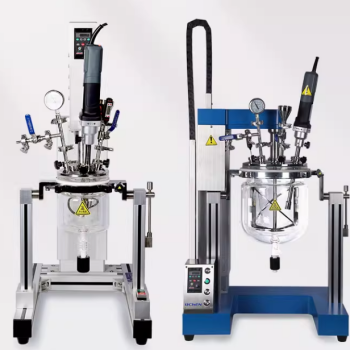
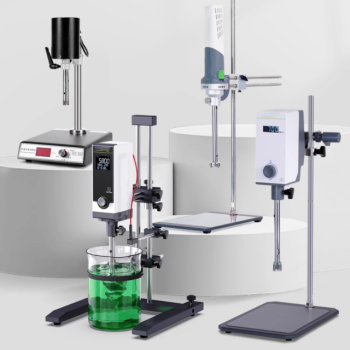
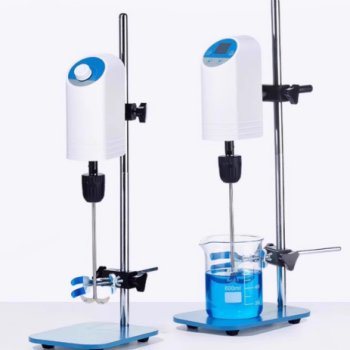
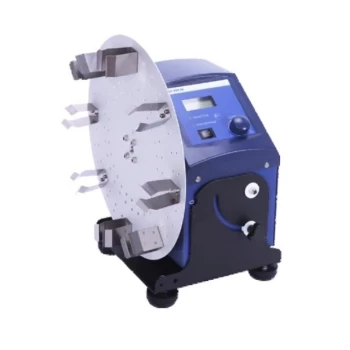
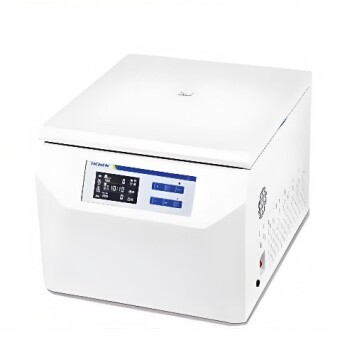
High-performance homogenization is the critical factor in transforming $Fe_3O_4@C_9$ nanopowders into a functional electrode. This equipment applies the intense high-shear forces necessary to break down material agglomerates and ensure a perfectly uniform distribution of active materials, conductive agents, and binders within the NMP solvent. Without this level of dispersion, the resulting slurry will suffer from inconsistent electrical contact and poor mechanical stability, leading to premature battery failure.
A high-performance homogenizer is essential because it overcomes the natural tendency of nano-sized particles to aggregate, creating a stable, uniform suspension. This process is the foundation for low internal resistance, even charge distribution, and a defect-free coating on the copper foil current collector.
Overcoming Nanoscale Agglomeration
Breaking Down Powder Clusters
Nanoparticles like $Fe_3O_4@C_9$ possess high surface energy, which causes them to naturally clump into large aggregates. Standard mixing techniques lack the energy density required to separate these clusters into individual particles.
Achieving a Stable Suspension
High-shear mixers use high-speed rotational forces to generate intense mechanical stress within the NMP solvent. This ensures that the active material and conductive agents remain fully dispersed rather than settling or re-clumping during the coating process.
Prerequisite for Defect-Free Coating
A uniform slurry is necessary for a smooth, "mirror-like" application onto the copper foil. Eliminating large particles through homogenization prevents coating defects and ensures the electrode sheet has a consistent thickness across its entire surface.
Establishing the Internal Electrical Network
Creating Tight Electrical Contact
The primary goal of homogenization is to ensure that the conductive agents are in direct, intimate contact with the $Fe_3O_4@C_9$ particles. This contact creates a robust electrical network that allows for efficient electron transport during charge and discharge cycles.
Ensuring Charge Distribution Uniformity
If the slurry is not homogenized, "hot spots" can develop where the active material is concentrated or isolated from the conductive network. High-performance dispersion ensures a uniform charge distribution, which prevents localized overcharging and extends the lifespan of the battery.
Minimizing Internal Resistance
A well-dispersed slurry results in a consistent microstructure with fewer gaps in the conductive matrix. This reduces the internal resistance (ESR) of the finished cell, directly improving power density and thermal management.
Understanding the Trade-offs and Risks
The Risk of Over-Shearing
While high shear is necessary, excessive force can lead to the mechanical degradation of the active materials or the carbon coating on the $Fe_3O_4$. If the shear forces are too high for too long, they may strip the protective $C_9$ layer or break the polymer chains of the binder, reducing its adhesive strength.
Viscosity and Processing Challenges
Increasing the dispersion level can significantly alter the rheological properties of the slurry. A highly dispersed slurry may exhibit lower viscosity, which can lead to "running" during coating, or higher viscosity due to increased surface area interaction, requiring precise control over the solids content.
Thermal Management During Mixing
High-shear homogenization generates significant heat through friction within the fluid. If not properly cooled, this temperature rise can cause the NMP solvent to evaporate prematurely or degrade the binder, leading to a brittle electrode sheet.
How to Optimize Your Slurry Preparation
To achieve the best results with $Fe_3O_4@C_9$ chemistries, the mixing strategy must balance energy input with material integrity.
- If your primary focus is maximizing cycle life: Prioritize a multi-stage mixing process that uses moderate shear to protect the $C_9$ coating while ensuring the binder is fully dissolved.
- If your primary focus is high-rate performance: Utilize high-energy homogenization to ensure the smallest possible particle size and the most dense conductive network for rapid electron transport.
- If your primary focus is manufacturing yield: Focus on achieving a stable, "settle-resistant" slurry through high-shear dispersion to ensure coating consistency across long production runs.
Effective homogenization is the bridge between raw nanomaterial potential and a high-performance, commercially viable lithium-ion battery.
Summary Table:
| Key Function | Impact on Battery Performance | Critical Process Parameter |
|---|---|---|
| Agglomeration Breakup | Higher stability & uniform suspension | High-shear energy density |
| Electrical Network | Lower internal resistance (ESR) | Conductive agent distribution |
| Coating Consistency | Defect-free, "mirror-like" application | Slurry viscosity & rheology |
| Material Protection | Long-term cycle life & yield | Shear force & temperature control |
Elevate Your Battery Research with KINTEK
Unlock the full potential of your $Fe_3O_4@C_9$ chemistries with KINTEK’s high-performance homogenizers and laboratory systems. We provide the precision equipment necessary to bridge the gap between material synthesis and high-performance device output.
Beyond mixing, KINTEK offers a comprehensive portfolio for battery R&D and material science, including:
- Advanced Homogenizers & Shakers for perfectly dispersed, settle-resistant slurries.
- High-Temperature Furnaces (CVD, Vacuum, Muffle) for precise material synthesis.
- Crushing, Milling & Sieving Systems to achieve optimal particle size distributions.
- Hydraulic Presses & Battery Consumables to streamline your electrode fabrication.
Whether you are focusing on maximizing cycle life or high-rate performance, our tools ensure the material integrity and conductive network reliability your project demands.
Ready to optimize your slurry preparation? Contact KINTEK Today to discover how our specialized laboratory solutions can enhance your manufacturing yield and research precision.
References
- Juti Rani Deka, Yung‐Chin Yang. Fe3O4 Nanoparticle-Decorated Bimodal Porous Carbon Nanocomposite Anode for High-Performance Lithium-Ion Batteries. DOI: 10.3390/batteries9100482
This article is also based on technical information from Kintek Solution Knowledge Base .
Related Products
- High Performance Lab Homogenizer for Pharma Cosmetics and Food R&D
- High Shear Homogenizer for Pharmaceutical and Cosmetic Applications
- Laboratory High Throughput Tissue Grinding Mill Grinder
- High Performance Laboratory Stirrers for Diverse Applications
- Lab Sterile Slapping Type Homogenizer for Tissue Mashing and Dispersing
People Also Ask
- What is the primary function of high-performance homogenizers for SAPO-34 MMMs? Ensure Superior Gas Separation Efficiency
- How do lab stirrers & homogenizers ensure uniform distribution? Optimize Your Complex Multiphase Chemical Mixing
- What role does a laboratory homogenizer play in radioactive cesium detection? Ensure Accuracy in Wildlife Sampling
- How does a laboratory automatic masticator or homogenizer facilitate the processing of biofilm samples? Optimize Accuracy
- Why Use a High Shear Homogenizer for Cathode Slurries? Optimize Double-Layer Solid-State Battery Production