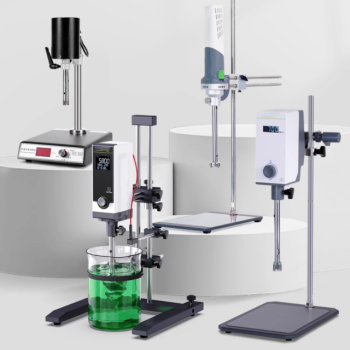
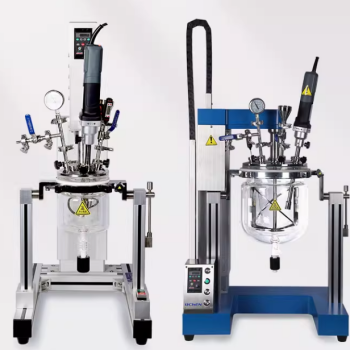
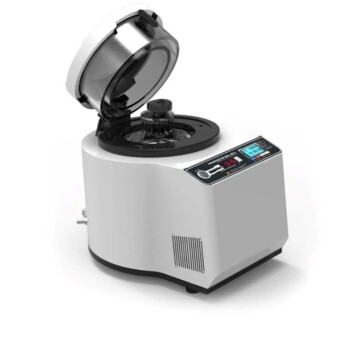
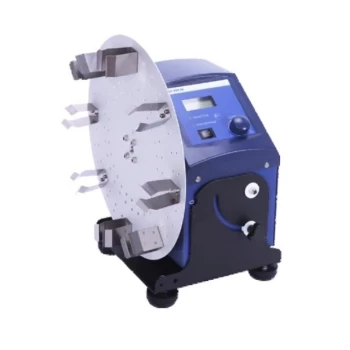
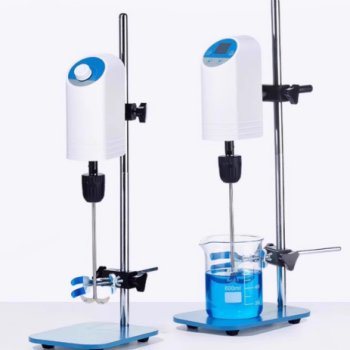
High-shear homogenization provides a critical mechanical advantage over ordinary stirring by applying intense physical force to disrupt the coating mixture at a microscopic level. While ordinary stirring is sufficient for blending simple fluids, a high-shear homogenizer utilizes high-speed rotation to generate powerful shear forces and turbulence, ensuring that complex fillers like nano-manganese dioxide and cellulose nanofibers are thoroughly dispersed into the BED/GMA monomer matrix.
The Core Insight Ordinary stirring often fails to break down particle clumps, leading to inconsistent coating performance. High-shear homogenization is essential because it overcomes the attractive forces between nanoparticles, ensuring a molecular-level uniformity that guarantees consistent physical properties and anti-fouling protection across the entire surface.
The Mechanics of Dispersion
Generating Shear Force and Turbulence
Ordinary stirring primarily creates flow, moving the liquid around the vessel. In contrast, a high-shear homogenizer utilizes high-speed rotation to create intense turbulence.
This mechanical energy translates into powerful shear forces that act directly on the fluid components. This intensity is required to physically pull apart materials that naturally resist mixing.
Overcoming Particle Attraction
Nanomaterials, such as the fillers used in BED/GMA coatings, are prone to agglomeration (clumping). This is often due to microscopic attractive forces, known as Van der Waals forces, which bind particles together.
Ordinary stirring rarely generates enough energy to overcome these forces. High-shear homogenization provides the necessary mechanical stress to break these bonds, preventing agglomeration and ensuring distinct particles are suspended in the polymer matrix.
Impact on Coating Quality
Achieving True Uniformity
The primary goal of the mixing process is to distribute fillers—specifically nano-manganese dioxide and cellulose nanofibers—into the mixed monomers of bisphenol A epoxy diacrylate (BED) and glycidyl methacrylate (GMA).
A high-shear process ensures these components are dispersed at a molecular or micron-level. This creates a mixture where the ratio of filler to polymer is identical at every point in the solution.
Consistent Physicochemical Properties
When the mixture is uniform, the cured coating exhibits stable physical and chemical characteristics.
If the dispersion is poor, the final product may have weak spots or structural inconsistencies. Homogenization eliminates this variability, ensuring the material performs predictably under stress.
Reliability in Anti-Fouling Performance
For functional coatings, the distribution of active ingredients dictates performance.
By ensuring the active components are evenly spread, the high-shear method guarantees that anti-fouling effects remain consistent across the entire surface area of the coating, leaving no microscopic gaps for pathogens or fouling agents to exploit.
The Risks of Inadequate Mixing
The Trap of "Good Enough" Mixing
It is a common pitfall to assume that visual blending equates to microscopic dispersion.
Using ordinary stirring for BED/GMA solutions often results in a solution that appears mixed to the naked eye but contains micro-agglomerates.
The Consequence of Clumping
If these agglomerates remain, the active surface area of the nanoparticles is reduced.
This leads to compromised pathogen-killing capabilities and uneven mechanical strength, rendering the coating less effective despite containing the correct ingredients.
Making the Right Choice for Your Goal
To ensure your BED/GMA coating performs as intended, consider the following regarding your equipment selection:
- If your primary focus is consistent protection: You must use high-shear homogenization to ensure anti-fouling agents are distributed evenly across every micron of the surface.
- If your primary focus is material durability: High-shear processing is required to prevent particle clumping, which creates weak points and undermines the physicochemical integrity of the polymer.
Ultimately, the quality of your dispersion dictates the quality of your protection; high-shear homogenization turns a mixture of ingredients into a high-performance material.
Summary Table:
| Feature | Ordinary Stirring | High-Shear Homogenizer |
|---|---|---|
| Mixing Mechanism | Low-speed fluid flow | High-speed rotation & intense turbulence |
| Shear Force | Minimal | Powerful mechanical shear forces |
| Particle Agglomeration | Fails to break nanoparticle clumps | Overcomes Van der Waals forces |
| Dispersion Level | Macroscopic visual blending | Molecular/Micron-level uniformity |
| Coating Performance | Inconsistent; potential weak spots | Predictable; stable physicochemical properties |
| Anti-Fouling Effect | Uneven; microscopic gaps likely | Consistent protection across the entire surface |
Elevate Your Material Research with KINTEK Precision
Don't let inadequate mixing compromise your coating's performance. KINTEK specializes in advanced laboratory equipment designed to solve complex dispersion challenges. From high-performance homogenizers and shakers to high-temperature furnaces and precision hydraulic presses, we provide the tools necessary to ensure your BED/GMA polymer solutions achieve true molecular uniformity.
Our value to you:
- Superior Dispersion: Overcome nanoparticle clumping with our high-shear solutions.
- Comprehensive Lab Range: Access everything from crushing and milling systems to autoclaves and electrolytic cells.
- Expert Support: Our team helps you select the right tools for battery research, material science, and dental applications.
Ready to transform your mixture into a high-performance material? Contact KINTEK today to find your perfect equipment solution!
References
- Madelyn N. Moawad, Ahmed Nasr Alabssawy. Fabrication of environmentally safe antifouling coatings using nano-MnO2/cellulose nanofiber composite with BED/GMA irradiated by electron beam. DOI: 10.1038/s41598-023-46559-1
This article is also based on technical information from Kintek Solution Knowledge Base .
Related Products
- High Shear Homogenizer for Pharmaceutical and Cosmetic Applications
- High Performance Lab Homogenizer for Pharma Cosmetics and Food R&D
- Laboratory High Throughput Tissue Grinding Mill Grinder
- Lab Sterile Slapping Type Homogenizer for Tissue Mashing and Dispersing
- Laboratory Disc Rotary Mixer for Efficient Sample Mixing and Homogenization
People Also Ask
- Why Use a High Shear Homogenizer for Cathode Slurries? Optimize Double-Layer Solid-State Battery Production
- What is the function of high-shear dispersion equipment in corona-resistant nanocomposites? Elevate Your Insulation
- What is the necessity of using an industrial-grade high-shear homogenizer for biomass washing? Ensure Process Efficiency
- What role does a high-shear homogenizer play in ODC catalyst suspensions? Unlock Superior Electrochemical Efficiency
- What functions do laboratory centrifuges and high-shear homogenizers perform? Optimize Your Nano-Modified Composites