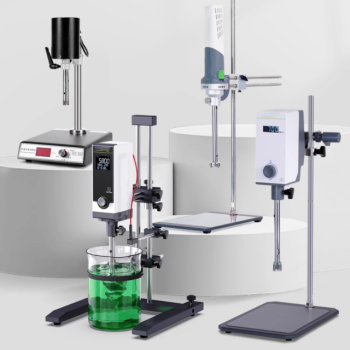
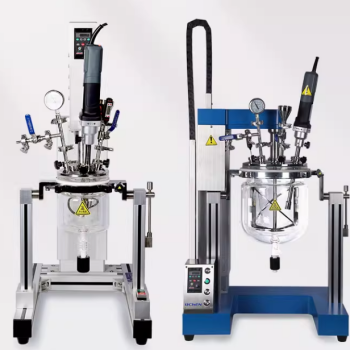
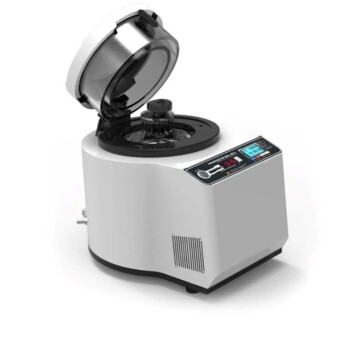
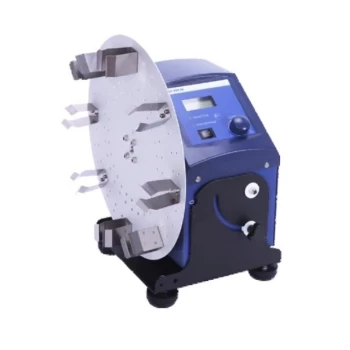
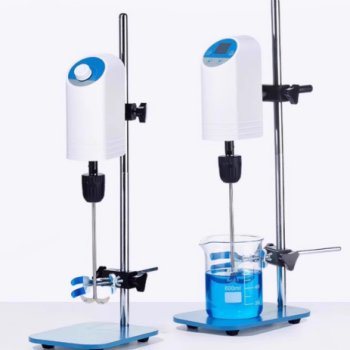
Laboratory centrifuges and high-shear homogenizers are essential processing tools for creating high-quality nano-modified composite matrices. The high-shear homogenizer functions as the primary dispersion mechanism, utilizing intense mechanical forces to break down aggregated nanoparticles—such as Graphene Oxide (GO) or Multi-Walled Carbon Nanotubes (MWCNTs)—and distribute them evenly within a resin. Following this, the laboratory centrifuge acts as a purification and degassing stage, removing air bubbles introduced during mixing and separating out large, un-exfoliated impurities to prevent structural defects.
Effective nano-modification requires a two-step balance: the homogenizer ensures the filler is evenly spread to enhance properties, while the centrifuge removes defects that would otherwise cause stress concentration and material failure.
The Role of High-Shear Homogenization
The first critical step in preparing a composite matrix is ensuring the nanomaterials are not clumped together.
Breaking Down Aggregates
Nanomaterials, particularly MWCNTs and GO, have a natural tendency to clump together due to strong inter-particle forces.
A high-shear homogenizer applies intense mechanical shear forces to physically disrupt these clusters.
This process breaks large agglomerates down into individual nanoparticles or smaller bundles, which is necessary for the material to function correctly.
Ensuring Uniform Dispersion
Once the aggregates are broken, the homogenizer distributes the particles throughout the liquid resin.
Uniform dispersion is vital because it ensures the mechanical or electrical properties of the nanoparticle are imparted to the entire matrix, rather than just isolated spots.
Without this step, the composite would have inconsistent properties, leading to weak spots in the final product.
The Role of Laboratory Centrifugation
High-speed mixing often introduces unwanted byproducts, specifically air and remaining impurities, which must be removed.
Degassing the Matrix
The violent action of a high-shear homogenizer inevitably traps air within the viscous resin.
A laboratory centrifuge uses centrifugal force to separate materials by density, effectively removing air bubbles from the mixture.
eliminating these voids is critical, as air bubbles create voids that significantly weaken the composite structure.
Eliminating Impurities
Even after homogenization, some large-scale impurities or un-exfoliated particles may remain.
These larger particles do not reinforce the material; instead, they act as contaminants that interrupt the matrix continuity.
The centrifuge forces these heavier, non-integrated particles out of the suspension, leaving behind only the optimally dispersed mixture.
Understanding the Trade-offs
While these processes are necessary, they introduce specific risks that must be managed to avoid damaging the material.
Risk of Re-agglomeration
If the centrifugation process is too aggressive or prolonged, it can accidentally separate the dispersed nanoparticles from the resin.
This effectively undoes the work of the homogenizer, leading to a resin rich in filler at the bottom and devoid of filler at the top.
Stress Concentration Points
The ultimate goal of using both machines is to prevent stress concentration points.
If bubbles or large impurities remain because the centrifugation step was skipped, forces applied to the material will focus on those defects.
This leads to premature cracking or failure, negating the benefits of adding the high-performance nanomaterials in the first place.
Making the Right Choice for Your Goal
To achieve a high-performance composite, you must tune both the mixing and purification stages to the specific needs of your resin and filler.
- If your primary focus is mechanical uniformity: Prioritize the high-shear homogenizer settings to ensure every aggregate is fully broken down before moving to the next step.
- If your primary focus is structural reliability: Ensure sufficient time in the laboratory centrifuge to fully degas the matrix, as voids are the most common cause of catastrophic failure.
By integrating these two processes, you transform a raw mixture into a refined, engineering-grade composite material.
Summary Table:
| Equipment | Primary Function | Key Process | Benefit for Composites |
|---|---|---|---|
| High-Shear Homogenizer | Dispersion | Breaking aggregates (MWCNTs/GO) | Ensures uniform mechanical & electrical properties |
| Laboratory Centrifuge | Purification | Degassing & impurity removal | Eliminates structural voids and stress concentrations |
Elevate Your Material Research with KINTEK
Precision in nano-modification requires equipment that delivers consistent, repeatable results. KINTEK specializes in high-performance laboratory centrifuges and homogenizers designed to handle the rigorous demands of resin-nanoparticle processing.
Beyond dispersion tools, we offer a comprehensive suite of laboratory equipment, including high-temperature furnaces, vacuum reactors, and hydraulic presses, to support your entire material synthesis workflow. From PTFE consumables to cooling solutions, we provide the tools needed to eliminate structural defects and achieve engineering-grade composite reliability.
Ready to optimize your lab's efficiency? Contact KINTEK today to find the perfect equipment solution for your research needs!
References
- Abdulhammed K. Hamzat, Ramazan Asmatulu. Fiber-reinforced composites for aerospace, energy, and marine applications: an insight into failure mechanisms under chemical, thermal, oxidative, and mechanical load conditions. DOI: 10.1007/s42114-024-01192-y
This article is also based on technical information from Kintek Solution Knowledge Base .
Related Products
- High Shear Homogenizer for Pharmaceutical and Cosmetic Applications
- High Performance Lab Homogenizer for Pharma Cosmetics and Food R&D
- Laboratory High Throughput Tissue Grinding Mill Grinder
- Lab Sterile Slapping Type Homogenizer for Tissue Mashing and Dispersing
- Laboratory Disc Rotary Mixer for Efficient Sample Mixing and Homogenization
People Also Ask
- Why Use a High Shear Homogenizer for Cathode Slurries? Optimize Double-Layer Solid-State Battery Production
- What is the function of high-shear dispersion equipment in corona-resistant nanocomposites? Elevate Your Insulation
- What is the necessity of using an industrial-grade high-shear homogenizer for biomass washing? Ensure Process Efficiency
- What are the advantages of using a high-shear homogenizer for BED/GMA coatings? Achieve Superior Nano-Dispersion
- What role does a high-shear homogenizer play in ODC catalyst suspensions? Unlock Superior Electrochemical Efficiency