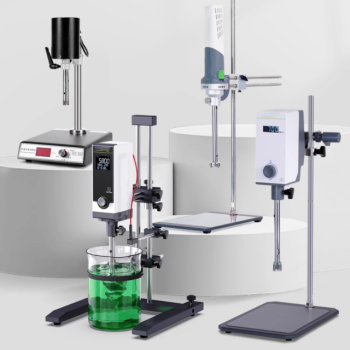
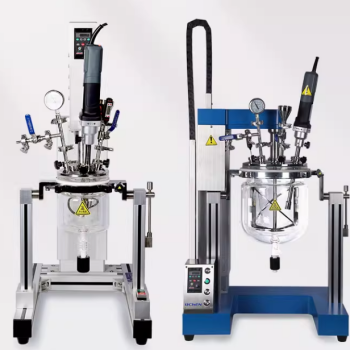
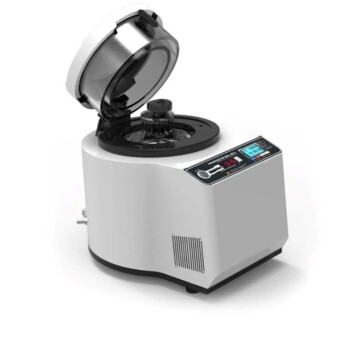
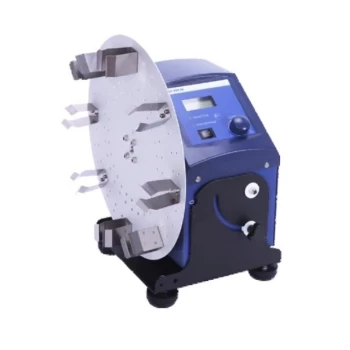
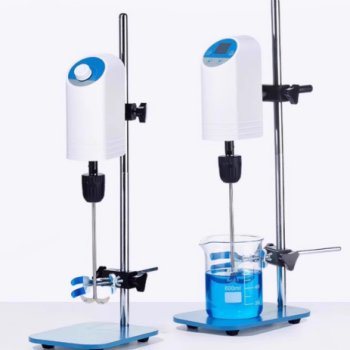
High-shear dispersion equipment serves a critical mechanical function: it exerts intense force to break apart clustered nanoparticles and distribute them evenly throughout a mixture. In the specific context of manufacturing high-performance corona-resistant insulation, this equipment ensures that inorganic fillers—such as silica or alumina—achieve a molecular-level uniform distribution within polymer matrices like polyimide or epoxy resin.
Core Insight: The primary value of high-shear dispersion is not just mixing, but defect prevention. By forcefully breaking down nanoparticle agglomerates, the equipment eliminates weak points where electric fields concentrate, directly preventing premature insulation failure caused by corona aging.
The Mechanism of High-Shear Dispersion
Breaking Down Agglomerates
Nanoparticles have a strong natural tendency to clump together, or agglomerate, due to surface forces. Standard mixing is often insufficient to separate these clusters.
High-shear equipment, such as a homogenizer, applies powerful mechanical shear force that overcomes these binding forces. This action physically rips apart the agglomerates into individual particles.
Achieving Molecular-Level Uniformity
Once the particles are separated, the equipment ensures they are dispersed evenly throughout the polymer matrix.
The goal is a homogeneous blend where the distance between nanoparticles is consistent. This level of uniformity is essential for the material to function as a true nanocomposite rather than a polymer with filler inclusions.
Why Dispersion Defines Corona Resistance
Preventing Electric Field Concentration
The performance of insulating materials is often dictated by their weakest point.
When nanoparticles clump together, they create irregularities within the insulation. These irregularities act as focal points for the electric field, leading to localized stress.
Enhancing Material Longevity
By ensuring a uniform distribution, high-shear dispersion dissipates electrical stress evenly across the entire material structure.
This prevents the localized "hot spots" that lead to corona discharge and subsequent material degradation. The result is a significant improvement in the material's resistance to corona aging.
Understanding the Trade-offs
The Risk of Over-Shearing
While mechanical energy is necessary to refine particle distribution, excessive shear can introduce problems.
Too much energy input can generate significant heat, potentially curing resins prematurely or degrading the polymer chains. It is a balance between breaking particles and preserving the matrix integrity.
Process Complexity vs. Performance
Using high-shear homogenizers adds a step to the manufacturing process compared to simple stirring.
However, relying on lower-energy methods (like magnetic stirring) often fails to achieve the specific surface area coverage required for high-performance insulation. The trade-off is higher energy and equipment cost for vastly superior electrical properties.
Making the Right Choice for Your Project
High-shear dispersion is a tool to align your manufacturing process with your performance requirements.
- If your primary focus is maximum voltage endurance: Prioritize high-shear processing to ensure zero agglomeration, as even microscopic clusters can become failure points.
- If your primary focus is matrix integrity: Monitor the temperature and shear duration carefully to prevent thermal degradation of the polymer while still achieving dispersion.
Ultimately, the uniformity of your dispersion is the ceiling of your insulation's performance.
Summary Table:
| Feature | Mechanical Action | Impact on Insulation Performance |
|---|---|---|
| Agglomerate Breaking | Overcomes surface forces to separate nanoparticle clusters | Eliminates weak points where electric fields concentrate |
| Uniform Dispersion | Distributes inorganic fillers at a molecular level | Ensures consistent dielectric properties across the matrix |
| Defect Prevention | Minimizes irregularities and localized stress | Directly prevents premature failure from corona aging |
| Energy Control | Balances shear force with temperature monitoring | Preserves polymer matrix integrity and prevents degradation |
Optimize Your Nanocomposite Performance with KINTEK
Achieving molecular-level uniformity is critical for the longevity of high-performance insulating materials. At KINTEK, we specialize in the advanced laboratory equipment necessary to bridge the gap between material research and industrial excellence.
Our precision homogenizers, high-pressure reactors, and crushing systems are designed to provide the exact shear forces required to eliminate nanoparticle agglomeration without compromising your polymer matrix. Whether you are developing corona-resistant polyimides or advanced epoxy resins, KINTEK offers the comprehensive range of battery research tools, cooling solutions, and specialized ceramics to support your entire workflow.
Ready to eliminate material defects and enhance your voltage endurance? Contact our technical experts today to find the perfect dispersion and processing solution for your laboratory.
References
- Chuanyang Li, Yunlong Zi. Insulating materials for realising carbon neutrality: Opportunities, remaining issues and challenges. DOI: 10.1049/hve2.12232
This article is also based on technical information from Kintek Solution Knowledge Base .
Related Products
- High Shear Homogenizer for Pharmaceutical and Cosmetic Applications
- High Performance Lab Homogenizer for Pharma Cosmetics and Food R&D
- Laboratory High Throughput Tissue Grinding Mill Grinder
- Lab Sterile Slapping Type Homogenizer for Tissue Mashing and Dispersing
- Laboratory Disc Rotary Mixer for Efficient Sample Mixing and Homogenization
People Also Ask
- Why Use a High Shear Homogenizer for Cathode Slurries? Optimize Double-Layer Solid-State Battery Production
- What is the necessity of using an industrial-grade high-shear homogenizer for biomass washing? Ensure Process Efficiency
- What are the advantages of using a high-shear homogenizer for BED/GMA coatings? Achieve Superior Nano-Dispersion
- What role does a high-shear homogenizer play in ODC catalyst suspensions? Unlock Superior Electrochemical Efficiency
- What functions do laboratory centrifuges and high-shear homogenizers perform? Optimize Your Nano-Modified Composites