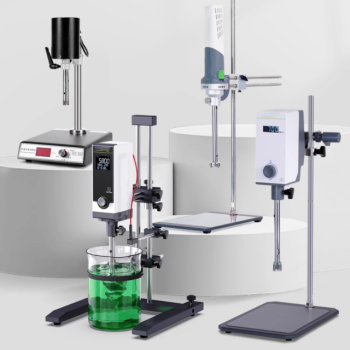
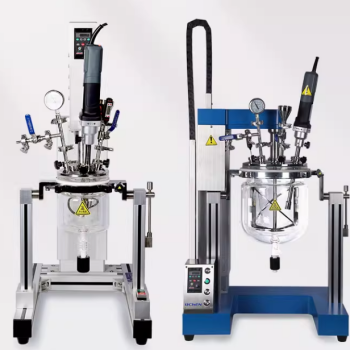
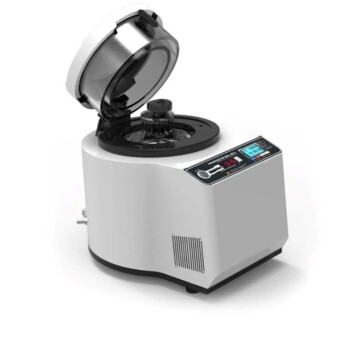
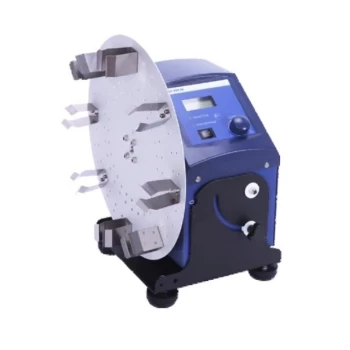
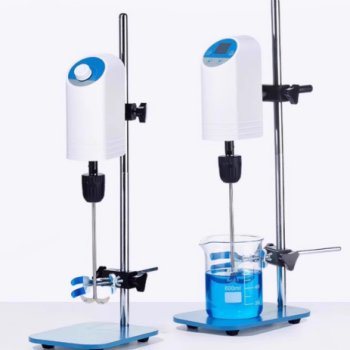
The high-shear homogenizer serves as the foundational tool for structural uniformity in Oxygen Depolarized Cathode (ODC) manufacturing. It utilizes high-speed rotation to generate intense impact and shear forces. These forces are required to rigorously blend micrometer-scale silver catalysts, Polytetrafluoroethylene (PTFE) dispersions, and methylcellulose solutions into a cohesive suspension.
Achieving high performance in an ODC requires more than simply combining ingredients; it necessitates the integration of materials with opposing physical properties. The high-shear homogenizer overcomes these differences to ensure a molecular-level distribution, which is the prerequisite for establishing an ideal three-phase interface.
The Mechanics of Suspension Preparation
Generating High-Energy Forces
The preparation process relies on more than simple stirring. The equipment uses high-speed rotation to create strong shear and impact forces.
This mechanical energy is sufficient to break down agglomerates and physical barriers within the mixture. It forces materials that might naturally separate to integrate effectively.
The Component Triad
The homogenizer is tasked with blending three distinct components: micrometer-scale silver catalysts, PTFE dispersions, and methylcellulose solutions.
Because these materials differ significantly in density and surface properties, high-energy processing is the only reliable method to achieve a uniform suspension.
Why Uniformity Drives Performance
Overcoming Hydrophobic Barriers
A major challenge in ODC preparation is the presence of hydrophobic components, specifically the PTFE dispersions.
The high-shear action forces these hydrophobic elements to distribute evenly alongside the catalytic components (silver). This prevents phase separation that would occur under lower-energy mixing conditions.
Enabling the Three-Phase Interface
The ultimate goal of this mixing stage is to facilitate subsequent processing steps.
By achieving uniformity at the molecular level now, the process sets the stage for an ideal "three-phase interface" (the point where gas, liquid, and solid meet). This interface is critical for the electrochemical efficiency of the final cathode.
Critical Process Requirements
The Risk of Insufficient Shear
The primary pitfall in this process is under-processing. Standard mixing methods often fail to break the physical barriers on the surface of the raw materials.
If the shear force is too low, the hydrophobic PTFE and the silver catalyst may not achieve full contact. This results in a chemically inconsistent slurry that cannot support the necessary electrochemical reactions later in production.
Uniformity vs. Stability
While high shear is necessary for distribution, the inclusion of methylcellulose serves as a stabilizing agent.
The homogenizer ensures this thickener is fully dispersed, locking the silver and PTFE into place to maintain the suspension's integrity over time.
Optimization for Production Goals
To ensure you are utilizing the high-shear homogenizer effectively for your specific requirements, consider the following focuses:
- If your primary focus is Electrochemical Efficiency: Prioritize maximizing shear duration to guarantee the molecular-level distribution required for a perfect three-phase interface.
- If your primary focus is Process Stability: Ensure the methylcellulose solution is introduced effectively during the shear phase to lock in the uniformity of the suspension.
Proper high-shear homogenization transforms a disparate mixture of raw materials into a unified, high-performance electrochemical engine.
Summary Table:
| Process Component | Role in Suspension | Key Benefit of High Shear |
|---|---|---|
| Silver Catalyst | Active reaction site | Ensures micrometer-scale distribution |
| PTFE Dispersion | Hydrophobic binder | Overcomes phase separation barriers |
| Methylcellulose | Stabilizing agent | Uniform thickening & suspension integrity |
| Energy Forces | Impact & Shear | Breaks down agglomerates for molecular blending |
Elevate Your Electrochemical Research with KINTEK Precision
Achieving the perfect three-phase interface in Oxygen Depolarized Cathode (ODC) production requires more than standard mixing—it demands the high-energy precision of KINTEK high-shear homogenizers.
At KINTEK, we specialize in the laboratory equipment essential for advanced battery research and materials science. Beyond our industry-leading homogenizers and shakers, we provide a comprehensive suite of tools including:
- High-temperature furnaces and reactors for catalyst synthesis.
- Electrolytic cells and electrodes for performance testing.
- PTFE consumables and ceramics to maintain purity in harsh environments.
Whether you are refining ODC suspensions or scaling up battery research, our technical experts are ready to help you select the right tools for uniform, stable, and high-performance results.
Contact KINTEK Today to Optimize Your Lab Workflow
References
- Marcus Gebhard, Christina Roth. Design of an In-Operando Cell for X-Ray and Neutron Imaging of Oxygen-Depolarized Cathodes in Chlor-Alkali Electrolysis. DOI: 10.3390/ma12081275
This article is also based on technical information from Kintek Solution Knowledge Base .
Related Products
- High Shear Homogenizer for Pharmaceutical and Cosmetic Applications
- High Performance Lab Homogenizer for Pharma Cosmetics and Food R&D
- Laboratory High Throughput Tissue Grinding Mill Grinder
- Lab Sterile Slapping Type Homogenizer for Tissue Mashing and Dispersing
- Laboratory Disc Rotary Mixer for Efficient Sample Mixing and Homogenization
People Also Ask
- Why Use a High Shear Homogenizer for Cathode Slurries? Optimize Double-Layer Solid-State Battery Production
- What is the function of high-shear dispersion equipment in corona-resistant nanocomposites? Elevate Your Insulation
- What is the necessity of using an industrial-grade high-shear homogenizer for biomass washing? Ensure Process Efficiency
- What are the advantages of using a high-shear homogenizer for BED/GMA coatings? Achieve Superior Nano-Dispersion
- What functions do laboratory centrifuges and high-shear homogenizers perform? Optimize Your Nano-Modified Composites