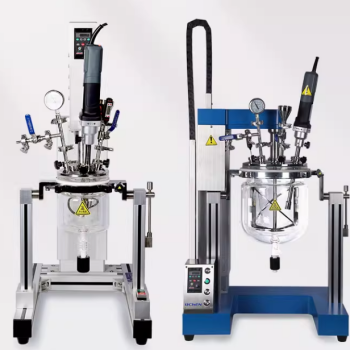
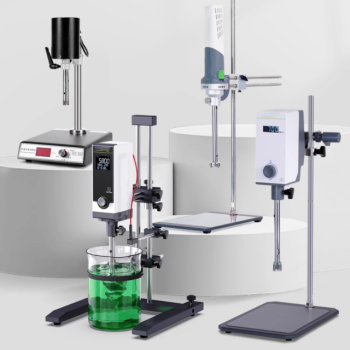
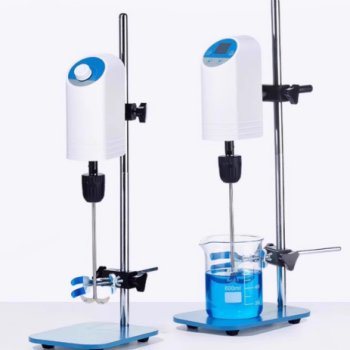
High-precision stirring and homogenizing devices are indispensable in the phase inversion method because they provide the high shear force necessary to navigate the physics of viscous polymer solutions. These devices are required to integrate modified titanium dioxide nanoparticles, polymers, and solvents into a single, cohesive mixture. Without this intense mechanical intervention, achieving the required molecular-level dispersion is virtually impossible.
The Core Reality Nanoparticles in a polymer solution have a natural tendency to clump together, which compromises the final membrane. High-precision homogenizers disrupt these agglomerates, ensuring the consistent porosity and uniform distribution of active sites required for effective photocatalysis.
The Mechanics of Dispersion
Overcoming Solution Viscosity
The phase inversion method relies on a casting solution composed of polymers and solvents. This creates a highly viscous environment that resists simple flow.
Standard low-speed stirring cannot generate enough turbulence to move the heavy fluid effectively. High-precision devices are engineered to drive movement through this resistance, ensuring the entire volume is treated equally.
Applying High Shear Force
The primary function of a homogenizer is the application of high shear force. This is distinct from mere mixing; it is a violent mechanical stress applied to the fluid.
This force is critical for breaking apart the physical bonds that hold particle clusters together. It physically forces the solvent and polymer chains to intersperse between individual nanoparticles.
Achieving Molecular-Level Uniformity
The goal is not just a visual blend, but a molecular-level uniform dispersion. This means the nanocatalysts (titanium dioxide) are evenly spaced throughout the polymer matrix.
High-precision equipment ensures that no "dead zones" exist within the mixing vessel. This guarantees that the resulting solution is chemically identical at every point.
Impact on Membrane Structure and Performance
Preventing Particle Agglomeration
Without high shear, nanoparticles will naturally aggregate into larger clumps, known as agglomeration. These clumps create weak points and irregularities in the casting solution.
Homogenizers prevent this by continuously breaking these clusters down before the membrane is cast. This maintenance of particle separation is the foundation of membrane quality.
Ensuring Consistent Porosity
The phase inversion process transforms the liquid solution into a solid membrane with specific pore structures. The uniformity of the liquid solution directly dictates the consistency of the porosity in the final film.
If the dispersion is poor, the phase inversion will occur unevenly. This results in unpredictable pore sizes that can hinder filtration or flow rates.
Distributing Active Sites
For a photocatalytic membrane to function, the active sites (the titanium dioxide) must be accessible. A uniform dispersion guarantees uniformly distributed active sites across the membrane surface.
If agglomeration occurs, large sections of the membrane may lack catalytic activity. High-precision mixing ensures maximum efficiency by spreading the catalyst evenly.
Common Pitfalls and Trade-offs
Equipment Complexity vs. Necessity
Using high-precision homogenizers introduces higher equipment costs and operational complexity compared to magnetic stirring. However, this is a necessary trade-off for working with nanocomposites.
Attempting to bypass this equipment to save costs often results in wasted raw materials due to batch failure.
Heat Generation
The application of high shear force generates significant friction, which translates to heat.
Operators must monitor the temperature of the solution to prevent solvent evaporation or polymer degradation during the mixing process.
Making the Right Choice for Your Goal
To maximize the performance of your photocatalytic membranes, align your mixing protocol with your specific outcomes:
- If your primary focus is Membrane Durability: Prioritize shear duration to eliminate all agglomerates, ensuring a defect-free structure with consistent porosity.
- If your primary focus is Catalytic Efficiency: Focus on the intensity of the shear force to maximize the surface area and distribution of the active sites ($TiO_2$) throughout the polymer matrix.
The success of the phase inversion method is determined before the casting even begins; it relies entirely on the quality of the initial dispersion.
Summary Table:
| Feature | Impact of High-Precision Homogenization | Resulting Membrane Quality |
|---|---|---|
| Particle Dispersion | Disrupts nanoparticle clusters and agglomerates | Maximized catalytic surface area |
| Solution Viscosity | Overcomes resistance through high shear force | Perfect molecular-level uniformity |
| Pore Structure | Ensures consistent liquid-to-solid transition | Uniform porosity and filtration rates |
| Active Sites | Evenly distributes $TiO_2$ throughout matrix | Consistent photocatalytic activity |
| Structural Integrity | Eliminates weak points caused by clumps | Enhanced durability and performance |
Elevate Your Membrane Research with KINTEK Precision
Don't let poor dispersion compromise your photocatalytic efficiency. KINTEK specializes in advanced laboratory equipment designed to handle the most demanding viscous solutions. From high-speed homogenizers and shakers to specialized crushing and milling systems, we provide the high-shear power necessary for flawless nanoparticle integration.
Whether you are developing next-generation membranes, working with high-temperature high-pressure reactors, or optimizing battery research tools, our comprehensive portfolio ensures your materials meet the highest standards of uniformity and performance.
Ready to achieve molecular-level precision? Contact our experts today to find the perfect solution for your lab.
References
- Kipchumba Nelson, Zeinab A. Suliman. Recent Trends in the Application of Photocatalytic Membranes in Removal of Emerging Organic Contaminants in Wastewater. DOI: 10.3390/pr13010163
This article is also based on technical information from Kintek Solution Knowledge Base .
Related Products
- High Performance Lab Homogenizer for Pharma Cosmetics and Food R&D
- High Shear Homogenizer for Pharmaceutical and Cosmetic Applications
- Laboratory High Throughput Tissue Grinding Mill Grinder
- Lab Sterile Slapping Type Homogenizer for Tissue Mashing and Dispersing
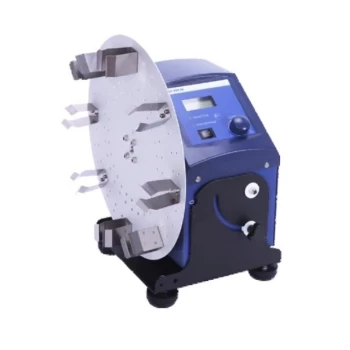
- Laboratory Disc Rotary Mixer for Efficient Sample Mixing and Homogenization
People Also Ask
- Why is a high-performance homogenizer essential for Fe3O4@C9 anode slurries? Boost Battery Performance & Stability.
- What is the primary function of high-performance homogenizers for SAPO-34 MMMs? Ensure Superior Gas Separation Efficiency
- How do lab stirrers & homogenizers ensure uniform distribution? Optimize Your Complex Multiphase Chemical Mixing
- What role does a laboratory homogenizer play in radioactive cesium detection? Ensure Accuracy in Wildlife Sampling
- How does a laboratory automatic masticator or homogenizer facilitate the processing of biofilm samples? Optimize Accuracy