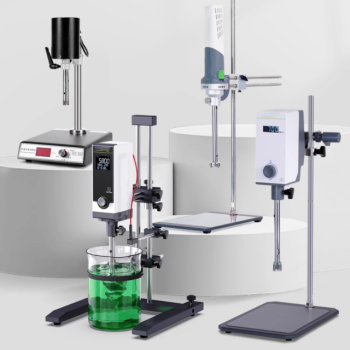
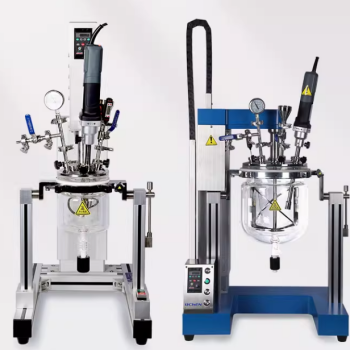
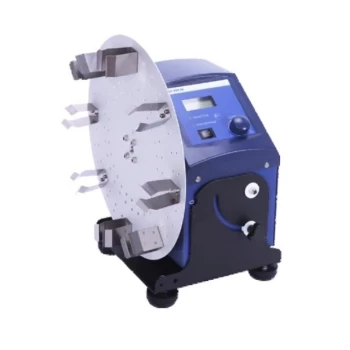
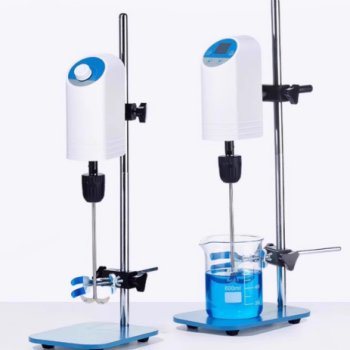
The use of an industrial-grade high-shear homogenizer is critical for overcoming physical mass transfer barriers. When anti-solvents are introduced to biomass pretreated with ionic liquids, the material tends to form dense, gel-like clumps that trap the ionic liquid inside. A high-shear homogenizer is necessary to physically pulverize these aggregates, ensuring that the ionic liquid can be fully washed out to prevent the failure of downstream processes.
Core Insight: Without the physical destruction of gel-like flocs, washing is superficial and ineffective. High-shear homogenization is the only reliable method to expose the internal surface area of the biomass, ensuring the removal of residual ionic liquids that would otherwise inhibit enzymatic catalysis.
The Physical Challenge: Why Simple Washing Fails
The Formation of Impermeable Aggregates
When biomass undergoes ionic liquid pretreatment, it does not remain a loose powder. Upon the addition of an anti-solvent like ethanol, the material undergoes a phase change, precipitating into gel-like or lumpy flocs.
The "Trapping" Effect
These gelatinous structures create a physical barrier. The ionic liquid used for pretreatment becomes trapped within the internal structure of these lumps.
Standard washing methods often fail to penetrate these dense aggregates, leaving a significant amount of ionic solvent hidden inside the biomass solids.
The Mechanism of High-Shear Homogenization
Physical Pulverization
An industrial-grade high-shear homogenizer applies intense mechanical force to the mixture. Its primary function is the physical pulverization of the solid aggregates.
Unlike simple stirring, which moves particles around, high-shear processing actively shatters the gel-like flocs into significantly smaller particles.
Maximizing Surface Area
By breaking down the lumps, the homogenizer drastically increases the contact surface area of the biomass.
This exposure is the prerequisite for effective diffusion. It transforms a few large, impenetrable clumps into a suspension of fine particles that interact fully with the wash solvent.
Critical Impact on Downstream Processing
Facilitating Complete Solvent Exchange
The ultimate goal of the washing phase is to replace the toxic ionic liquid with water.
High-shear homogenization ensures that the wash water can reach the core of the biomass material. This allows for the thorough replacement of the residual ionic liquid, which is impossible if the biomass remains agglomerated.
Preventing Enzymatic Inhibition
The necessity of this step is dictated by the sensitivity of the subsequent biological processes. Residual ionic liquids are potent inhibitors of enzymes.
If the washing is incomplete due to poor homogenization, the retained ionic liquid will inhibit enzymatic catalysis. This renders the entire pretreatment process useless by stalling the conversion of biomass into fermentable sugars.
Understanding the Trade-offs
Equipment Complexity vs. Process Success
Implementing high-shear homogenization adds mechanical complexity and energy consumption to the washing circuit compared to passive washing tanks.
However, this is a necessary trade-off. Attempting to save on equipment costs at this stage often results in a "false economy," where the downstream enzymatic hydrolysis fails due to toxicity.
Mechanical Stress and Heat
High-shear processing generates friction and heat. While the primary reference focuses on the necessity of pulverization, operators must ensure that the temperature remains controlled to avoid chemically altering the biomass components unintentionally during the wash.
Making the Right Choice for Your Process
Depending on your specific processing goals, here is how you should view the application of high-shear homogenization:
- If your primary focus is Maximum Yield: You must treat homogenization as mandatory; without it, residual inhibitors will suppress your enzyme activity and lower overall conversion rates.
- If your primary focus is Process Consistency: You should standardize the shear rate and duration to ensure that every batch of biomass achieves the same particle size and cleanliness profile.
In summary, the high-shear homogenizer is not merely a mixing tool, but a critical enabling technology that unlocks the reactive potential of pretreated biomass.
Summary Table:
| Feature | Passive Washing | High-Shear Homogenization |
|---|---|---|
| Material State | Dense, gel-like flocs | Fine, pulverized suspension |
| Mass Transfer | Restricted by physical barriers | Maximized via surface area exposure |
| Ionic Liquid Removal | Superficial/Incomplete | Thorough solvent exchange |
| Downstream Impact | High risk of enzyme inhibition | Optimized enzymatic catalysis |
| Process Success | Low/Inconsistent | High/Repeatable |
Optimize Your Biomass Conversion with KINTEK Precision
Don't let residual solvents stall your research or production. KINTEK specializes in high-performance laboratory equipment designed to overcome the toughest mass transfer challenges. From industrial-grade homogenizers that ensure complete ionic liquid removal to our comprehensive range of high-temperature reactors, autoclaves, and crushing systems, we provide the tools necessary for superior biomass pretreatment.
Maximize your yields and ensure enzymatic success—Contact KINTEK today for expert equipment solutions!
References
- Ling Liang, Ning Sun. Scale-up of biomass conversion using 1-ethyl-3-methylimidazolium acetate as the solvent. DOI: 10.1016/j.gee.2018.07.002
This article is also based on technical information from Kintek Solution Knowledge Base .
Related Products
- High Shear Homogenizer for Pharmaceutical and Cosmetic Applications
- High Performance Lab Homogenizer for Pharma Cosmetics and Food R&D
- Laboratory High Throughput Tissue Grinding Mill Grinder
- Lab Sterile Slapping Type Homogenizer for Tissue Mashing and Dispersing
- Laboratory Disc Rotary Mixer for Efficient Sample Mixing and Homogenization
People Also Ask
- Why Use a High Shear Homogenizer for Cathode Slurries? Optimize Double-Layer Solid-State Battery Production
- What is the function of high-shear dispersion equipment in corona-resistant nanocomposites? Elevate Your Insulation
- What are the advantages of using a high-shear homogenizer for BED/GMA coatings? Achieve Superior Nano-Dispersion
- What role does a high-shear homogenizer play in ODC catalyst suspensions? Unlock Superior Electrochemical Efficiency
- What functions do laboratory centrifuges and high-shear homogenizers perform? Optimize Your Nano-Modified Composites