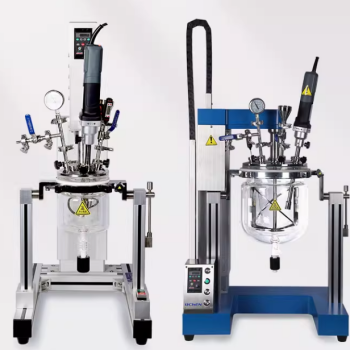
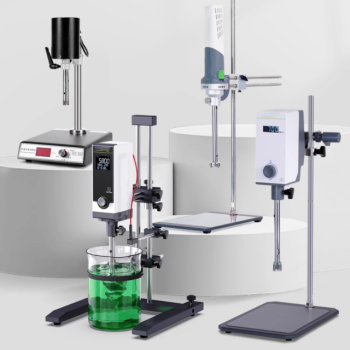
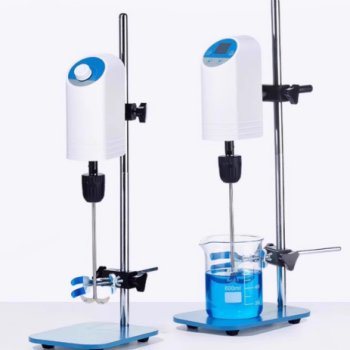
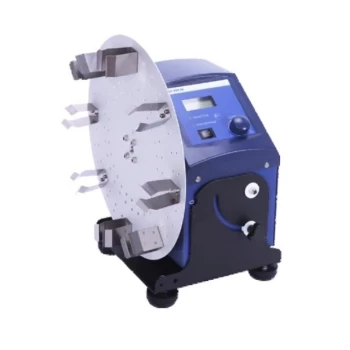
The primary function of high-performance homogenizers in SAPO-34 mixed matrix membrane (MMM) preparation is to apply high shear forces that uniformly distribute zeolite particles throughout a viscous polymer matrix.
This mechanical dispersion is the critical manufacturing step that breaks down particle clusters. By ensuring the SAPO-34 particles are evenly spread rather than clumped, the equipment facilitates the creation of a defect-free membrane structure capable of effective gas separation.
The core value of high-shear dispersion is the prevention of particle agglomeration. By forcing a uniform distribution, this process secures a strong interfacial bond between the filler and the polymer, which is strictly required to eliminate non-selective defects and enhance carbon dioxide permeability.
The Mechanics of Effective Dispersion
Overcoming Matrix Viscosity
Polymer casting solutions used for membranes are inherently viscous. Standard mixing methods often fail to penetrate these thick fluids effectively.
High-performance homogenizers utilize intense shear forces to cut through this viscosity. This ensures that the SAPO-34 zeolite particles are not just suspended, but are driven into a molecular-level distribution within the polymer.
Breaking Particle Agglomeration
Nanoparticles and zeolites like SAPO-34 possess high surface energy, creating a natural tendency for them to stick together, or agglomerate.
Homogenizers disrupt these attractive forces. Whether through mechanical shear or acoustic cavitation (in ultrasonic variations), the equipment physically forces these clusters apart to ensure individual particles are isolated and surrounded by the polymer.
Impact on Membrane Performance
Ensuring Interfacial Bonding
The ultimate success of a mixed matrix membrane depends on the interfacial bond—the point where the solid particle meets the polymer.
High-shear dispersion maximizes the surface area contact between the SAPO-34 and the matrix. A uniform dispersion ensures that the polymer chains can wrap around individual particles, creating a tight, cohesive seal.
Preventing Non-Selective Defects
When particles agglomerate, they create voids or "sieves" that allow all gases to pass through indiscriminately. These are known as non-selective defects.
By eliminating agglomeration, homogenizers ensure that gas transport occurs through the selective zeolite pores and the polymer, rather than through accidental gaps. This directly enhances the carbon dioxide permeability and selectivity of the final membrane.
Common Pitfalls to Avoid
The Risk of Micro-void Formation
If the dispersion equipment fails to generate sufficient shear force, "islands" of agglomerated particles will remain.
These clusters prevent the polymer from wetting the particle surface completely. This lack of adhesion leads to micro-voids, which compromise the membrane's structural integrity and separation efficiency.
Inconsistent Pore Distribution
Without high-performance homogenization, the distribution of SAPO-34 becomes random rather than uniform.
This results in unpredictable performance across the membrane surface. Areas with low particle concentration will lack permeability, while areas with high concentration (clumping) will likely suffer from mechanical instability or leaks.
Making the Right Choice for Your Goal
To ensure your SAPO-34 mixed matrix membranes perform as intended, apply the following principles:
- If your primary focus is CO2 Permeability: Ensure your dispersion protocol creates enough shear to fully separate particles, maximizing the active surface area available for gas transport.
- If your primary focus is Structural Integrity: Prioritize the elimination of agglomeration to prevent non-selective defects and ensure a robust polymer-particle interface.
Uniform dispersion is not merely a mixing step; it is the fundamental prerequisite for synthesizing high-performance gas separation membranes.
Summary Table:
| Feature of Homogenization | Impact on SAPO-34 MMM Preparation | Benefit to Membrane Performance |
|---|---|---|
| High Shear Force | Overcomes polymer matrix viscosity | Ensures molecular-level zeolite distribution |
| De-agglomeration | Breaks down zeolite particle clusters | Prevents non-selective defects and voids |
| Interfacial Bonding | Maximizes contact between filler and polymer | Enhances structural integrity and selectivity |
| Uniformity Control | Ensures consistent pore distribution | Provides predictable CO2 permeability across surface |
Elevate Your Membrane Research with KINTEK Precision
Achieving the perfect SAPO-34 distribution requires more than just mixing—it requires the intense shear and reliability of KINTEK high-performance homogenizers. Whether you are developing advanced gas separation membranes or specialized polymer composites, our lab equipment ensures a defect-free, uniform matrix every time.
Why choose KINTEK?
- Comprehensive Lab Solutions: From high-shear homogenizers and crushing systems to high-temperature vacuum furnaces and hydraulic pellet presses.
- Precision Engineering: Optimized for sensitive battery research, chemical synthesis, and material science.
- Expert Support: We provide the tools—including autoclaves, electrolytic cells, and essential ceramic consumables—to scale your innovation.
Ready to eliminate micro-voids and boost CO2 permeability? Contact our experts today to find the perfect homogenization solution for your lab!
References
- Ali Hosin Alibak, Babak Aghel. Developing a Hybrid Neuro-Fuzzy Method to Predict Carbon Dioxide (CO2) Permeability in Mixed Matrix Membranes Containing SAPO-34 Zeolite. DOI: 10.3390/membranes12111147
This article is also based on technical information from Kintek Solution Knowledge Base .
Related Products
- High Performance Lab Homogenizer for Pharma Cosmetics and Food R&D
- High Shear Homogenizer for Pharmaceutical and Cosmetic Applications
- Laboratory High Throughput Tissue Grinding Mill Grinder
- Lab Sterile Slapping Type Homogenizer for Tissue Mashing and Dispersing
- High Performance Laboratory Stirrers for Diverse Applications
People Also Ask
- Why is a high-performance homogenizer essential for Fe3O4@C9 anode slurries? Boost Battery Performance & Stability.
- How do lab stirrers & homogenizers ensure uniform distribution? Optimize Your Complex Multiphase Chemical Mixing
- What role does a laboratory homogenizer play in radioactive cesium detection? Ensure Accuracy in Wildlife Sampling
- How does a laboratory automatic masticator or homogenizer facilitate the processing of biofilm samples? Optimize Accuracy
- Why Use a High Shear Homogenizer for Cathode Slurries? Optimize Double-Layer Solid-State Battery Production