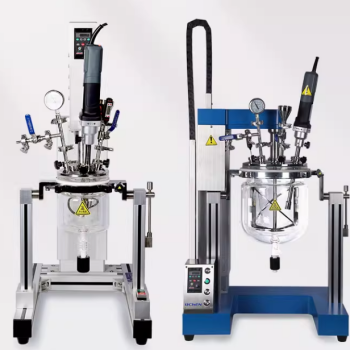
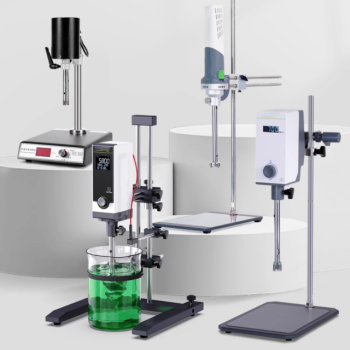
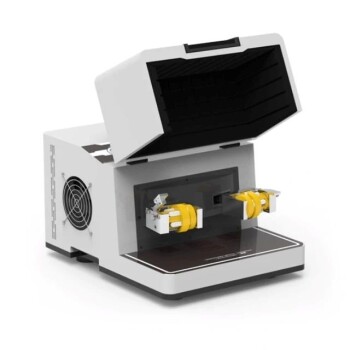
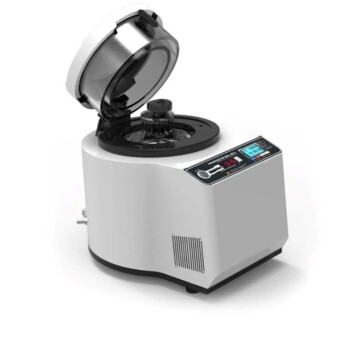
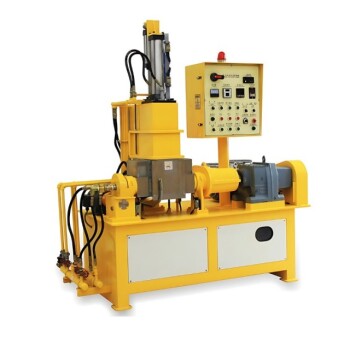
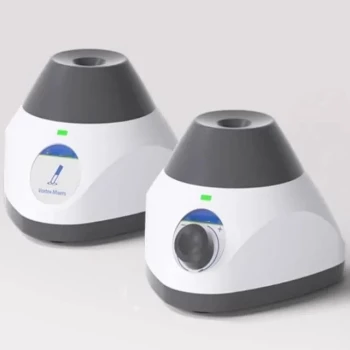
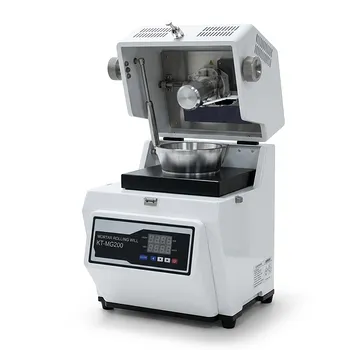
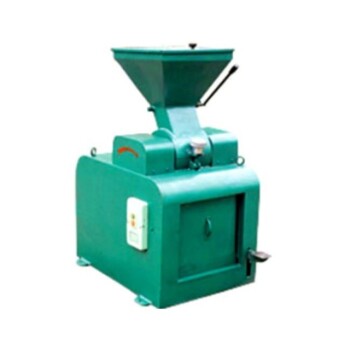
A laboratory homogenizer serves as the fundamental preparation tool for ensuring accurate radioactive cesium detection in wildlife tissue. By applying high-energy mechanical shear, it physically transforms irregular tissue samples—such as wild boar or deer—into a uniform mixture, preventing the physical composition of the meat from distorting analytical results.
The presence of "hotspots" in tissue leads to bad data. Without thorough homogenization, radioactive isotopes may be clustered in specific areas of a sample. The laboratory homogenizer eliminates these local concentration differences, ensuring the material placed in the Marinelli container is truly representative for gamma-ray spectroscopy.
The Science of Sample Preparation
High-Energy Mechanical Shear
To detect radiation accurately, the physical structure of the tissue must be broken down completely. A laboratory homogenizer uses high-energy mechanical shear to pulverize muscle and tissue fibers.
This process goes beyond simple mixing; it effectively destroys the cellular cohesion of tough wildlife meats. The result is a slurry or paste where every cubic centimeter contains a statistically similar composition to the rest of the sample.
Preparing for the Marinelli Container
Gamma-ray spectroscopy typically involves placing the sample into a specific vessel known as a Marinelli container. This container is designed to fit over the detector to maximize counting efficiency.
The homogenizer ensures that when the tissue is packed into this container, there are no air gaps or lumps. A consistent density across the entire volume of the container is vital for the detector to model the radiation geometry correctly.
Why Homogeneity Dictates Accuracy
Eliminating Local Concentration Differences
In wildlife, radioactive cesium may not be distributed evenly throughout muscle tissue. Some areas may have higher concentrations than others due to biological variances.
If a sample is analyzed without homogenization, the detector might measure a "hotspot" and overestimate the contamination, or measure a "cold spot" and underestimate it. The homogenizer eliminates these measurement errors by distributing the cesium atoms evenly throughout the sample matrix.
Enabling Quantitative Analysis
Qualitative analysis merely tells you if radiation is present; quantitative analysis tells you exactly how much is there.
For quantitative analysis to be valid, the sample must be homogeneous. The homogenizer provides the physical consistency required to trust the mathematical models used in gamma-ray spectroscopy.
Understanding the Risks of Inadequate Preparation
The Trap of False Variability
The primary pitfall in radiation testing is attributing a reading to the actual contamination level when it is actually a result of sample geometry.
If the tissue retains its original structure, the density varies across the sample. This leads to unpredictable attenuation of gamma rays within the sample itself. The detector cannot distinguish between low radiation and radiation that was simply blocked by a dense lump of un-homogenized meat.
Specific Challenges with Wildlife Tissue
Wildlife samples, such as deer or boar, often contain tough connective tissue and varying fat content.
Unlike softer laboratory samples, these tissues resist manual mixing. Relying on low-energy mixing methods often fails to break down these distinct tissue types, leaving local concentration gradients intact and compromising the validity of the final scan.
Making the Right Choice for Your Goal
To ensure your radioactive cesium detection provides actionable data, consider the following recommendations:
- If your primary focus is Quantitative Precision: You must prioritize high-energy shearing to ensure the sample density in the Marinelli container is perfectly uniform, eliminating geometry-based errors.
- If your primary focus is Analyzing Diverse Wildlife: Recognize that boar and deer tissues require more aggressive pulverization than standard samples to prevent local concentration differences from skewing results.
Data accuracy in spectroscopy begins not at the detector, but with the mechanical consistency of the sample preparation.
Summary Table:
| Feature | Role in Sample Preparation | Impact on Detection Accuracy |
|---|---|---|
| High-Energy Shear | Pulverizes muscle and connective fibers into a uniform slurry | Eliminates "hotspots" and local concentration differences |
| Physical Homogenization | Ensures consistent density throughout the sample matrix | Prevents unpredictable attenuation of gamma rays |
| Optimized Geometry | Facilitates seamless packing into Marinelli containers | Maximizes detector efficiency and geometric modeling |
| Quantitative Prep | Creates a statistically representative sample | Enables precise, reliable quantitative radiation analysis |
Elevate Your Analytical Precision with KINTEK
Don't let sample variability compromise your critical research. KINTEK specializes in advanced laboratory equipment designed for the most demanding sample preparation tasks. Our high-performance laboratory homogenizers ensure that tough wildlife tissues—from wild boar to deer—are perfectly prepared for gamma-ray spectroscopy, providing the homogeneity required for reliable quantitative results.
Beyond homogenization, KINTEK offers a comprehensive range of specialized laboratory solutions, including:
- High-Temperature Furnaces (Muffle, Tube, Vacuum, and more) for material processing.
- Crushing and Milling Systems for diverse sample types.
- Hydraulic Presses and High-Pressure Autoclaves for advanced material synthesis.
- Cooling Solutions (ULT Freezers, Freeze Dryers) to preserve sample integrity.
Ready to eliminate measurement errors and optimize your lab's workflow? Contact KINTEK today to discover how our premium equipment and consumables can enhance your laboratory's accuracy and efficiency.
References
- Magdalena Podolak, Anna Bielawska. Anticancer properties of novel Thiazolidinone derivatives tested in MDA-MB-231 breast cancer cell lines.. DOI: 10.21175/rad.abstr.book.2023.10.3
This article is also based on technical information from Kintek Solution Knowledge Base .
Related Products
- High Performance Lab Homogenizer for Pharma Cosmetics and Food R&D
- Lab Sterile Slapping Type Homogenizer for Tissue Mashing and Dispersing
- High Shear Homogenizer for Pharmaceutical and Cosmetic Applications
- Laboratory Disc Rotary Mixer for Efficient Sample Mixing and Homogenization
- Laboratory Hybrid Tissue Grinding Mill
People Also Ask
- Why is a high-performance homogenizer essential for Fe3O4@C9 anode slurries? Boost Battery Performance & Stability.
- What is the primary function of high-performance homogenizers for SAPO-34 MMMs? Ensure Superior Gas Separation Efficiency
- How do lab stirrers & homogenizers ensure uniform distribution? Optimize Your Complex Multiphase Chemical Mixing
- How does a laboratory automatic masticator or homogenizer facilitate the processing of biofilm samples? Optimize Accuracy
- Why Use a High Shear Homogenizer for Cathode Slurries? Optimize Double-Layer Solid-State Battery Production