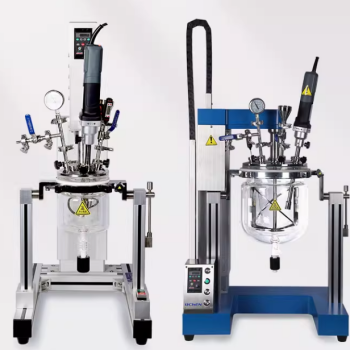
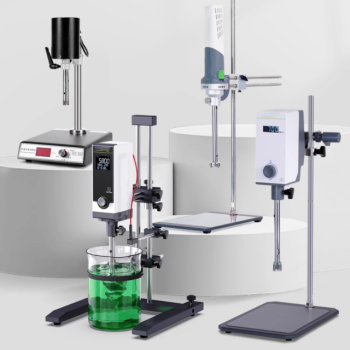
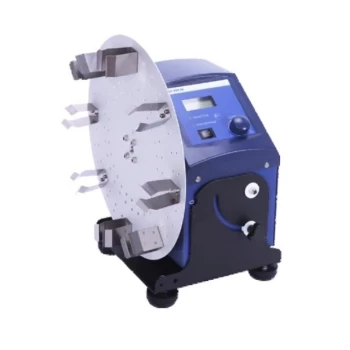
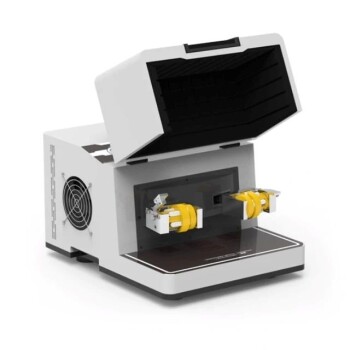
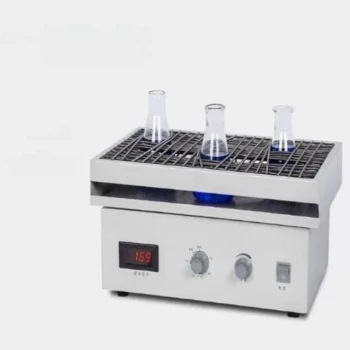
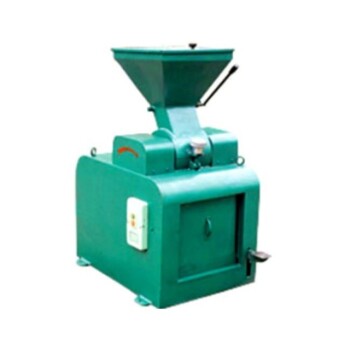
A laboratory automatic masticator or homogenizer facilitates biofilm processing by applying precise mechanical action to disperse samples collected from surfaces into a buffer solution. By physically breaking down the protective extracellular polymeric substance (EPS) matrix, these devices release embedded bacterial cells to create a uniform suspension essential for accurate quantitative analysis.
Biofilms are complex, adhesive structures that resist simple mixing. The automatic masticator bridges the gap between raw sample collection and data analysis by transforming clustered biomass into a homogenous suspension, ensuring that subsequent counts reflect the true bacterial population.
Breaking Down the Biofilm Structure
Dispersing Material from the Surface
Biofilm samples are typically collected on surfaces known as coupons. The primary role of the masticator is to mechanically dislodge the biological material from these coupons and disperse it into a liquid medium.
This process usually utilizes a standard buffer solution, such as phosphate-buffered saline (PBS), to maintain cell viability during the mechanical agitation.
Disrupting the EPS Matrix
The defining feature of a biofilm is the complex extracellular polymeric substance (EPS) matrix that binds bacteria together.
The homogenizer applies mechanical force specifically designed to break down this tough matrix. This action is critical for liberating the bacterial cells that are otherwise embedded and protected within the structure.
Improving Analytical Accuracy
Achieving Sample Uniformity
For any biological measurement to be valid, the sample must be consistent. Effective homogenization ensures that the released bacterial cells are distributed evenly throughout the buffer solution.
This uniformity eliminates the irregularities found in raw samples, creating a standardized suspension that represents the entire biofilm population.
Enabling Precise Enumeration
Once the sample is homogenized, it becomes suitable for sensitive downstream procedures.
The process directly increases the accuracy of methods such as serial dilution and heterotrophic plate counts (HPC). It also facilitates precise microscopic enumeration by presenting individual cells rather than opaque clusters.
Understanding the Trade-offs
The Risk of Under-Processing
If the mechanical action is insufficient, the EPS matrix may not fracture completely.
This results in bacterial cells remaining clumped together. In analytical terms, a cluster of hundreds of bacteria might appear as a single data point or colony, leading to a significant underestimation of the biomass.
Making the Right Choice for Your Goal
If your primary focus is Quantitative Accuracy:
- Prioritize homogenization to fully break down the EPS matrix, ensuring that colony counts represent individual cells rather than clusters.
If your primary focus is Process Standardization:
- Utilize an automatic masticator to ensure consistent mechanical dispersion of samples from coupons into the buffer, reducing human error.
Effective biofilm analysis relies on the ability to turn a static, complex structure into a fluid, measurable suspension.
Summary Table:
| Feature | Impact on Biofilm Processing | Benefit for Researchers |
|---|---|---|
| Mechanical Dispersion | Dislodges material from coupons into buffer | Ensures complete sample recovery from surfaces |
| EPS Matrix Disruption | Breaks down protective polymeric structures | Liberates embedded cells for true population counts |
| Sample Uniformity | Creates a consistent, homogenized suspension | Eliminates sampling bias and irregular data points |
| Analytical Precision | Enables accurate serial dilutions and HPC | Prevents underestimation of bacterial biomass |
Elevate Your Biofilm Research with KINTEK Precision
Accuracy in biofilm analysis starts with perfect sample preparation. KINTEK specializes in advanced laboratory equipment designed to handle the toughest samples, from crushing and milling systems to high-performance homogenizers and shakers. Whether you are disrupting complex EPS matrices or standardizing your dispersion process, our solutions ensure your data reflects reality.
Ready to achieve superior sample uniformity? Contact us today to explore our full range of laboratory solutions!
References
- Cansu Vatansever, İrfan Türetgen. Investigating the effects of different physical and chemical stress factors on microbial biofilm. DOI: 10.4314/wsa.v44i2.16
This article is also based on technical information from Kintek Solution Knowledge Base .
Related Products
- High Performance Lab Homogenizer for Pharma Cosmetics and Food R&D
- Lab Sterile Slapping Type Homogenizer for Tissue Mashing and Dispersing
- High Shear Homogenizer for Pharmaceutical and Cosmetic Applications
- Laboratory Disc Rotary Mixer for Efficient Sample Mixing and Homogenization
- Laboratory Hybrid Tissue Grinding Mill
People Also Ask
- Why is a high-performance homogenizer essential for Fe3O4@C9 anode slurries? Boost Battery Performance & Stability.
- What is the primary function of high-performance homogenizers for SAPO-34 MMMs? Ensure Superior Gas Separation Efficiency
- How do lab stirrers & homogenizers ensure uniform distribution? Optimize Your Complex Multiphase Chemical Mixing
- What role does a laboratory homogenizer play in radioactive cesium detection? Ensure Accuracy in Wildlife Sampling
- Why Use a High Shear Homogenizer for Cathode Slurries? Optimize Double-Layer Solid-State Battery Production