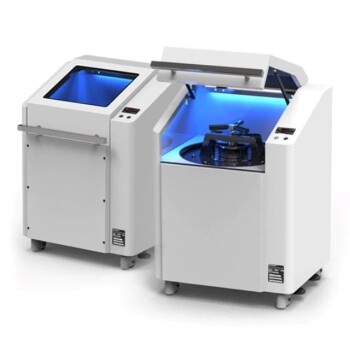
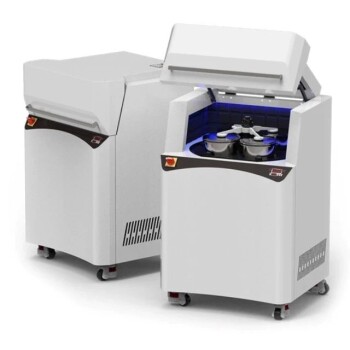
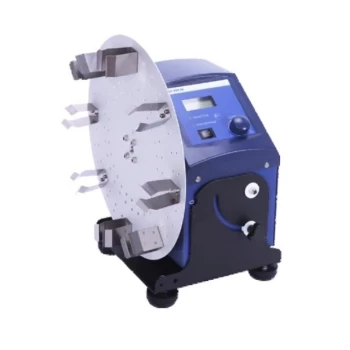
An industrial-grade disk mill serves as the primary tool for fine pulverization and homogenization of solid fuels. In the context of thermal analysis, its function is to reduce raw materials like brown coal and biomass into a fine, microscopic powder. This mechanical process ensures that the resulting fuel mixture has a standardized particle size distribution, which is essential for accurate laboratory measurement.
The primary role of a disk mill is to transform raw solid fuels into a micron-scale powder through mechanical shearing and impact. This process eliminates the influence of macroscopic particle size variations, ensuring the accuracy and reproducibility of thermal and elemental analyses.
Achieving Microscopic Uniformity
Reducing Particle Size for Standardization
The disk mill takes raw inputs, such as birch sawdust or coal (typically smaller than 10mm), and refines them into a consistent powder. This reduction to micron-scale fineness is vital for ensuring the sample represents the bulk material accurately.
The Mechanics of Shearing and Impact
These machines utilize mechanical shearing and impact forces to fracture tough, fibrous, or brittle materials. This combination allows for precise control over the final particle size distribution, which is a prerequisite for experimental repeatability.
Facilitating Homogeneous Mixtures
When preparing blends of different fuels, such as coal and biomass, the mill ensures microscopic uniformity. Without this level of refinement, the different materials would remain segregated, leading to inconsistent results during thermal testing.
Enhancing Analytical Precision
Increasing Specific Surface Area
Fine grinding dramatically increases the specific surface area of the fuel particles. A higher surface area ensures more uniform heat transfer and reactive contact during thermogravimetric and elemental analyses.
Eliminating Macroscopic Bias
By standardizing the feed to 1 mm or less, the mill removes the "noise" caused by macroscopic particle size differences. This ensures that the results of combustion characteristic experiments reflect the material's chemical properties rather than its physical dimensions.
Preparing Standardized Feeds
Beyond simple analysis, the disk mill provides a standardized feed for further modification processes. This is critical for downstream applications like torrefaction modification and pelletizing, where particle size influences structural integrity.
Understanding the Trade-offs
Thermal Degradation Risks
The intense friction inherent in disk milling can generate significant heat during the grinding process. If not managed, this localized temperature rise may cause premature devolatilization or thermal modification of sensitive biomass samples.
Material Cross-Contamination
Disk mills require rigorous cleaning between batches to prevent sample carryover. Residual particles from a previous run can skew the elemental analysis of the current fuel mixture, compromising data integrity.
Energy and Wear Considerations
Processing highly abrasive materials can lead to component wear, which might introduce trace metallic contaminants into the sample. Balancing throughput with the longevity of the grinding disks is a constant operational challenge.
Applying Milling Principles to Your Project
How to Apply This to Your Project
Proper mechanical pretreatment is the foundation of reliable thermal analysis, turning raw bulk materials into high-precision scientific data.
- If your primary focus is analytical accuracy: Process the material to a sub-1mm uniformity to maximize specific surface area and eliminate size-based combustion variables.
- If your primary focus is process standardization: Use the disk mill to create a consistent feed for subsequent torrefaction or pelletizing, ensuring predictable mechanical behavior.
- If your primary focus is sample integrity: Monitor the mill’s temperature during operation and implement strict cleaning protocols to prevent thermal degradation and cross-contamination.
Proper mechanical pretreatment is the foundation of reliable thermal analysis, turning raw bulk materials into high-precision scientific data.
Summary Table:
| Feature | Function in Sample Preparation | Impact on Thermal Analysis |
|---|---|---|
| Pulverization | Reduces raw fuel to <1mm micron-scale powder | Eliminates macroscopic size bias & noise |
| Shearing/Impact | Mechanical fracture of tough or fibrous biomass | Ensures standardized particle distribution |
| Homogenization | Microscopic blending of different fuel types | Guarantees representative & repeatable data |
| Surface Area | Drastically increases specific surface area | Enhances heat transfer & reactive contact |
Elevate Your Material Analysis with KINTEK Precision
Don't let inconsistent particle sizes compromise your research data. KINTEK specializes in high-performance crushing and milling systems, including industrial-grade disk mills designed to deliver the microscopic uniformity essential for accurate thermal and elemental analysis.
Whether you are preparing coal-biomass blends or optimizing feed for pelletizing, our robust laboratory equipment ensures repeatable results while minimizing contamination risks. Explore our full range of high-temperature furnaces, hydraulic presses, and grinding solutions tailored for demanding laboratory environments.
Ready to standardize your sample preparation? Contact our experts today to find the perfect milling solution for your project's specific needs!
References
- A. V. Zhuikov, S. G. Stepanov. Application a solid fuel mixture based on Bolshesyrsky lignite and birch wood waste in power plants. DOI: 10.21285/1814-3520-2023-2-310-321
This article is also based on technical information from Kintek Solution Knowledge Base .
Related Products
- Vibrating Disc Mill Small Laboratory Grinding Machine
- Laboratory Disc Cup Vibratory Mill for Sample Grinding
- Disc Cup Vibrating Mill Multi-Platform for Lab
- Laboratory Disc Rotary Mixer for Efficient Sample Mixing and Homogenization
People Also Ask
- What role do disc mills play in the wet or dry pretreatment of lignocellulosic waste? Scalable Biomass Solutions
- What is the function of a laboratory grinding mill? Achieve Precise Sample Preparation for Accurate Results
- What is the function of an industrial vibratory mill? Optimize Fe-Cr-Al Alloy Powder Production
- What laboratory apparatus is used for grinding? Match the Right Mill to Your Sample Material
- Why use stainless steel jars and balls for solid-state battery slurries? Maximize Dispersion and Conductivity