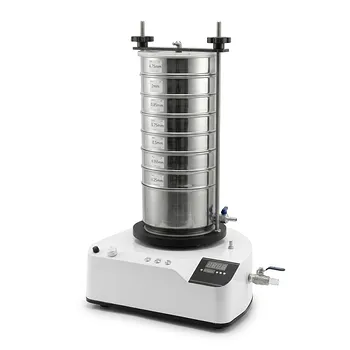
Knowledge What is the primary function of vibration milling in Heusler alloy preparation? Achieve High-Reactivity Fine Powders
Author avatar

Tech Team · Kintek Solution

Updated 1 day ago

What is the primary function of vibration milling in Heusler alloy preparation? Achieve High-Reactivity Fine Powders


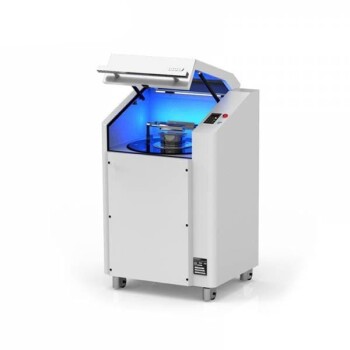
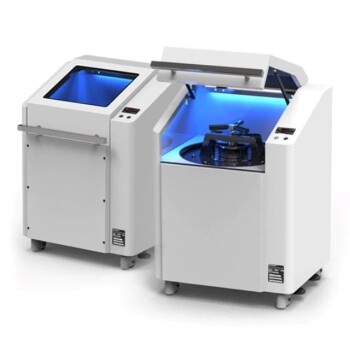
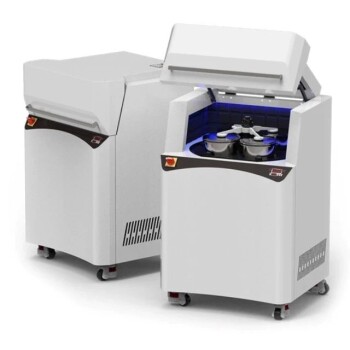
Vibration milling functions as the essential pulverization stage in the processing of Ni-Mn-Sn-In Heusler alloys, specifically transforming melt-spun ribbons into processable fine powders. By utilizing high-frequency impact forces, this method fractures the brittle ribbons into raw material powders that possess the specific particle sizes and high reactivity necessary for successful consolidation.

The core purpose of vibration milling is not merely size reduction; it is the activation of the material. By increasing the specific surface area of the powder, this process ensures the material is sufficiently reactive to undergo diffusion and densification during subsequent vacuum hot pressing sintering.

The Mechanics of Pulverization

Leveraging Impact Force

The primary mechanism driving this process is high-frequency vibration.

Unlike standard crushing, vibration milling generates intense impact forces. This kinetic energy is transferred to the material, causing rapid fracture and refinement.

Processing Brittle Morphologies

The input materials for this process are typically melt-spun ribbons.

These ribbons are inherently brittle. Vibration milling exploits this brittleness, effectively shattering the ribbon structure into a particulate form without the need for extreme thermal energy.

Achieving Micron-Scale Refinement

The ultimate physical goal is to reduce the material to a fine powder.

While specific durations vary, extended milling (similar to industrial standards of 32 hours for hard alloys) can reduce particles to micron-level sizes. This reduction is critical for the physical packing of the powder in later stages.

Why Reactivity Matters for Sintering

Increasing Specific Surface Area

As the particle size decreases, the specific surface area of the powder increases drastically.

This is the technical "value add" of the process. A larger surface area means more of the material is exposed and available for chemical and physical interaction.

Enhancing Diffusion Capabilities

The primary reference highlights the need for "high reactivity" for vacuum hot pressing.

In this context, reactivity refers to the powder's ability to diffuse. High-energy impact creates defects and fresh surfaces that accelerate atomic diffusion.

Ensuring Uniform Consolidation

The milled powder is a precursor, not the final product.

The high reactivity ensures that during the sintering phase, the components can diffuse sufficiently. This leads to a uniform solid solution and a structurally sound final alloy.

Understanding the Trade-offs

Pulverization vs. Mechanical Alloying

It is vital to distinguish between grinding and alloying.

In this specific application, the vibration mill is primarily used to pulverize an existing alloy (the ribbon). While high-energy ball milling can force elemental powders into a solid solution (mechanical alloying), the function here is focused on refining the physical state of the pre-alloyed ribbon to prepare it for sintering.

The Risk of Over-Processing

While high impact is necessary, it introduces energy into the material.

Operators must balance the need for fine particle size against the efficiency of the process. The goal is to achieve the necessary reactivity for sintering without expending unnecessary energy or introducing excessive contamination from the grinding media.

Making the Right Choice for Your Goal

To optimize the preparation of Ni-Mn-Sn-In alloys, align your milling parameters with your specific downstream requirements:

  • If your primary focus is Densification: Prioritize milling durations that achieve a particle size distribution optimized for packing during vacuum hot pressing.
  • If your primary focus is Chemical Homogeneity: Focus on achieving maximum specific surface area to facilitate rapid diffusion and uniform solid solution formation during sintering.

Vibration milling is the critical bridge that converts raw, brittle cast structures into highly active powders ready for high-performance consolidation.

Summary Table:

Feature Function in Ni-Mn-Sn-In Processing
Primary Mechanism High-frequency impact forces to fracture brittle melt-spun ribbons
Physical Goal Micron-scale refinement and increased specific surface area
Chemical Impact Activation of material to enhance atomic diffusion capabilities
Key Outcome Preparation of highly reactive precursors for vacuum hot pressing
Distinction Focus on pulverization/refinement rather than mechanical alloying

Elevate Your Advanced Material Synthesis with KINTEK

Precision in Ni-Mn-Sn-In Heusler alloy production demands high-performance equipment that ensures consistent particle size and reactivity. KINTEK specializes in the laboratory equipment and consumables essential for every stage of your research—from crushing and milling systems to vacuum hot pressing sintering support.

Our comprehensive portfolio includes:

  • High-Temperature Furnaces & Reactors: Muffle, tube, and vacuum systems for precise thermal processing.
  • Material Preparation: Advanced milling systems, sieving equipment, and hydraulic presses (pellet, hot, isostatic) for optimal powder consolidation.
  • Specialized Lab Tools: Homogenizers, shakers, and high-quality consumables like ceramics and crucibles.

Ready to optimize your powder metallurgy workflow? Contact our experts today to find the perfect solutions for your laboratory needs and ensure uniform, high-density results for your target customers.

Related Products

People Also Ask

Related Products

High Energy Planetary Ball Mill for Laboratory Horizontal Tank Type Milling Machine

High Energy Planetary Ball Mill for Laboratory Horizontal Tank Type Milling Machine

KT-P4000H uses the unique Y-axis planetary motion trajectory, and utilizes the collision, friction and gravity between the sample and the grinding ball to have a certain anti-sinking ability, which can obtain better grinding or mixing effects and further improve the sample output.

High Energy Planetary Ball Mill Milling Machine for Laboratory

High Energy Planetary Ball Mill Milling Machine for Laboratory

The biggest feature is that the high energy planetary ball mill can not only perform fast and effective grinding, but also has good crushing ability

Laboratory Ten-Body Horizontal Jar Mill for Lab Use

Laboratory Ten-Body Horizontal Jar Mill for Lab Use

The Ten-body horizontal jar mill is for 10 ball mill pots (3000ml or less). It has frequency conversion control, rubber roller movement, and PE protective cover.

Laboratory Vibratory Sieve Shaker Machine Slap Vibrating Sieve

Laboratory Vibratory Sieve Shaker Machine Slap Vibrating Sieve

KT-T200TAP is a slapping and oscillating sieving instrument for laboratory desktop use, with 300 rpm horizontal circular motion and 300 vertical slapping motions to simulate manual sieving to help sample particles pass through better.

Laboratory Vibratory Sieve Shaker Machine for Dry and Wet Three-Dimensional Sieving

Laboratory Vibratory Sieve Shaker Machine for Dry and Wet Three-Dimensional Sieving

KT-VD200 can be used for sieving tasks of dry and wet samples in the laboratory. The screening quality is 20g-3kg. The product is designed with a unique mechanical structure and an electromagnetic vibrating body with a vibration frequency of 3000 times per minute.

Vibratory Sieve Shaker Machine Dry Three-Dimensional Vibrating Sieve

Vibratory Sieve Shaker Machine Dry Three-Dimensional Vibrating Sieve

The KT-V200 product focuses on solving common sieving tasks in the laboratory. It is suitable for sieving 20g-3kg dry samples.

Laboratory Test Sieves and Vibratory Sieve Shaker Machine

Laboratory Test Sieves and Vibratory Sieve Shaker Machine

Efficiently process powders, granules, and small blocks with a high-frequency vibration sieve. Control vibration frequency, screen continuously or intermittently, and achieve accurate particle size determination, separation, and classification.

Small Lab Rubber Calendering Machine

Small Lab Rubber Calendering Machine

Small lab rubber calendering machine is used for producing thin, continuous sheets of plastic or rubber materials. It is commonly employed in laboratories, small-scale production facilities, and prototyping environments to create films, coatings, and laminates with precise thickness and surface finish.

HFCVD Machine System Equipment for Drawing Die Nano-Diamond Coating

HFCVD Machine System Equipment for Drawing Die Nano-Diamond Coating

The nano-diamond composite coating drawing die uses cemented carbide (WC-Co) as the substrate, and uses the chemical vapor phase method ( CVD method for short ) to coat the conventional diamond and nano-diamond composite coating on the surface of the inner hole of the mold.

Automatic Laboratory Hydraulic Pellet Press Machine for Lab Use

Automatic Laboratory Hydraulic Pellet Press Machine for Lab Use

Experience efficient sample preparation with our Automatic Lab Press Machine. Ideal for material research, pharmacy, ceramics, and more. Features a compact size and hydraulic press functionality with heating plates. Available in various sizes.

Benchtop Laboratory Freeze Dryer for Lab Use

Benchtop Laboratory Freeze Dryer for Lab Use

Premium benchtop laboratory freeze dryer for lyophilization, preserving samples with ≤ -60°C cooling. Ideal for pharmaceuticals & research.

Vacuum Hot Press Furnace Machine for Lamination and Heating

Vacuum Hot Press Furnace Machine for Lamination and Heating

Experience clean and precise lamination with Vacuum Lamination Press. Perfect for wafer bonding, thin-film transformations, and LCP lamination. Order now!

Single Punch Electric Tablet Press Machine TDP Tablet Punching Machine

Single Punch Electric Tablet Press Machine TDP Tablet Punching Machine

The electric tablet punching machine is a laboratory equipment designed for pressing various granular and powdery raw materials into discs and other geometric shapes. It is commonly used in pharmaceutical, healthcare products, food, and other industries for small batch production and processing. The machine is compact, lightweight, and easy to operate, making it suitable for use in clinics, schools, laboratories, and research units.

Automatic Heated Hydraulic Press Machine with Heated Plates for Laboratory Hot Press 25T 30T 50T

Automatic Heated Hydraulic Press Machine with Heated Plates for Laboratory Hot Press 25T 30T 50T

Efficiently prepare your samples with our Automatic Heated Lab Press. With a pressure range up to 50T and precise control, it's perfect for various industries.

Lab Plastic PVC Calender Stretch Film Casting Machine for Film Testing

Lab Plastic PVC Calender Stretch Film Casting Machine for Film Testing

The cast film machine is designed for the molding of polymer cast film products and has multiple processing functions such as casting, extrusion, stretching, and compounding.

Single Punch Tablet Press Machine and Mass Production Rotary Tablet Punching Machine for TDP

Single Punch Tablet Press Machine and Mass Production Rotary Tablet Punching Machine for TDP

Rotary tablet punching machine is an automatic rotating and continuous tableting machine. It is mainly used for tablet manufacturing in the pharmaceutical industry, and is also suitable for industrial sectors such as food, chemicals, batteries, electronics, ceramics, etc. to compress granular raw materials into tablets.

Electric Split Lab Cold Isostatic Press CIP Machine for Cold Isostatic Pressing

Electric Split Lab Cold Isostatic Press CIP Machine for Cold Isostatic Pressing

Split cold isostatic presses are capable of providing higher pressures, making them suitable for testing applications that require high pressure levels.

Heated Hydraulic Press Machine with Integrated Manual Heated Plates for Lab Use

Heated Hydraulic Press Machine with Integrated Manual Heated Plates for Lab Use

Efficiently process heat-pressing samples with our Integrated Manual Heated Lab Press. With a heating range up to 500°C, it's perfect for various industries.

Small Injection Molding Machine for Lab Use

Small Injection Molding Machine for Lab Use

The small injection molding machinehas fast and stable movements; good controllability and repeatability, super energy saving; the product can be automatically dropped and formed; the machine body is low, convenient for feeding, easy to maintain, and no height restrictions on the installation site.

Manual High Temperature Heated Hydraulic Press Machine with Heated Plates for Lab

Manual High Temperature Heated Hydraulic Press Machine with Heated Plates for Lab

The High Temperature Hot Press is a machine specifically designed for pressing, sintering and processing materials in a high temperature environment. It is capable of operating in the range of hundreds of degrees Celsius to thousands of degrees Celsius for a variety of high temperature process requirements.


Leave Your Message