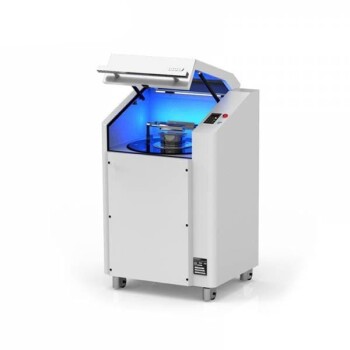
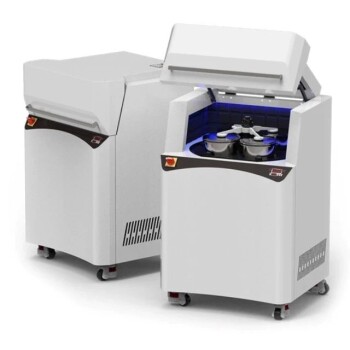
The primary function of a laboratory vibratory mill in this context is to perform the precise micronization of bulk or coarse Cs-aluminosilicate materials following heat treatment. Through controlled grinding durations, the mill reduces these materials to a strict, uniform particle size range of 1 to 5 µm.
Core Takeaway While the mechanical action reduces particle size, the strategic goal is consistency. By standardizing the particle size to 1–5 µm, the mill eliminates variations in specific surface area, ensuring that subsequent physicochemical analyses and moisture adsorption experiments yield accurate, comparable data.
The Mechanics of Processing
Achieving Micron-Scale Precision
The vibratory mill is not designed for mere crushing; it is a precision instrument for micronization. Its objective is to take coarse material and reduce it to a specific target window of 1 to 5 µm.
Timing and Control
Achieving this specific size range requires precise control over the grinding duration. The operator must modulate how long the material is subjected to the vibratory forces to prevent under-grinding or over-refining.
Post-Heat Treatment Processing
It is critical to note where this fits in the workflow. This milling step is specifically applied after the Cs-aluminosilicate materials have undergone heat treatment, preparing the altered bulk material for final analysis.
The Scientific Necessity
Standardizing Specific Surface Area
In powder analysis, particle size is directly correlated with specific surface area. By homogenizing the particle size, the vibratory mill ensures that the surface area available for chemical reactions or physical interactions is constant across samples.
Impact on Adsorption Performance
The ultimate goal of this standardization is to support physicochemical analysis. Specifically, it facilitates long-term moisture exposure experiments.
By minimizing surface area variations, researchers ensure that any observed changes in adsorption performance are due to material properties, not inconsistent grinding.
Operational Versatility
Adaptability of Milling Modes
Beyond the specific processing of Cs-aluminosilicate, these mills offer operational flexibility. They are capable of performing both dry and wet ball milling, allowing researchers to adapt the environment to the specific chemical stability of the powder.
Efficiency and Handling
The equipment is designed for high efficiency in a small footprint. It is lightweight and compact, making it suitable for laboratory environments where space is at a premium.
Ease of Maintenance
Reliability is a key feature of these mills. They are engineered to be simple to operate and, crucially, easy to clean, which prevents cross-contamination between different sample batches.
Critical Considerations and Trade-offs
The Risk of Incorrect Duration
The primary reference emphasizes the need for "precisely controlling the grinding duration." If the milling time is too short, the material remains too coarse; if too long, it may become too fine.
Deviating from the 1–5 µm range alters the specific surface area, which will skew the adsorption data and render the physicochemical analysis invalid.
Customization vs. Standardization
While the supplementary data suggests these mills can be "customized according to specific requirements," this adds a layer of complexity.
In the context of Cs-aluminosilicate analysis, standardization is more valuable than customization. Altering the mill's configuration could introduce variables that make it difficult to replicate the standard 1–5 µm particle distribution.
Ensuring Analytical Success
To maximize the utility of a laboratory vibratory mill for your specific Cs-aluminosilicate projects, consider the following:
- If your primary focus is Data Accuracy: Strictly calibrate grinding duration to ensure particles fall exactly within the 1–5 µm range to minimize surface area variables.
- If your primary focus is Workflow Efficiency: Leverage the mill's easy-to-clean design and wet/dry capabilities to process multiple sample types without significant downtime.
Consistency in your milling process is the single most controllable factor in guaranteeing the reliability of your moisture adsorption data.
Summary Table:
| Feature | Specification/Benefit |
|---|---|
| Target Particle Size | 1 to 5 µm (Micronization) |
| Processing Stage | Post-heat treatment of Cs-aluminosilicate |
| Primary Goal | Standardize specific surface area for data accuracy |
| Milling Modes | Dry and wet ball milling capability |
| Key Advantages | High efficiency, easy cleaning, and compact footprint |
| Critical Factor | Precise control of grinding duration |
Optimize Your Sample Preparation with KINTEK Precision
Ensure your analytical data is never compromised by inconsistent particle sizes. KINTEK specializes in high-performance laboratory equipment, including advanced crushing and milling systems and sieving equipment designed to meet the rigorous demands of material science.
Whether you are processing Cs-aluminosilicate or conducting advanced battery research, our portfolio—from high-temperature furnaces and vacuum reactors to PTFE consumables and cooling solutions—provides the reliability your lab requires.
Ready to achieve superior homogenization and micron-scale precision? Contact KINTEK today to discover how our experts can streamline your workflow and enhance your research outcomes.
References
- Guido Cerri, Antonio Brundu. A Six-Year Hydration Evaluation of Cs-Bearing Materials at Room Temperature and 55% Relative Humidity Simulating Radioactive Waste with Different Crystallinities. DOI: 10.3390/molecules29061302
This article is also based on technical information from Kintek Solution Knowledge Base .
Related Products
- Lab Vibration Mill
- Laboratory Disc Cup Vibratory Mill for Sample Grinding
- High Energy Vibratory Laboratory Ball Mill Double Tank Type
- Vibrating Disc Mill Small Laboratory Grinding Machine
- High Energy Vibratory Laboratory Ball Mill Grinding Mill Single Tank Type
People Also Ask
- What are the different types of laboratory mills? Choose the Right Grinder for Your Sample Material
- What is use for grinding in the laboratory? Select the Right Mill for Accurate Sample Prep
- What is the function of an industrial vibratory mill? Optimize Fe-Cr-Al Alloy Powder Production
- What role does a vibration mill play in Zeta potential measurements? Prepare Ultrafine Samples for Accurate Analysis
- What is the function of a laboratory grinding mill? Achieve Precise Sample Preparation for Accurate Results