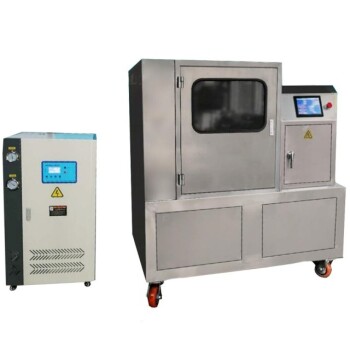
Vibratory ball mills operate by utilizing high-frequency vibration to drive grinding media, delivering highly concentrated energy per impact rather than the centrifugal and shear forces characteristic of planetary milling. While planetary mills rely on complex rotational movements to generate heavy shear and impact for inorganic alloying, vibratory mills focus on high-frequency energy transfer, making them uniquely suited for specific chemical transformations.
Core Takeaway The choice between these technologies depends on the nature of the target material. Vibratory mills provide high-frequency, concentrated energy impacts ideal for precise organic transformations and cocrystal formation. In contrast, planetary mills generate intense shear and centrifugal forces, making them the superior choice for breaking down hard inorganic lattices, synthesizing solid-state electrolytes, and mechanical alloying.
Technical Mechanics of Vibratory Milling
The Driver: High-Frequency Vibration
Unlike rotational mills, vibratory ball mills do not rely on centrifugal force. Instead, they utilize high-frequency vibration to agitate the grinding jar.
This mechanism causes the grinding media to move rapidly, resulting in an extremely high frequency of impacts against the sample material.
Energy Transfer and Density
The efficiency of a vibratory mill is governed by two main variables: the vibration frequency and the mass density of the grinding balls.
Because the energy is highly concentrated per impact, these mills allow for fine-tuning of the kinetic energy input. This makes them highly effective for experiments where the reaction conditions must be strictly controlled to prevent degradation or unwanted side reactions.
Technical Mechanics of Planetary Milling
The Driver: Dual-Axis Rotation
Planetary ball mills create a high-energy environment through a complex motion: the grinding jars rotate around a central axis (revolution) while simultaneously spinning on their own axes in the opposite direction.
The Forces: Shear and Impact
This counter-rotation generates intense centrifugal forces.
The grinding media is subjected to both high-frequency impacts (collision) and strong shear forces (friction). This combination is critical for breaking down solid particles, reducing particle size, and forcing the reorganization of chemical bonds in hard materials.
Applications in Mechanochemical Synthesis
Vibratory Mills: Organic and Sensitive Synthesis
Due to their precise energy input, vibratory mills are the standard for organic mechanochemistry.
They are frequently employed to induce cocrystal formation, where distinct molecular entities are combined into a single crystalline lattice. They are also preferred for performing precise organic transformations where high shear might damage the molecular structure.
Planetary Mills: Inorganic and Solid-State Synthesis
Planetary mills are the workhorses for high-energy inorganic synthesis.
They are extensively used to synthesize solid-state electrolytes (such as halides and sulfides like Li6PS5Br). The intense energy allows for solid-phase reactions at room temperature, often eliminating the need for high-temperature sintering.
Additionally, they are used for lithium-containing ceramics and mechanical alloying. The shear forces achieve atomic-scale mixing and uniform refinement, creating the necessary precursors for phase formation.
Understanding the Trade-offs
Precision vs. Brute Force
Vibratory mills offer precision. They excel when the goal is a specific molecular arrangement or when handling "soft" organic materials that require high impact frequency but less shear.
Planetary mills offer power. The inclusion of strong shear forces makes them more effective for "hard" chemistry—breaking down crystal lattices of metals and ceramics or forcing alloys to form.
Temperature and Sintering Implications
A distinct advantage of planetary milling in inorganic chemistry is the potential to bypass thermal processing.
For materials like argyrodite-type electrolytes, planetary milling can synthesize the final face-centered cubic (fcc) structure directly. Vibratory mills may not always provide the specific type of shear energy required to drive these solid-state lattice changes without subsequent heating.
Making the Right Choice for Your Goal
Select the milling technology that aligns with the structural integrity of your reagents and your desired end product.
- If your primary focus is Organic Synthesis or Cocrystallization: Choose a vibratory ball mill to leverage high-frequency impacts for precise transformations without excessive shear.
- If your primary focus is Inorganic Ceramics or Solid-State Electrolytes: Choose a planetary ball mill to utilize high-energy shear forces for atomic-scale mixing and room-temperature phase synthesis.
Summary: Use vibratory mills for the delicate precision required by organic chemistry, and reserve planetary mills for the high-energy shear required to restructure inorganic lattices.
Summary Table:
| Feature | Vibratory Ball Mill | Planetary Ball Mill |
|---|---|---|
| Primary Driver | High-frequency vibration | Dual-axis counter-rotation |
| Main Forces | High-frequency impact | Centrifugal, shear, and impact |
| Energy Focus | Precision energy transfer | Intense "brute force" energy |
| Best For | Organic synthesis, cocrystal formation | Inorganic alloying, solid-state electrolytes |
| Material Type | Sensitive or "soft" organic molecules | Hard ceramics, metals, and minerals |
| Key Benefit | Controlled kinetic energy input | Room-temperature phase synthesis |
Elevate Your Synthesis Precision with KINTEK
Whether you are performing delicate organic mechanochemistry or high-energy solid-state electrolyte synthesis, choosing the right milling technology is critical for your research success. KINTEK specializes in advanced laboratory equipment, providing high-performance crushing and milling systems tailored to your specific material needs.
From high-frequency vibratory mills for precise transformations to powerful planetary mills for atomic-scale mixing, our experts help you optimize your workflows. We also offer a comprehensive range of laboratory equipment, including high-temperature furnaces, hydraulic presses, and specialized consumables like ceramics and crucibles to support your entire experimental lifecycle.
Ready to achieve superior particle size reduction and chemical transformation? Contact KINTEK Today to Find Your Perfect Milling Solution!
References
- Adam A.L. Michalchuk, Vladimir V. Boldyrev. Tribochemistry, Mechanical Alloying, Mechanochemistry: What is in a Name?. DOI: 10.3389/fchem.2021.685789
This article is also based on technical information from Kintek Solution Knowledge Base .
Related Products
- Hybrid High Energy Vibratory Ball Mill for Lab Use
- High Energy Vibratory Ball Mill for Lab Use
- High Energy Vibratory Laboratory Ball Mill Double Tank Type
- High Energy Vibratory Laboratory Ball Mill Grinding Mill Single Tank Type
- Lab Vibration Mill
People Also Ask
- What is the core function of a high-energy vibratory ball mill? Unlock Advanced Mechanochemical Synthesis
- What is the function of a high-energy ball mill in the synthesis of amorphous NaTaCl6? Optimize Your Ion Conductivity
- What is the role of a high-energy ball mill in battery material prep? Optimize Nanostructuring for Li-ion Performance
- What physical conditions do high-energy ball mills provide? Optimize Catalyst Synthesis via Mechanical Activation
- What is the function of a high-energy ball mill in the preparation of Ti2448 medical alloys? Key Roles Explained