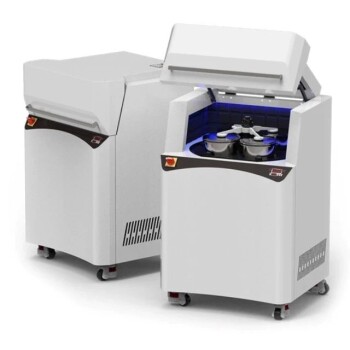
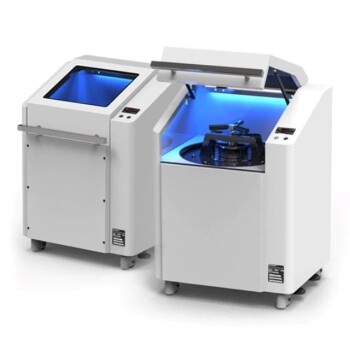
The core function of the high-energy vibratory ball mill in this specific context is to act as a high-density energy source that induces mechanochemical reactions. Through high-energy impacts, the mill refines and alloys the raw Fe-Cr-Ni-Mn-N powders while simultaneously forcing nitrogen atoms into the metal crystal lattice. This process creates a solid solution with a supersaturated concentration, enabling synthesis at room temperature.
The vibratory mill serves as the primary power source for non-equilibrium synthesis, utilizing intense impact energy to drive atomic-level mixing and nitrogen supersaturation that is chemically difficult to achieve through standard thermal processing.
The Mechanics of High-Energy Alloying
Inducing Mechanochemical Reactions
The mill does far more than simply mix or grind materials; it initiates mechanochemical synthesis. By delivering high-density energy directly to the powder mixture, the equipment overcomes the activation energy barriers required for chemical changes. This allows for the creation of complex alloy structures without the need for external heating.
Atomic-Level Refinement and Alloying
Through continuous high-frequency vibration, the mill subjects the powders to intense impact and friction. This mechanical force drives the refinement of the raw powder particles, breaking them down to increase their specific surface area. Simultaneously, it facilitates alloying, where the distinct elements (Iron, Chromium, Nickel, Manganese) are mechanically mixed until they achieve chemical uniformity.
Forcing Nitrogen into the Lattice
A critical function specific to Fe-Cr-Ni-Mn-N powders is the handling of nitrogen. The high-energy impact generated by the mill physically forces nitrogen atoms into the metallic crystal lattice. This results in the formation of a solid solution with a supersaturated concentration of nitrogen, a state that significantly alters the material's properties and stability.
Understanding the Trade-offs
Energy Intensity vs. Contamination
While the high-density energy is necessary for inducing reactions and forcing nitrogen alloying, it places extreme stress on the milling media. The Risk: Extended processing times required for supersaturation can lead to contamination from the milling jar and balls (e.g., iron contamination), which may alter the final alloy composition.
Non-Equilibrium Stability
The mill creates "non-equilibrium" materials, meaning they are chemically metastable. The Implication: While this allows for unique properties (like high nitrogen content), these microstructures can be sensitive to subsequent thermal treatments, potentially leading to unwanted phase precipitation if not managed correctly during sintering or consolidation.
Making the Right Choice for Your Goal
To maximize the efficacy of the vibratory ball mill for your specific project, consider these focal points:
- If your primary focus is Nitrogen Content: Prioritize milling parameters (frequency and time) that maximize impact energy to ensure the nitrogen is fully forced into the supersaturated solid solution.
- If your primary focus is Particle Refinement: Monitor the process to balance the reduction of particle size against the risk of agglomeration, ensuring the high surface area translates to better sintering activity later.
The vibratory ball mill is not just a grinder; it is a reactor that uses kinetic energy to engineer the atomic structure of your alloy.
Summary Table:
| Feature | Function in Mechanical Alloying |
|---|---|
| Energy Source | Acts as a high-density energy reactor to overcome activation barriers |
| Particle Refinement | Uses high-frequency vibration to reduce powders to sub-micron levels |
| Alloying Process | Achieves atomic-level mixing of Fe, Cr, Ni, and Mn at room temperature |
| Nitrogen Integration | Forces nitrogen atoms into the metal crystal lattice for supersaturation |
| Synthesis Type | Enables non-equilibrium synthesis for metastable materials |
Elevate Your Materials Synthesis with KINTEK
Precision in mechanical alloying requires equipment that can withstand the rigors of high-density energy transfer. KINTEK specializes in advanced laboratory solutions, including high-performance crushing and milling systems designed for the most demanding mechanochemical reactions.
Whether you are refining complex Fe-Cr-Ni-Mn-N alloys or exploring new frontiers in battery research, our comprehensive range of vibratory mills, hydraulic presses, and high-temperature furnaces provides the reliability your research demands.
Ready to achieve superior powder refinement and nitrogen supersaturation? Contact us today to discover how KINTEK’s expert-grade laboratory equipment can streamline your synthesis process.
References
- Anatoly Popovich, Evgeniy L. Gulihandanov. Development of Fe-Cr-Ni-Mn-N High-Alloyed Powder Processed by Mechanical Alloying. DOI: 10.4236/ojmetal.2013.32a2004
This article is also based on technical information from Kintek Solution Knowledge Base .
Related Products
- High Energy Vibratory Ball Mill for Lab Use
- Hybrid High Energy Vibratory Ball Mill for Lab Use
- High Energy Vibratory Laboratory Ball Mill Double Tank Type
- High Energy Vibratory Laboratory Ball Mill Grinding Mill Single Tank Type
- High Energy Planetary Ball Mill Milling Machine for Laboratory
People Also Ask
- What is the role of a high-energy ball mill in Al/Si/Al2O3/SiO2/MWCNTs nanocomposites? Master Powder Pretreatment
- How is a high-energy ball mill utilized in the dry-process preparation of composite electrolytes? | KINTEK
- What is the function of a high-energy ball mill in the preparation of nanoparticle-reinforced steel? | KINTEK
- Why is a high-energy ball mill used in the preparation of NTP electrode slurries? Maximize Conductivity & Performance
- What is the role of a high-energy ball mill in battery material prep? Optimize Nanostructuring for Li-ion Performance