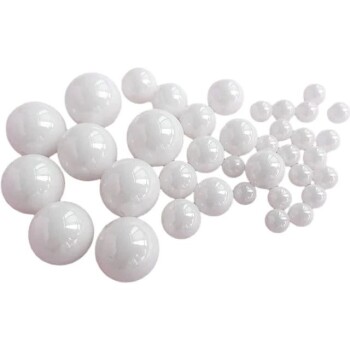
High-density zirconia grinding balls function as the primary energy transfer medium to achieve uniform dispersion and facilitate critical chemical modifications in silicon carbide ceramic membrane slurries. In the ball milling stage, these balls use high-energy impact to break down powder agglomerates and mix micron-sized silicon carbide, pore-forming agents, and binders. Beyond physical mixing, they introduce trace amounts of zirconium that ultimately transform into zirconium dioxide, which enhances the membrane's hydrophilicity and structural integrity.
Core Takeaway: Zirconia grinding balls provide the necessary kinetic energy for physical homogenization while simultaneously acting as a beneficial "dopant" source that improves the surface chemistry and mechanical strength of the final silicon carbide membrane.
Achieving Uniform Dispersion and Homogenization
High-Energy Impact and Deagglomeration
High-density zirconia balls are selected for their ability to generate significant collision energy during the milling process. This energy is essential to break up powder agglomerates and ensure that micron-sized silicon carbide, pore-forming agents, and binders are distributed evenly throughout the slurry.
Without this high-energy impact, the slurry would suffer from poor consistency, leading to defects in the final ceramic membrane structure. The high hardness of the zirconia ensures that the balls maintain their shape and efficiency over long milling cycles.
Optimizing Slurry Rheology and Stability
The mechanical action of the grinding media directly influences the particle size distribution within the slurry. Proper distribution is critical for achieving the desired viscosity and flow characteristics required for coating or shaping processes.
By providing stable shear forces, zirconia balls help create a stable suspension. This prevents the premature settling of heavy silicon carbide particles, ensuring the slurry remains workable for extended periods.
Enhancing Material Properties through Trace Introduction
The Chemical Evolution of Zirconium
Unlike many applications where media wear is purely detrimental, the preparation of silicon carbide membranes utilizes trace wear to its advantage. During grinding, minute amounts of zirconium are introduced into the mixture.
These trace elements react to form zirconium carbide (ZrC) during the initial stages. During subsequent post-oxidation heat treatments, this zirconium carbide transforms into zirconium dioxide ($ZrO_2$), integrating directly into the membrane framework.
Hydrophilic Modification and Structural Reinforcement
The resulting zirconium dioxide plays a vital role in the hydrophilic modification of the silicon carbide surface. This makes the membrane more effective at attracting water, which is a critical performance metric for filtration applications.
Furthermore, the presence of these zirconium compounds contributes to the structural reinforcement of the ceramic matrix. This secondary phase helps bridge gaps and strengthen the bond between silicon carbide grains, increasing the overall durability of the membrane.
Understanding the Trade-offs
Media Wear vs. Chemical Purity
While the introduction of zirconium is beneficial in this specific silicon carbide context, it represents a calculated contamination. In other ceramic processes, such as the production of high-purity RBSN substrates, any media wear is viewed as an impurity that could degrade thermal conductivity.
Density and Energy Efficiency
The high density of zirconia allows for faster processing times but requires equipment capable of handling the increased mechanical load. Using media that is too dense for a specific mill can lead to excessive heat generation or damage to the mill lining.
Matching Media to Material
To maintain chemical integrity, the grinding media should ideally match the ceramic system as closely as possible. Using zirconia balls for silicon carbide is a strategic choice because the resulting byproduct ($ZrO_2$) is functional rather than purely a contaminant.
How to Apply This to Your Project
When selecting or utilizing zirconia grinding media for ceramic slurry preparation, consider the following strategic alignments:
- If your primary focus is filtration efficiency: Ensure the post-oxidation process is optimized to fully convert introduced zirconium into hydrophilic zirconium dioxide.
- If your primary focus is mechanical durability: Utilize higher-density balls to maximize the impact energy, ensuring a denser packing of the micron-sized particles before sintering.
- If your primary focus is preventing foreign contamination: Choose high-purity Yttria-Stabilized Zirconia (YSZ) to ensure that only zirconium—and no metallic ions—is introduced into the slurry.
By treating the grinding media as both a mechanical tool and a chemical additive, manufacturers can significantly enhance the performance of silicon carbide ceramic membranes.
Summary Table:
| Function | Mechanism | Impact on SiC Membrane |
|---|---|---|
| Homogenization | High-energy impact | Breaks agglomerates and ensures slurry consistency. |
| Rheology Control | Shear force stabilization | Optimizes viscosity and prevents particle settling. |
| Chemical Modification | Trace Zr introduction | Transforms to $ZrO_2$, enhancing surface hydrophilicity. |
| Reinforcement | Secondary phase formation | Bridges gaps between grains to increase mechanical strength. |
Elevate Your Ceramic Research with KINTEK Precision
Maximize the performance of your silicon carbide membranes with KINTEK’s industry-leading laboratory solutions. Whether you need high-purity zirconia grinding media, advanced crushing and milling systems, or precision high-temperature furnaces (Muffle, Vacuum, CVD) to finalize your ceramic structures, we provide the technical edge your project demands.
Why partner with KINTEK?
- Comprehensive Portfolio: From hydraulic pellet presses to specialized electrolytic cells.
- Quality Assurance: High-durability ceramics and crucibles designed for rigorous thermal processing.
- Expert Support: Tailored equipment recommendations to optimize your specific slurry rheology and sintering workflows.
Contact KINTEK today to optimize your laboratory workflow!
References
- Liqun Hu, Jinjie Wang. Effect of Post-Oxidation Treatment on the Performance and Microstructure of Silicon Carbide Ceramic Membrane. DOI: 10.3390/coatings13050957
This article is also based on technical information from Kintek Solution Knowledge Base .
Related Products
- Laboratory Jar Ball Mill with Alumina Zirconia Grinding Jar and Balls
- Precision Machined Zirconia Ceramic Ball for Engineering Advanced Fine Ceramics
- Laboratory Jar Mill with Agate Grinding Jar and Balls
- Laboratory Ball Mill Jar Mill with Metal Alloy Grinding Jar and Balls
- Laboratory Micro Tissue Grinding Mill Grinder
People Also Ask
- What are the primary functions of using a ball mill for BZCY72 powder? Achieve High Purity and Enhanced Sintering
- In what way does a laboratory ball mill affect material properties when modifying PHBV/pulp fiber composites?
- Why is a laboratory ball mill required for ultra-fine fly ash? Unlock Nano-Scale Adsorption Power
- What is the function of a laboratory ball mill in the preparation of AMMCs? Optimize Dispersion & Grain Refinement
- What is the function of a laboratory ball mill in the pretreatment of waste tire char (WTC)? Optimize Material Reactivity