
Hot forging is the manufacturing process behind many of the most critical, high-strength metal components used across modern industry. This method is specifically chosen for parts where structural integrity and failure resistance are paramount, such as automotive crankshafts, aerospace landing gear, and heavy-duty industrial hardware. It involves heating metal above its recrystallization temperature, making it malleable enough to be shaped into complex forms under immense pressure.
While many manufacturing processes can shape metal, hot forging is uniquely specified for components that must withstand extreme stress, fatigue, and impact. It is the process of choice when a part’s failure would have catastrophic consequences.
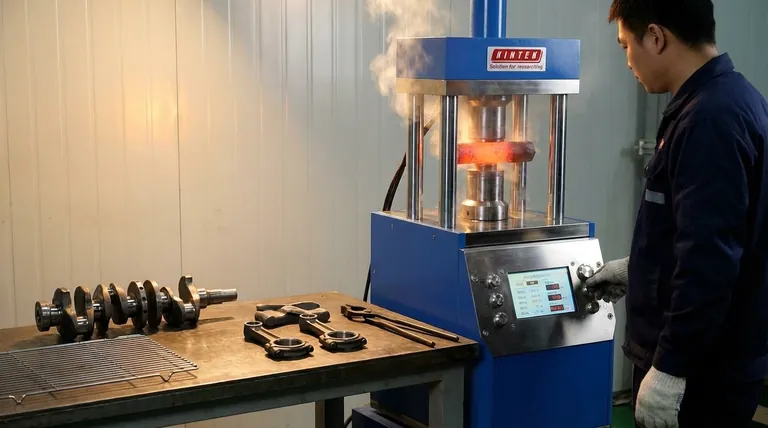
Why Hot Forging is Essential for Demanding Applications
The decision to use hot forging is driven by the unique material properties it imparts. The process fundamentally alters the metal's internal structure, creating a component that is far superior to one made by casting or machining alone.
Unmatched Strength and Ductility
Heating the metal billet to a precise temperature (often over 1,100°C for steel) causes its crystalline structure to recrystallize.
When the part is then forged, this process refines the grain structure of the metal, eliminating porosity and producing a denser, more uniform material. This results in exceptional tensile strength and ductility.
The Ability to Create Complex Geometries
The high temperature makes the metal extremely malleable, almost like a dense clay.
This allows it to flow and completely fill intricate and complex die cavities under the force of the press or hammer. This is how complex parts like connecting rods or multi-axis joints can be formed into a single, robust piece, as noted in the reference.
Superior Fatigue Resistance
This is the most significant advantage of forging. The process directs the internal grain flow of the metal to follow the contours of the part.
Imagine the grain of a piece of wood running along its length, making it strong. Forging does the same for metal, meaning the part is incredibly resistant to cracking and fatigue failure when subjected to repeated cycles of stress and vibration. Machining, by contrast, cuts through these grain flows, creating weak points.
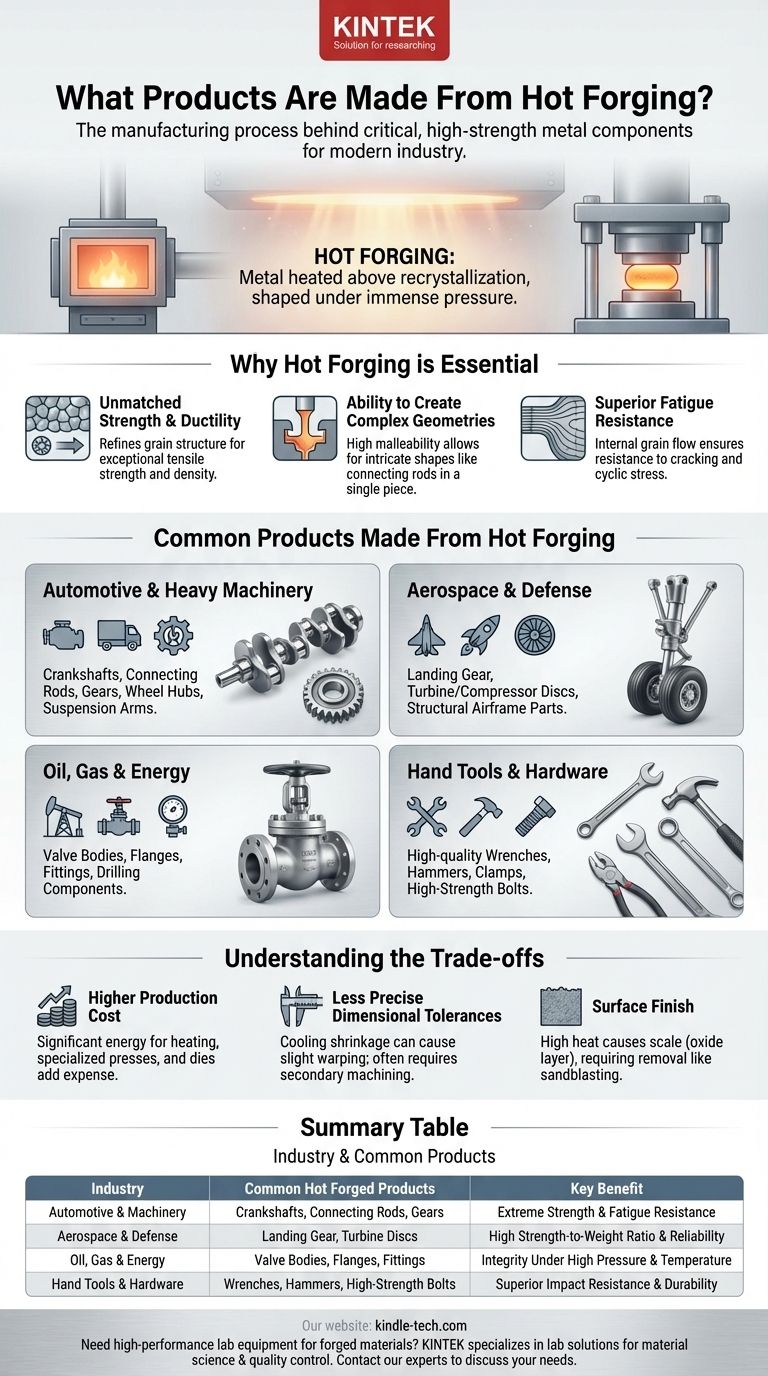
Common Products Made From Hot Forging
Hot forged parts are ubiquitous in industries where reliability is non-negotiable. The process is selected because of the properties discussed above.
Automotive and Heavy Machinery
These industries rely on hot forging for components in engines, drivetrains, and chassis that are under constant dynamic load.
Examples include crankshafts, connecting rods, gears, wheel hubs, and suspension arms. Their forged grain structure prevents failure from engine torque and road impacts.
Aerospace and Defense
In aerospace, the strength-to-weight ratio is critical, and failure is not an option. Hot forging provides this reliability.
Components like landing gear, turbine and compressor discs, and structural airframe parts are almost exclusively hot forged.
Oil, Gas, and Energy
Parts used in this sector must withstand extreme pressures, high temperatures, and corrosive environments.
Valve bodies, flanges, fittings, and drilling components are hot forged to ensure they have the material integrity to prevent leaks or blowouts under thousands of PSI of pressure.
Hand Tools and Hardware
For tools that need to withstand repeated impact and high leverage, hot forging provides the necessary durability.
High-quality wrenches, hammers, clamps, and high-strength bolts and hooks are hot forged to prevent them from fracturing or deforming under load.
Understanding the Trade-offs
Despite its benefits, hot forging is not the right choice for every application. Understanding its limitations is key to making an informed decision.
Higher Production Cost
Heating tons of metal to extreme temperatures requires significant energy. Furthermore, the specialized presses and hardened dies add to the overall expense, as the reference correctly points out.
Less Precise Dimensional Tolerances
As the hot forged part cools, it shrinks and can warp slightly. This results in lower dimensional accuracy compared to cold forging or machining.
Because of this, hot forged parts often require a secondary machining process to achieve their final, precise dimensions, adding another step and cost.
Surface Finish
The high heat causes a layer of scale (an oxide layer) to form on the surface of the part. This results in a rougher surface finish that must often be removed through processes like sandblasting or pickling.
Making the Right Choice for Your Goal
Selecting a manufacturing process depends entirely on the component's end-use and performance requirements.
- If your primary focus is maximum strength and failure resistance for a critical part: Hot forging is the definitive choice, especially for complex shapes that will endure high stress or fatigue.
- If your primary focus is high-volume production with tight dimensional accuracy: Cold forging or precision machining may be more cost-effective, assuming the ultimate strength of hot forging is not required.
- If your primary focus is minimizing cost for a non-structural component: Casting is often a more economical alternative for creating complex shapes where internal grain structure is not a concern.
Understanding these trade-offs empowers you to select the process that ensures your component is not just made, but made correctly for its purpose.
Summary Table:
| Industry | Common Hot Forged Products | Key Benefit |
|---|---|---|
| Automotive & Machinery | Crankshafts, Connecting Rods, Gears | Extreme Strength & Fatigue Resistance |
| Aerospace & Defense | Landing Gear, Turbine Discs | High Strength-to-Weight Ratio & Reliability |
| Oil, Gas & Energy | Valve Bodies, Flanges, Fittings | Integrity Under High Pressure & Temperature |
| Hand Tools & Hardware | Wrenches, Hammers, High-Strength Bolts | Superior Impact Resistance & Durability |
Need high-performance lab equipment to test or process forged materials? KINTEK specializes in the lab equipment and consumables that support the development and quality control of these critical components. From furnaces for heat treatment to testing apparatus, our solutions help ensure your materials meet the highest standards of strength and reliability. Contact our experts today to discuss how we can support your laboratory's specific needs in material science and manufacturing.
Visual Guide
Related Products
People Also Ask
- What is the function of press molds during the preparation of SiCf/Ti-43Al-9V composites? Achieve Structural Precision
- How to use a press mold? Master the Art of Creating Consistent Ceramic Forms
- What is the purpose of specialized pressure devices in sulfide solid-state batteries? Ensure Chemo-Mechanical Stability
- Why is a laboratory hydraulic hot press essential for high-density, additive-free Silicon Carbide? Unlock Pure SiC.
- What are the functions of hydraulic pressure in diffusion bonding? Master Superior Composite Material Integration
