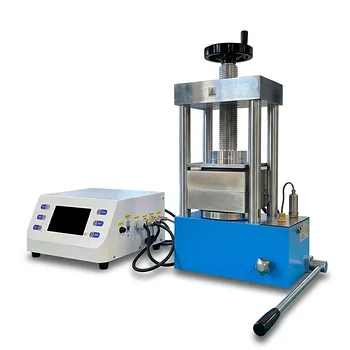
A laboratory hydraulic hot press is the critical enabler for processing pure Silicon Carbide (SiC) because it overcomes the material's natural resistance to densification. By applying uniaxial mechanical pressure simultaneously with high heat, this equipment forces the material to reach near-theoretical density without the need for sintering additives that would otherwise compromise purity.
Silicon Carbide possesses strong covalent bonds and low self-diffusion rates, making it exceptionally difficult to sinter using heat alone. The hydraulic hot press solves this by mechanically forcing grain boundary sliding and plastic deformation, allowing for the production of high-purity, high-density ceramics essential for sensitive semiconductor applications.
Overcoming the Physical Limitations of Silicon Carbide
The Challenge of Strong Covalent Bonds
Silicon Carbide is characterized by strong covalent bonds and a low self-diffusion coefficient.
These physical properties mean the material resists atomic movement, making it nearly impossible to densify using standard pressureless sintering without very high temperatures or chemical aids.
The Role of Simultaneous Pressure and Heat
The hydraulic hot press applies uniaxial mechanical pressure at the same time the material is heated.
This coupling effect acts as a mechanical catalyst, providing the external energy required to overcome the material's internal resistance to forming a solid mass.
The Mechanism of Densification
Facilitating Grain Boundary Sliding
The primary mechanism utilized by the hot press is the facilitation of grain boundary sliding.
The external pressure forces the grains of the material to move and rearrange against each other, a process that would not occur spontaneously under heat alone.
Inducing Plastic Deformation
Under the influence of heat and pressure, the Silicon Carbide undergoes plastic deformation.
This forces the material into a closer configuration, effectively closing gaps and increasing the density of the final component.
Eliminating Residual Pores
The hydraulic system, often capable of delivering precise tonnage, forces powder particles to rearrange while in a softened state.
This action is critical for eliminating residual pores, ensuring the final product possesses high impact toughness and structural integrity.
Why "Additive-Free" Processing Matters
Lowering Sintering Temperatures
Typically, additives are mixed with ceramics to lower the temperature required for sintering, but these additives act as impurities.
The mechanical pressure provided by the hot press allows Silicon Carbide to densify at lower temperatures than would otherwise be possible, negating the need for these chemical sintering aids.
Purity for Semiconductor Applications
High-density, additive-free Silicon Carbide is particularly vital for semiconductor components.
These applications are highly sensitive to impurities; therefore, the ability to achieve high density through mechanical force rather than chemical additives is a distinct manufacturing advantage.
Understanding the Trade-offs
Geometry Limitations
Hydraulic hot pressing typically uses uniaxial pressure, which applies force in one direction.
This limits the complexity of shapes that can be produced compared to isostatic pressing, making it best suited for simple geometries like plates, discs, or pucks.
Production Scalability
This process is generally a batch operation, processing one mold or a stack of molds at a time.
While it produces superior material properties, it often has a lower throughput compared to continuous pressureless sintering methods.
Making the Right Choice for Your Goal
The decision to utilize a laboratory hydraulic hot press depends on your specific requirements for material purity and density.
- If your primary focus is Semiconductor Purity: The hot press is essential to achieve full density without introducing chemical sintering aids that could contaminate the wafer environment.
- If your primary focus is Mechanical Performance: The process ensures near-theoretical density and the elimination of pores, maximizing the fracture toughness and wear resistance of the ceramic.
By replacing chemical additives with mechanical force, the hydraulic hot press unlocks the full potential of pure Silicon Carbide.
Summary Table:
| Feature | Pressureless Sintering | Hydraulic Hot Pressing |
|---|---|---|
| Sintering Additives | Required (increases impurities) | Not required (maintains high purity) |
| Densification Mechanism | Thermal diffusion only | Mechanical force + Thermal diffusion |
| Density Achieved | Lower/Requires chemicals | Near-theoretical (high density) |
| Porosity | Higher residual pores | Minimal residual pores |
| Ideal Application | Complex shapes, mass production | Semiconductor parts, high-purity discs |
Elevate Your Advanced Ceramics Research with KINTEK
Achieving near-theoretical density in pure Silicon Carbide requires the precision and power of advanced laboratory equipment. KINTEK specializes in providing high-performance hydraulic hot presses and isostatic presses designed to overcome the most challenging material limitations.
Our extensive portfolio for materials science includes:
- High-Temperature Furnaces: Muffle, vacuum, and CVD systems for precise thermal control.
- Precision Pressing: Manual and automatic hydraulic presses for pellet and puck production.
- Processing Tools: Crushing, milling, and sieving equipment for powder preparation.
- Advanced Lab Solutions: High-pressure reactors, cooling systems, and essential ceramics like crucibles.
Whether you are developing semiconductor components or high-toughness industrial ceramics, KINTEK offers the technical expertise and robust equipment to ensure your success. Contact us today to find the perfect pressing solution for your lab!
References
- Hidehiko Tanaka. Silicon carbide powder and sintered materials. DOI: 10.2109/jcersj2.119.218
This article is also based on technical information from Kintek Solution Knowledge Base .
Related Products
- 30T 40T Split Automatic Heated Hydraulic Press Machine with Heated Plates for Laboratory Hot Press
- 24T 30T 60T Heated Hydraulic Press Machine with Heated Plates for Laboratory Hot Press
- Automatic Heated Hydraulic Press Machine with Heated Plates for Laboratory Hot Press 25T 30T 50T
- Automatic Heated Hydraulic Press Machine with Heated Plates for Laboratory Hot Press
- Heated Hydraulic Press Machine with Heated Plates for Vacuum Box Laboratory Hot Press
People Also Ask
- What are the advantages of using a laboratory hydraulic press for hot pressing? Achieve Peak Nano-Composite Density
- What are the core advantages of using a laboratory hot press to produce Bi2Se3? Achieve 93% Density & High Conductivity
- How does a laboratory hydraulic hot press ensure the quality of PHBV/natural fiber composites? Expert Guide
- What is the function of a laboratory hydraulic hot press in the assembly of solid-state photoelectrochemical cells?
- How does a laboratory hot press improve alloy performance? Optimize Liquid Phase Sintering for High-Strength Materials