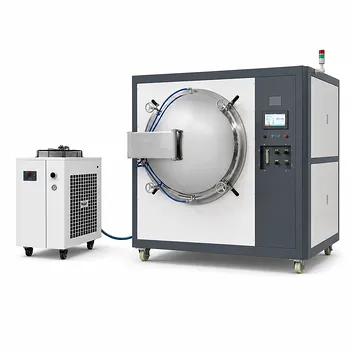
The uniaxial pressing function acts as the primary mechanical driver for densification and bonding. By applying sustained pressure (specifically 20 MPa) during the thermal cycle, the furnace forces the distinct ZrC and SiC layers into intimate physical contact. This compression is the critical variable that enables the transition from loose layers to a cohesive, physically bonded ceramic structure.
The core function of uniaxial pressing is to mechanically eliminate the gaps that naturally exist between layers. Without this pressure, high temperatures alone cannot remove interlaminar pores or reduce overall porosity to the target level of approximately 9.3%, rendering the material structurally weak.
The Mechanics of Interfacial Bonding
Forcing Physical Contact
In a layered ceramic system, the interfaces between materials are vulnerable points.
The vacuum hot press utilizes uniaxial pressure to force the ZrC and SiC layers into close contact. This mechanical action bridges the gap between the materials, ensuring they touch at the microscopic level required for bonding to occur.
Eliminating Interlaminar Pores
Without pressure, gas pockets or voids would remain trapped between the ceramic layers.
The application of 20 MPa of pressure effectively squeezes out these interlaminar pores. This process is essential for removing defects that would otherwise act as crack initiation sites or points of delamination in the final product.
Achieving Structural Density
Reduction of Overall Porosity
The influence of the pressing function extends beyond just the interface; it densifies the entire bulk material.
By compressing the ceramic matrix at high temperatures, the furnace reduces the overall porosity of the composite to approximately 9.3%. This reduction is a direct result of the applied force collapsing internal voids.
Creation of a Dense Interfacial Bond
The ultimate goal of this function is the creation of a unified microstructure.
The combination of heat and uniaxial pressure enables the creation of a dense interfacial bond. This transforms the separate layers into a singular, integrated component capable of withstanding structural stress.
Understanding the Operational Necessity
Pressure as a Prerequisite
It is critical to understand that this pressure is not merely an enhancement; it is a necessary processing condition.
Passive heating (sintering without pressure) would likely result in poor adhesion between the ZrC and SiC layers. The physical bonding mechanism relies entirely on the external force to overcome the material's resistance to densification.
The Limits of Porosity Reduction
While the pressure is effective, it does not eliminate porosity entirely.
The process targets a porosity reduction to roughly 9.3%. Operators must recognize that while interlaminar gaps are eliminated, some intrinsic porosity remains within the material structure as a natural characteristic of this processing method.
Making the Right Choice for Your Goal
To maximize the performance of layered ZrC-SiC ceramics, you must ensure the uniaxial pressing parameters are strictly controlled.
- If your primary focus is Interface Adhesion: Ensure the full 20 MPa of pressure is applied to force close contact and eliminate interlaminar pores, which are the main cause of layer delamination.
- If your primary focus is Bulk Density: Monitor the pressing cycle to verify that overall porosity reaches the ~9.3% benchmark, ensuring the material is sufficiently dense for structural applications.
The uniaxial pressing function is the bridge that turns separate ceramic layers into a unified, bonded composite.
Summary Table:
| Parameter | Impact on Microstructure | Goal for ZrC-SiC ceramics |
|---|---|---|
| Pressure Application | Forces intimate physical contact between layers | Create a dense interfacial bond |
| Interlaminar Pores | Mechanically squeezed out to remove voids | Eliminate crack initiation sites |
| Bulk Porosity | Collapses internal voids via compression | Achieve ~9.3% overall porosity |
| Mechanical Force | Acts as primary driver for densification | Prevent layer delamination |
Elevate Your Advanced Material Research with KINTEK
Precision in uniaxial pressing and vacuum control is critical for achieving high-performance layered ceramics. At KINTEK, we specialize in cutting-edge laboratory equipment designed for the most demanding thermal processing requirements.
Our extensive portfolio features high-performance vacuum hot press furnaces, muffle and tube furnaces, and advanced hydraulic presses (pellet, hot, isostatic) engineered for uniform densification. Beyond furnace technology, we provide the complete ecosystem for material science—from crushing and milling systems to high-temperature high-pressure reactors and specialized ceramics and crucibles.
Ready to optimize your densification process? Contact KINTEK today to discover how our high-temperature solutions can enhance your lab's efficiency and material integrity.
Related Products
- Vacuum Hot Press Furnace Heated Vacuum Press Machine Tube Furnace
- 600T Vacuum Induction Hot Press Furnace for Heat Treat and Sintering
- Vacuum Hot Press Furnace Machine Heated Vacuum Press
- Vacuum Hot Press Furnace Machine for Lamination and Heating
- Vacuum Heat Treat and Pressure Sintering Furnace for High Temperature Applications
People Also Ask
- What advantages does a vacuum hot press furnace provide for LSLBO ceramic electrolytes? Achieve 94% Relative Density
- What role does a Vacuum Hot Press (VHP) furnace play in the densification of austenitic stainless steel 316 composites?
- What are the advantages of using a vacuum hot pressing furnace? Superior Densification for 2024Al/Gr/SiC Composites
- What are the advantages of a vacuum hot press furnace for LTPO solid electrolytes? Boost Density and Conductivity
- What core processing conditions does a vacuum hot press furnace provide? Achieve High-Density Cu-SiC/Diamond Composites