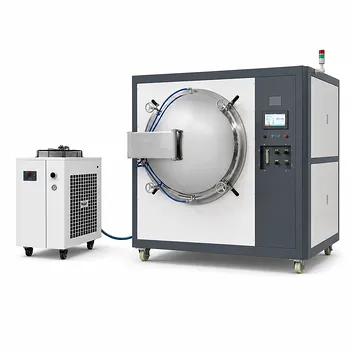
Precise temperature control dictates the structural integrity of the interface between carbon fibers and the silicon nitride matrix. It acts as a strict gatekeeper, ensuring the ceramic matrix densifies completely without triggering destructive chemical reactions that degrade the reinforcing fibers. By maintaining a narrow thermal window, you prevent the conversion of carbon fibers into brittle compounds, directly preserving the composite's mechanical and dielectric performance.
Core Takeaway Temperature precision creates a critical "sintering window" that balances necessary material densification with chemical stability. By strictly maintaining temperatures near 1600°C and avoiding excursions to 1700°C, the process prevents carbon fibers from reacting with the matrix to form silicon carbide (SiC), thereby securing the composite's structural strength.
Regulating Interfacial Reactions
The Chemical Tipping Point
The most critical function of temperature precision is preventing unwanted chemical changes. In a Carbon Fiber/Silicon Nitride ($C_{f}/Si_{3}N_{4}$) system, there is a fine line between stability and reactivity.
Controlling Silicon Carbide Formation
At temperatures approaching 1700°C, carbon fibers react aggressively with the silicon nitride matrix. This reaction converts the carbon into silicon carbide (SiC). Precision control is required to keep the process closer to 1600°C, where this reaction is minimized.
Preserving Fiber Reinforcement
When the temperature is strictly regulated to minimize SiC formation, the carbon fibers remain intact. If the fibers react and degrade, they lose their ability to reinforce the ceramic, compromising the mechanical properties of the final composite.
Achieving Densification Without Degradation
Lowering Activation Energy
Silicon nitride is naturally difficult to sinter. The vacuum hot-pressing furnace applies simultaneous mechanical pressure and heat to significantly lower the activation energy required for densification.
The "Optimal Sintering Window"
Precision temperature control maintains the process within an "optimal sintering window." This specific thermal range is hot enough to promote particle rearrangement and plastic flow for high density, yet cool enough to prevent fiber damage.
The Role of the Vacuum Environment
While temperature controls the reaction rate, the vacuum environment supports the microstructure by preventing oxidation of the carbon fibers. It also facilitates the removal of gases from internal pores, which is essential for achieving a void-free, dense material.
Understanding the Trade-offs
The Consequence of Overheating
If the furnace control lacks precision and overshoots the target temperature (even locally), the interface between the fiber and matrix degrades. The resulting formation of Silicon Carbide creates brittle points that weaken the composite and alter its dielectric properties.
The Risk of Underheating
Conversely, if the temperature fluctuates too low in an attempt to protect the fibers, the silicon nitride matrix will not sinter fully. This results in a porous microstructure with poor mechanical integrity and low density.
Uniformity is Critical
Precision is not just about the average temperature; it is about uniformity. Any thermal gradients within the furnace can lead to uneven densification, where some sections are degraded by reaction while others remain porous.
Making the Right Choice for Your Goal
To optimize the manufacturing of $C_{f}/Si_{3}N_{4}$ composites, you must tune your process parameters based on the specific risks associated with this material system.
- If your primary focus is Maximizing Mechanical Strength: Prioritize temperature stability at or below 1600°C to ensure zero conversion of Carbon fibers into Silicon Carbide.
- If your primary focus is High Material Density: Ensure the furnace applies consistent pressure and heat to lower the activation energy, enabling densification without requiring temperatures that damage the fibers.
- If your primary focus is Dielectric Consistency: Focus on precise vacuum levels and uniform heating to remove all internal pores and prevent oxidation, which alters dielectric performance.
Success relies on hitting the narrow thermal target where the matrix flows but the fibers do not react.
Summary Table:
| Parameter | Influence on Microstructure | Consequence of Poor Precision |
|---|---|---|
| Sintering Window | Facilitates densification near 1600°C | Porous matrix or fiber damage |
| Interfacial Stability | Prevents Carbon conversion to SiC | Brittle interface & loss of strength |
| Vacuum Environment | Eliminates oxidation & removes pores | Altered dielectric properties & voids |
| Thermal Uniformity | Ensures consistent grain growth | Uneven density & localized weak points |
Elevate Your Material Research with KINTEK Precision
Unlock the full potential of your C_fiber/Si3N4 composites with KINTEK’s advanced thermal solutions. Our high-performance vacuum hot-pressing furnaces and vacuum furnaces provide the industry-leading temperature uniformity and pressure control required to hit the narrow sintering window for high-performance ceramics.
Whether you are focusing on battery research, aerospace components, or advanced electronic materials, KINTEK specializes in laboratory equipment designed for precision. Our portfolio includes:
- Advanced High-Temperature Furnaces (Muffle, Tube, Rotary, Vacuum, CVD/PECVD)
- High-Pressure Reactors & Autoclaves for chemical stability
- Crushing, Milling, and Hydraulic Presses for superior material density
- Precision Consumables (Ceramics, Crucibles, and PTFE products)
Ready to optimize your densification process? Contact KINTEK experts today to discover how our equipment can refine your microstructure and maximize mechanical strength.
Related Products
- Vacuum Hot Press Furnace Heated Vacuum Press Machine Tube Furnace
- 600T Vacuum Induction Hot Press Furnace for Heat Treat and Sintering
- Vacuum Hot Press Furnace Machine for Lamination and Heating
- Vacuum Hot Press Furnace Machine Heated Vacuum Press
- Vacuum Heat Treat and Pressure Sintering Furnace for High Temperature Applications
People Also Ask
- What advantages does a vacuum hot press furnace provide for LSLBO ceramic electrolytes? Achieve 94% Relative Density
- What role does a Vacuum Hot Press (VHP) furnace play in the densification of austenitic stainless steel 316 composites?
- What are the advantages of using a vacuum hot pressing furnace? Superior Densification for 2024Al/Gr/SiC Composites
- What are the advantages of a vacuum hot press furnace for LTPO solid electrolytes? Boost Density and Conductivity
- What core processing conditions does a vacuum hot press furnace provide? Achieve High-Density Cu-SiC/Diamond Composites