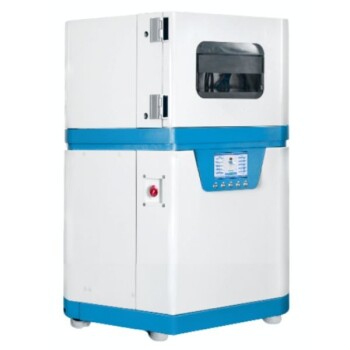
A vacuum hot pressing furnace establishes a precise trifecta of conditions to successfully sinter FeCrAl-based composites: a high-vacuum environment (typically below 1.5 x 10^-1 Pa), elevated temperatures (around 1100°C), and continuous mechanical pressure (approximately 30 MPa). This simultaneous application of thermal and mechanical energy prevents oxidation while physically forcing material densification.
Core Takeaway: The unique advantage of this process lies in the "coupling effect" of heat and pressure within a vacuum. This synergy drives plastic flow and atomic diffusion far more effectively than heat alone, accelerating in-situ phase synthesis to produce high-density, defect-free bulk materials.
The Critical Role of the Vacuum Environment
Preventing Material Degradation
For FeCrAl-based composites, maintaining purity is paramount. The furnace creates a high-vacuum state, specifically maintaining pressure levels below 1.5 x 10^-1 Pa.
Controlling Oxidation
Iron, Chromium, and Aluminum are reactive metals that can easily oxidize at sintering temperatures. The vacuum environment removes oxygen from the chamber, ensuring that the metal powders do not form unwanted oxide layers that would weaken the final composite.
Enhancing Particle Contact
Beyond preventing oxidation, the vacuum aids in extracting volatile gases trapped in the interstitial spaces between powder particles. Removing these gases allows for cleaner particle-to-particle contact, which is a prerequisite for effective diffusion bonding.
The Synergy of Heat and Mechanical Pressure
Thermal Activation
The furnace operates at elevated temperatures, typically reaching 1100°C for FeCrAl composites. This thermal energy activates the atomic structure of the metal powders, increasing their ductility and preparing them for diffusion.
Mechanical Densification
While the material is heated, the furnace applies a continuous mechanical pressure, generally around 30 MPa. Unlike pressureless sintering, which relies solely on surface energy to close pores, this external force mechanically squeezes particles together.
Promoting Plastic Flow
The combination of heat and pressure induces plastic flow in the metal powders. This mechanism forces material to slide and rearrange, filling voids and eliminating large pores that simple diffusion cannot remove.
Accelerating Phase Synthesis
The coupling of thermal and mechanical energy does more than just densify the material; it accelerates in-situ phase synthesis. This ensures the resulting FeCrAl composite achieves a fine-grained microstructure and high relative density.
Understanding the Trade-offs
Geometrical Limitations
Vacuum hot pressing typically utilizes a hydraulic loading system to apply uniaxial pressure (pressure from one direction). This generally limits the production capabilities to simple shapes, such as plates, disks, or cylinders, rather than complex 3D geometries.
Production Throughput
The process is inherently a batch operation requiring significant cycle times for heating, pressing, and cooling under vacuum. While it produces superior material properties, it generally has a lower throughput compared to continuous sintering methods.
Making the Right Choice for Your Goal
To determine if vacuum hot pressing is the correct processing route for your FeCrAl application, consider the following:
- If your primary focus is maximum density and purity: This method is ideal because the vacuum and pressure combination eliminates porosity and oxidation defects that weaken structural integrity.
- If your primary focus is complex part geometry: You may face challenges, as the uniaxial pressure application restricts the ability to sinter intricate net-shape components.
Success in sintering FeCrAl composites relies on balancing the protective nature of high vacuum with the densifying power of mechanical force.
Summary Table:
| Condition | Parameter Requirement | Primary Function in Sintering |
|---|---|---|
| Vacuum Level | < 1.5 x 10⁻¹ Pa | Prevents oxidation and extracts volatile gases |
| Temperature | Approximately 1100°C | Thermally activates atoms for diffusion and ductility |
| Mechanical Pressure | ~30 MPa (Uniaxial) | Drives plastic flow and eliminates porosity |
| Sintering Mechanism | Thermo-Mechanical Coupling | Accelerates in-situ phase synthesis for high density |
Elevate Your Advanced Material Synthesis with KINTEK
Precise control over vacuum levels and mechanical pressure is the key to producing defect-free FeCrAl composites. KINTEK specializes in high-performance laboratory equipment, including state-of-the-art vacuum hot pressing furnaces and isostatic presses designed for demanding R&D and industrial workflows.
Whether you are focusing on battery research, high-temperature ceramics, or complex alloy sintering, our comprehensive portfolio—from hydraulic presses and crushing systems to high-temperature reactors—provides the reliability your lab needs.
Ready to achieve maximum density and purity in your materials?
Contact our specialists today to find the perfect sintering solution for your application!
Related Products
- Vacuum Hot Press Furnace Heated Vacuum Press Machine Tube Furnace
- 600T Vacuum Induction Hot Press Furnace for Heat Treat and Sintering
- Vacuum Hot Press Furnace Machine Heated Vacuum Press
- Vacuum Hot Press Furnace Machine for Lamination and Heating
- Vacuum Heat Treat and Pressure Sintering Furnace for High Temperature Applications
People Also Ask
- What advantages does a vacuum hot press furnace provide for LSLBO ceramic electrolytes? Achieve 94% Relative Density
- What role does a Vacuum Hot Press (VHP) furnace play in the densification of austenitic stainless steel 316 composites?
- What are the advantages of using a vacuum hot pressing furnace? Superior Densification for 2024Al/Gr/SiC Composites
- What are the advantages of a vacuum hot press furnace for LTPO solid electrolytes? Boost Density and Conductivity
- What core processing conditions does a vacuum hot press furnace provide? Achieve High-Density Cu-SiC/Diamond Composites