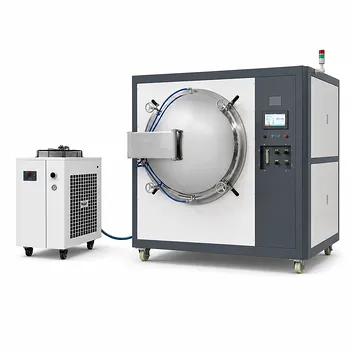
A vacuum hot pressing furnace is the preferred solution for creating high-density diamond/copper composites because it combines high heat with uniaxial mechanical pressure to physically overcome the material's resistance to bonding. While standard sintering relies on passive thermal diffusion, a hot press generates the kinetic force necessary to push liquid copper into the microscopic voids between rigid diamond particles, achieving relative densities that often exceed 96%.
The Core Insight: Standard sintering fails to achieve full density in this specific application because copper does not naturally "wet" (flow over) diamond surfaces easily. Vacuum hot pressing solves this by mechanically forcing the matrix to fill pores while simultaneously removing trapped gases that would otherwise create internal defects.
Overcoming Physical Barriers to Densification
The Problem of "Non-Wetting" Behavior
In a standard sintering furnace, liquid copper tends to bead up rather than spread across diamond surfaces due to high surface tension. Without external force, this leaves gaps between the diamond particles. Hot pressing applies mechanical pressure (often around 28 MPa) to overcome this surface tension, forcing the semi-liquid matrix to penetrate and fill these microscopic voids.
Breaking Through Rigid Obstacles
Diamond particles are extremely hard and create rigid structures that resist compaction. In a pressureless environment, these particles touch and create stable, open frameworks that lock porosity in place. The uniaxial pressure of the hot press forces particle rearrangement and plastic deformation of the copper, physically crushing these voids to achieve densities as high as 98.8%.
The Critical Role of the Vacuum Environment
Preventing Oxidation of Constituent Materials
Both copper and diamond are sensitive to oxygen at sintering temperatures. Copper readily oxidizes, which weakens the matrix, while diamond can degrade or graphitize. The furnace maintains a high vacuum (typically between $10^{-3}$ and $10^{-2}$ Pa) to effectively inhibit these reactions, ensuring the final composite retains high thermal and electrical conductivity.
Eliminating Gas-Induced Porosity
Raw powder compacts inevitably trap air and volatile substances within their structure. If these gases are not removed before the metal seals them in, the material will remain porous and weak. The vacuum environment actively extracts these internal gases (degassing) before full densification occurs, removing defects that standard atmospheric sintering cannot address.
Understanding the Trade-offs
Process Complexity vs. Material Quality
While vacuum hot pressing offers superior density, it is generally a more complex, batch-oriented process compared to continuous sintering methods. It requires specialized graphite dies to contain the powder and transmit pressure. However, for diamond/copper composites, this trade-off is accepted because standard methods simply cannot achieve the interfacial bonding strength or the near-theoretical density required for high-performance thermal management applications.
Making the Right Choice for Your Goal
- If your primary focus is Maximum Density (>96%): You must use vacuum hot pressing to mechanically force the copper matrix into the interstitial spaces between diamond particles.
- If your primary focus is Interface Quality: The vacuum environment is non-negotiable to prevent oxide layers from forming between the copper and diamond, which would destroy thermal transfer.
- If your primary focus is Structural Integrity: The simultaneous application of heat and pressure is required to minimize internal voids and maximize the mechanical bonding of the composite.
By integrating mechanical force with environmental control, vacuum hot pressing turns a theoretically difficult material pairing into a high-performance reality.
Summary Table:
| Feature | Standard Sintering Furnace | Vacuum Hot Pressing Furnace |
|---|---|---|
| Driving Force | Passive thermal diffusion | Heat + Uniaxial mechanical pressure |
| Copper Wetting | Poor (copper beads up) | Forced penetration into voids |
| Typical Density | Lower (persistent porosity) | High (>96% to 98.8%) |
| Atmosphere | Ambient or protective gas | High Vacuum ($10^{-3}$ to $10^{-2}$ Pa) |
| Oxidation Risk | High | Minimized/Eliminated |
| Best For | Simple metal powders | Complex, non-wetting composites |
Elevate Your Advanced Material Synthesis with KINTEK
Don't let porosity compromise your high-performance composites. KINTEK specializes in precision laboratory equipment designed for the most demanding research and production environments. Whether you are developing thermal management materials or advanced alloys, our vacuum hot pressing systems and isostatic presses provide the mechanical force and environmental control necessary to achieve near-theoretical density.
Our extensive portfolio includes:
- High-Temperature Furnaces: Muffle, tube, vacuum, and atmosphere furnaces.
- Pressure Solutions: Hydraulic pellet presses, hot presses, and autoclaves.
- Processing Tools: Crushing, milling, and sieving equipment for powder preparation.
- Specialized Labware: High-purity ceramics, crucibles, and PTFE consumables.
Ready to optimize your sintering process? Contact our technical experts today to find the perfect solution for your lab’s specific needs.
Related Products
- Vacuum Hot Press Furnace Heated Vacuum Press Machine Tube Furnace
- 600T Vacuum Induction Hot Press Furnace for Heat Treat and Sintering
- Vacuum Hot Press Furnace Machine Heated Vacuum Press
- Vacuum Hot Press Furnace Machine for Lamination and Heating
- Vacuum Heat Treat and Pressure Sintering Furnace for High Temperature Applications
People Also Ask
- What advantages does a vacuum hot press furnace provide for LSLBO ceramic electrolytes? Achieve 94% Relative Density
- What role does a Vacuum Hot Press (VHP) furnace play in the densification of austenitic stainless steel 316 composites?
- What are the advantages of using a vacuum hot pressing furnace? Superior Densification for 2024Al/Gr/SiC Composites
- What are the advantages of a vacuum hot press furnace for LTPO solid electrolytes? Boost Density and Conductivity
- What core processing conditions does a vacuum hot press furnace provide? Achieve High-Density Cu-SiC/Diamond Composites