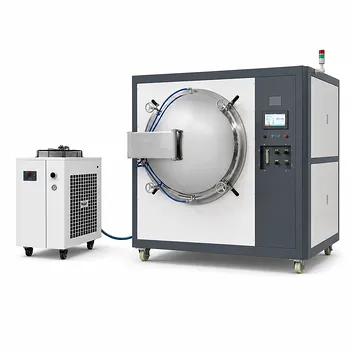
A vacuum hot pressing furnace serves as the definitive mechanism for densification in the production of high-performance Ti-6Al-7Nb alloys. It functions by simultaneously applying high temperature (typically 1300°C), mechanical pressure (30 MPa), and a high-vacuum environment (9.9 x 10^-5 Pa) to powder materials. This tri-factor approach forces the material to undergo plastic deformation and diffusion creep, effectively closing internal voids to achieve a relative density exceeding 99%.
The furnace does not merely heat the material; it provides the mechanical driving force required to eliminate porosity that thermal energy alone cannot resolve, ensuring the alloy achieves the specific alpha+beta microstructure necessary for superior mechanical performance.
The Mechanics of High-Density Fabrication
The Synergy of Heat and Pressure
Standard sintering relies on heat to bond particles, but this often leaves residual porosity. A vacuum hot pressing furnace overcomes this by adding uniaxial mechanical pressure (around 30 MPa).
At 1300°C, the alloy powder becomes malleable. The applied pressure physically forces these particles together, triggering plastic deformation.
This process creates a "densification driving force" that far exceeds the capabilities of pressureless sintering, ensuring that voids between particles are mechanically collapsed.
Driving Diffusion Creep
Beyond simple deformation, the combination of heat and pressure facilitates diffusion creep.
This mechanism allows atoms to move and rearrange along particle boundaries more efficiently.
By promoting this atomic migration, the furnace ensures that the bonding between particles is not just superficial, but results in a solid, cohesive bulk material.
Preserving Chemical Purity
The Necessity of High Vacuum
Titanium and its alloying elements (Aluminum and Niobium) are highly reactive and susceptible to oxidation at elevated temperatures.
The furnace operates at a high vacuum (typically 9.9 x 10^-5 Pa to 5×10^-2 Pa), acting as a shield that effectively prevents oxidation during the heating cycle.
Without this vacuum environment, oxygen would react with the titanium to form brittle oxides, severely compromising the mechanical integrity of the final part.
Elimination of Impurities
The vacuum environment performs a secondary, equally critical function: degassing.
It actively exhausts adsorbed gases and volatile impurities trapped within the gaps of the powder particles.
Removing these contaminants is essential for achieving high bonding strength and preventing gas-induced porosity in the final alloy.
Microstructural Control
Achieving the Alpha-Beta Structure
The ultimate goal of using this furnace is not just density, but specific material properties.
The precise control of temperature and cooling rates allows the Ti-6Al-7Nb alloy to form a typical alpha+beta microstructure.
This specific crystalline structure is directly responsible for the alloy's balance of strength, ductility, and fatigue resistance.
Understanding the Trade-offs
While vacuum hot pressing is superior for density, it introduces specific constraints you must consider.
Geometric Limitations
Because the pressure is typically applied uniaxially (from one direction), this process is generally limited to simple shapes like plates or cylinders. Complex geometries often require secondary machining.
Throughput vs. Quality
This is a batch process, not a continuous one. The cycle times for heating, holding under pressure, and cooling under vacuum are significant.
You are trading production speed for maximum material quality. This method is ideal for critical components where failure is not an option, but it may be cost-prohibitive for high-volume, low-stress commercial parts.
Making the Right Choice for Your Goal
To maximize the value of a vacuum hot pressing furnace for your application, consider these strategic priorities:
- If your primary focus is mechanical reliability: Prioritize the precise application of the 30 MPa pressure parameter to ensure relative density exceeds 99%, maximizing fatigue strength.
- If your primary focus is material purity: Ensure your vacuum system can reliably maintain pressures lower than 10^-4 Pa to prevent the embrittlement caused by titanium oxidation.
By leveraging the combined forces of thermal energy and mechanical pressure, you transform loose powder into a high-integrity engineering material capable of withstanding the most demanding environments.
Summary Table:
| Parameter | Typical Value | Role in Ti-6Al-7Nb Production |
|---|---|---|
| Temperature | 1300°C | Enables particle malleability and atomic diffusion creep. |
| Pressure | 30 MPa (Uniaxial) | Mechanically collapses voids to achieve >99% relative density. |
| Vacuum Level | 9.9 x 10^-5 Pa | Prevents titanium oxidation and exhausts volatile impurities. |
| Microstructure | Alpha + Beta | Ensures the optimal balance of strength and ductility. |
Elevate Your Material Integrity with KINTEK Advanced Thermal Solutions
Precise control over densification and purity is critical for high-performance Ti-6Al-7Nb alloys. KINTEK specializes in high-end laboratory equipment designed for the most demanding research and production environments. Whether you require our vacuum hot pressing furnaces for superior densification, high-temperature reactors, or crushing and milling systems for powder preparation, we provide the tools necessary to eliminate porosity and prevent oxidation.
Our value to you:
- Unmatched Precision: Advanced control systems for temperature, pressure, and vacuum levels.
- Comprehensive Portfolio: From hydraulic presses and dental furnaces to cooling solutions and essential ceramics.
- Expert Support: We help you select the right batch processing tools to ensure material reliability where failure is not an option.
Ready to achieve maximum material quality? Contact KINTEK today to discuss your laboratory needs!
Related Products
- Vacuum Hot Press Furnace Heated Vacuum Press Machine Tube Furnace
- 600T Vacuum Induction Hot Press Furnace for Heat Treat and Sintering
- Vacuum Hot Press Furnace Machine Heated Vacuum Press
- Vacuum Hot Press Furnace Machine for Lamination and Heating
- Vacuum Heat Treat and Pressure Sintering Furnace for High Temperature Applications
People Also Ask
- What advantages does a vacuum hot press furnace provide for LSLBO ceramic electrolytes? Achieve 94% Relative Density
- What role does a Vacuum Hot Press (VHP) furnace play in the densification of austenitic stainless steel 316 composites?
- What are the advantages of using a vacuum hot pressing furnace? Superior Densification for 2024Al/Gr/SiC Composites
- What are the advantages of a vacuum hot press furnace for LTPO solid electrolytes? Boost Density and Conductivity
- What core processing conditions does a vacuum hot press furnace provide? Achieve High-Density Cu-SiC/Diamond Composites