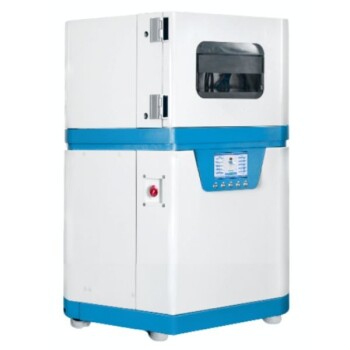
The primary function of a vacuum hot press furnace is to integrate high temperature, mechanical pressure, and a vacuum environment into a single processing step. For Al-Ti-Zr intermetallic compounds, this equipment drives in-situ reactive synthesis while simultaneously compressing the material to achieve high densification.
By combining thermal energy with mechanical force in an oxygen-free environment, this equipment overcomes the kinetic barriers of solid-state diffusion, ensuring the successful decomposition of precursors and the formation of a dense, oxide-free alloy.
Creating the Optimal Reaction Environment
The Critical Role of Vacuum
The synthesis of alloys containing Aluminum (Al), Titanium (Ti), and Zirconium (Zr) presents a significant chemical challenge due to their high reactivity.
The furnace creates a vacuum environment that eliminates oxygen during the heating process. This is essential to prevent the oxidation of the metal powders, which would otherwise compromise the structural integrity and purity of the final compound.
Thermal and Mechanical Synergy
Standard sintering often relies solely on heat, but a vacuum hot press adds substantial mechanical pressure—specifically up to 40.8 MPa in this context.
Combined with temperatures reaching 1400°C, this pressure facilitates solid-phase diffusion reactions between the mixed powders. It physically forces particles into contact, accelerating the chemical bonding process.
Decomposition of Hydrides
Specific to Al-Ti-Zr synthesis, the hot-pressing capability plays a distinct role in precursor management.
The application of heat and pressure facilitates the decomposition of hydrides. This step is necessary to release hydrogen and allow the remaining metal atoms to react and form the desired intermetallic phases.
Achieving Simultaneous Synthesis and Densification
One-Step Processing
The vacuum hot press furnace creates a unique synergy between thermal and mechanical activation.
Instead of separate steps for powder compacting and high-temperature sintering, this equipment combines them. This integration significantly lowers the required synthesis temperature and shortens the overall reaction time compared to conventional methods.
Controlling Microstructure
While high heat drives the reaction, the applied pressure and simultaneous densification help control the material's final structure.
The process inhibits excessive grain growth, preventing the material from becoming coarse and brittle. The result is a fine-grained microstructure that exhibits high hardness and superior density.
Understanding the Trade-offs
Balancing Temperature and Grain Growth
While high temperatures (up to 1400°C) are required for synthesis, they carry the risk of coarsening the material's structure.
The equipment relies on the vacuum and pressure to allow for effective sintering, but accurate thermal control is vital. If the temperature is maintained too long without adequate pressure, you risk losing the benefits of the fine-grained microstructure.
The Necessity of Pressure for Density
Reliance on vacuum sintering alone (without pressure) often fails to achieve full density for complex intermetallics.
Without the mechanical assistance of 40.8 MPa, the material may suffer from residual porosity. The equipment is indispensable specifically because thermal activation alone is insufficient to close all voids in these refractory compounds.
Making the Right Choice for Your Goal
To maximize the effectiveness of a vacuum hot press furnace for Al-Ti-Zr alloys, consider your specific processing objectives:
- If your primary focus is Material Purity: Ensure the vacuum integrity is maintained throughout the ramp-up to 1400°C to completely prevent oxidation of the reactive Ti and Zr elements.
- If your primary focus is Maximum Density: Prioritize the application of the full 40.8 MPa of pressure during the solid-phase diffusion stage to mechanically close voids and enforce particle contact.
- If your primary focus is Mechanical Hardness: leverage the rapid processing time to limit grain growth, ensuring the final microstructure remains fine and hard.
Success in this process relies on the precise synchronization of heat, pressure, and vacuum to force a reaction that nature would otherwise resist.
Summary Table:
| Feature | Function in Al-Ti-Zr Synthesis | Key Performance Metric |
|---|---|---|
| Vacuum Environment | Prevents oxidation of reactive Ti/Zr/Al powders | Oxygen-free purity |
| High Temperature | Drives solid-phase diffusion & hydride decomposition | Up to 1400°C |
| Mechanical Pressure | Eliminates porosity & facilitates particle contact | 40.8 MPa |
| Integrated Process | Simultaneous reactive synthesis and densification | Fine-grained microstructure |
Elevate Your Advanced Material Research with KINTEK
Precise control over temperature, pressure, and atmosphere is critical for the synthesis of complex intermetallic compounds like Al-Ti-Zr. KINTEK specializes in state-of-the-art laboratory equipment, offering high-performance vacuum hot press furnaces and high-temperature furnaces designed to meet the rigorous demands of material science.
Whether you are focusing on crushing and milling systems for powder preparation, isostatic hydraulic presses for uniform compaction, or specialized battery research tools, KINTEK provides the comprehensive solutions needed to ensure material purity and maximum density.
Ready to optimize your densification process? Contact our technical experts today to discover how KINTEK’s precision engineering can enhance your laboratory’s output and innovation.
Related Products
- Vacuum Hot Press Furnace Heated Vacuum Press Machine Tube Furnace
- 600T Vacuum Induction Hot Press Furnace for Heat Treat and Sintering
- Vacuum Hot Press Furnace Machine Heated Vacuum Press
- Vacuum Hot Press Furnace Machine for Lamination and Heating
- Vacuum Heat Treat and Pressure Sintering Furnace for High Temperature Applications
People Also Ask
- What advantages does a vacuum hot press furnace provide for LSLBO ceramic electrolytes? Achieve 94% Relative Density
- What role does a Vacuum Hot Press (VHP) furnace play in the densification of austenitic stainless steel 316 composites?
- What are the advantages of using a vacuum hot pressing furnace? Superior Densification for 2024Al/Gr/SiC Composites
- What are the advantages of a vacuum hot press furnace for LTPO solid electrolytes? Boost Density and Conductivity
- What core processing conditions does a vacuum hot press furnace provide? Achieve High-Density Cu-SiC/Diamond Composites