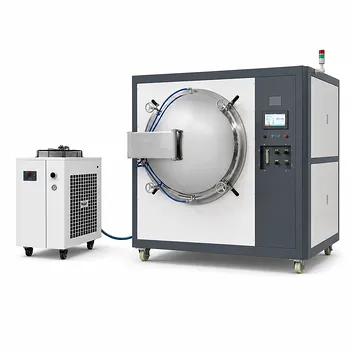
The primary advantage of using a vacuum hot press furnace for W-50%Cu composites is the achievement of near-theoretical density through simultaneous thermal and mechanical application. Unlike traditional pressureless sintering, this method actively forces particle rearrangement, allowing the material to reach approximately 99.6% density at significantly lower processing temperatures (e.g., 950°C).
Core Takeaway The vacuum hot press furnace solves the inherent poor sinterability of Tungsten-Copper (W-Cu) systems by mechanically overcoming particle resistance. While traditional heat promotes bonding, the addition of external pressure drives plastic flow, closing internal voids that pressureless sintering leaves behind.
Overcoming the Density Challenge
The Limits of Pressureless Sintering
In traditional pressureless sintering, densification relies almost entirely on atomic diffusion driven by thermal energy. For a composite like W-50%Cu, where the melting points and physical properties of Tungsten and Copper differ vastly, thermal energy alone is often insufficient. This frequently results in a microstructure containing residual pores and lower interface bonding strength.
The Mechanism of Pressure-Assisted Densification
A vacuum hot press furnace applies mechanical pressure (e.g., hydraulic force) directly to the powder during the heating phase. This external force promotes the plastic flow of the softer Copper matrix around the hard Tungsten particles. It forcibly closes internal pores and breaks down particle agglomerates that would otherwise resist densification.
Lower Temperature Requirements
Because mechanical pressure assists the densification process, the furnace does not need to rely solely on extreme heat to fuse particles. You can achieve high-quality results at temperatures as low as 950°C. This is notably lower than the temperatures required for conventional sintering, reducing energy consumption and thermal stress on the equipment.
The Role of the Vacuum Environment
Elimination of Trapped Gases
The vacuum component is critical for achieving high-purity composites. It effectively evacuates gases trapped within the powder interstices before and during the heating cycle. In pressureless atmospheric sintering, these gases can become trapped inside the material, forming permanent voids that weaken the final product.
Prevention of Oxidation
Tungsten and Copper are susceptible to oxidation at high temperatures, which degrades electrical conductivity and mechanical strength. The vacuum environment prevents high-temperature oxidation, ensuring the interface between the Tungsten and Copper remains clean. This facilitates better bonding and stabilizes the material's chemical composition.
Understanding the Trade-offs
Process Complexity vs. Outcome
While pressureless sintering is a simpler, passive process, it sacrifices material density. Vacuum hot pressing introduces complexity by requiring the synchronization of vacuum levels, hydraulic pressure, and temperature curves. However, this complexity is the necessary trade-off to eliminate the "resistance" of hard particles to matrix flow, a problem pressureless sintering cannot solve for W-Cu composites.
Efficiency and Throughput
The hot pressing process can be more time-efficient per cycle regarding sintering time. However, it is typically a batch process constrained by the size of the die and the press. While it offers superior product performance and high efficiency for specific high-density parts, it may differ in scalability compared to continuous belt furnaces used for lower-grade pressureless sintering.
Making the Right Choice for Your Goal
When deciding between vacuum hot pressing and traditional methods for W-50%Cu, consider your performance requirements:
- If your primary focus is Maximum Density and Conductivity: Choose Vacuum Hot Pressing. It is the only reliable way to achieve ~99.6% density and eliminate residual pores that impede electrical performance.
- If your primary focus is Low-Temperature Processing: Choose Vacuum Hot Pressing. It allows you to sinter effectively at 950°C, preserving the microstructure and reducing energy input compared to high-heat conventional methods.
Ultimately, for W-50%Cu composites, the vacuum hot press furnace transforms a difficult-to-sinter mixture into a solid, high-performance material by mechanically forcing the issue of densification.
Summary Table:
| Feature | Pressureless Sintering | Vacuum Hot Pressing |
|---|---|---|
| Achievable Density | Lower (Residual Porosity) | ~99.6% (Near-Theoretical) |
| Processing Temp | Higher | Lower (approx. 950°C) |
| Pressure Source | Thermal Diffusion Only | Thermal + Mechanical Force |
| Atmosphere | Ambient or Inert | High Vacuum (Oxidation-Free) |
| Microstructure | Potential Voids | Dense, Uniform Interface |
Elevate Your Materials Research with KINTEK Precision
Maximize the density and conductivity of your W-Cu composites with KINTEK’s advanced vacuum hot press furnaces. Specialized in high-performance laboratory equipment, we provide the mechanical and thermal precision required to eliminate porosity and achieve superior bonding in metal-matrix composites.
Our value to you:
- Comprehensive Range: From hydraulic hot presses and isostatic systems to high-temperature vacuum furnaces and crushing systems.
- Total Solutions: We supply everything from dental and induction furnaces to essential consumables like ceramics and crucibles.
- Targeted Performance: Perfect for battery research, metallurgical labs, and material science experts needing clean, oxidation-free environments.
Ready to transform your densification process? Contact KINTEK experts today to find the ideal furnace configuration for your research goals.
Related Products
- Vacuum Hot Press Furnace Heated Vacuum Press Machine Tube Furnace
- 600T Vacuum Induction Hot Press Furnace for Heat Treat and Sintering
- Vacuum Hot Press Furnace Machine for Lamination and Heating
- Vacuum Hot Press Furnace Machine Heated Vacuum Press
- Vacuum Heat Treat and Pressure Sintering Furnace for High Temperature Applications
People Also Ask
- What advantages does a vacuum hot press furnace provide for LSLBO ceramic electrolytes? Achieve 94% Relative Density
- What role does a Vacuum Hot Press (VHP) furnace play in the densification of austenitic stainless steel 316 composites?
- What are the advantages of using a vacuum hot pressing furnace? Superior Densification for 2024Al/Gr/SiC Composites
- What are the advantages of a vacuum hot press furnace for LTPO solid electrolytes? Boost Density and Conductivity
- What core processing conditions does a vacuum hot press furnace provide? Achieve High-Density Cu-SiC/Diamond Composites