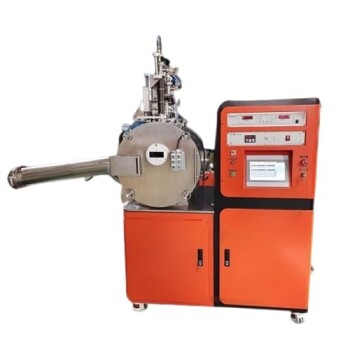
Vacuum sintering or hot pressing equipment functions as the critical processing engine that transforms loose FeCrAl metal powders into a solid, high-performance alloy. By applying extreme heat—and in the case of hot pressing, mechanical pressure—within a vacuum or controlled atmosphere, this equipment drives full densification, eliminates porosity, and engineers the material's microstructure for superior resistance to high-temperature stress.
Core Insight: While densification is the obvious output, the equipment’s true value lies in its ability to precisely manage the internal material structure. It creates a controlled environment that simultaneously prevents unwanted metal oxidation and facilitates the uniform distribution of strengthening oxide particles, which are essential for the alloy's high-temperature durability.
Achieving Full Densification and Purity
Eliminating Porosity through Negative Pressure
The vacuum system creates a negative pressure environment (typically greater than $1\times10^{-2}$ Pa) before and during the heating stage. This effectively exhausts air and volatiles trapped in the gaps between powder particles.
Removing these gases is a prerequisite for closing internal voids. By eliminating these "pore defects," the equipment lays the foundation for an alloy with high density and exceptional bonding strength.
Preventing Unwanted Oxidation
At the extreme temperatures required for sintering, metal powders are highly reactive to oxygen. The vacuum environment protects the FeCrAl powder from reacting with atmospheric oxygen.
This protection is critical because uncontrolled oxidation creates brittle layers that degrade performance. By maintaining low oxygen partial pressure, the equipment ensures the metallic purity of the alloy matrix.
Enhancing Mechanical Properties
Uniform Distribution of Dispersed Oxides
According to the primary technical reference, a key function of this equipment is the precise management of heating profiles. This control facilitates the uniform distribution of dispersed oxides throughout the alloy.
Unlike uncontrolled surface oxidation, these dispersed oxides are intentional and beneficial. They must be spread evenly to be effective.
Strengthening via Dislocation Barriers
The dispersed oxides serve a specific mechanical function: they act as barriers to "dislocation movement" within the material's crystal lattice.
When a material is stressed, dislocations (atomic defects) move, causing deformation. By pinning these dislocations in place, the oxides significantly improve the high-temperature strength and hardness of the finished FeCrAl alloy.
Process Efficiency and Integration
Consolidating Production Steps
Vacuum hot pressing equipment specifically integrates three distinct phases—powder degassing, compression molding, and pre-sintering—into a single operation.
Rapid Densification
By applying temperature and pressure simultaneously, the densification process occurs much faster than in traditional methods. This eliminates the long processing times and technical difficulties associated with separate cold-pressing and sintering workflows.
Understanding the Trade-offs
Managing Interface Reactions
While high vacuum and temperature are beneficial for the alloy, they can induce reactions between the sample and the mold.
As noted in supplementary data, the vacuum level influences these interface reactions. Operators must carefully balance vacuum settings to prevent impurities from the mold migrating into the alloy surface.
Sensitivity to Vacuum Levels
The process is intolerant of vacuum leaks or pump inefficiencies.
Maintaining specific pressure thresholds (e.g., $1.33\times10^{-1}$ Pa or better) is mandatory. A failure to maintain this environment immediately compromises the material by allowing gas entrapment or surface oxidation.
Making the Right Choice for Your Goal
When selecting or operating this equipment for FeCrAl production, prioritize your parameters based on the specific material requirement:
- If your primary focus is High-Temperature Strength: Prioritize precise heating profile control to ensure the uniform distribution of dispersed oxides, as these act as the primary dislocation barriers.
- If your primary focus is Material Purity and Density: Prioritize the vacuum system's capacity to maintain negative pressure ($>1\times10^{-2}$ Pa) during the pre-sintering phase to maximize gas exhaust and minimize pore defects.
The ultimate function of this equipment is not just to heat powder, but to engineer a microstructure that balances purity with structural reinforcement.
Summary Table:
| Feature | Function in FeCrAl Preparation | Benefit to Final Alloy |
|---|---|---|
| Vacuum Environment | Eliminates trapped gases & prevents oxidation | High purity, zero pore defects, & strong metallic bonding |
| Hot Pressing | Simultaneous application of heat and mechanical pressure | Rapid densification & integration of molding/sintering steps |
| Thermal Control | Manages heating profiles for oxide distribution | Enhanced high-temperature strength via dislocation barriers |
| Negative Pressure | Exhausts volatiles ($>1\times10^{-2}$ Pa) | Maximum density & elimination of internal voids |
Elevate Your Materials Engineering with KINTEK
Unlock the full potential of your FeCrAl alloys and advanced powder metallurgy projects. KINTEK specializes in high-performance laboratory equipment, offering state-of-the-art vacuum sintering furnaces and hot pressing systems designed for precision and durability.
Whether you require high-temperature furnaces, hydraulic presses, or specialized crucibles, our comprehensive portfolio supports every stage of your research and production. From ensuring uniform oxide dispersion to achieving full densification, KINTEK provides the tools you need for superior material properties.
Ready to optimize your lab's capabilities? Contact our technical experts today to find the perfect solution for your specific application requirements.
References
- Raúl B. Rebak, Peter L. Andresen. Resistance of Ferritic FeCrAl Alloys to Stress Corrosion Cracking for Light Water Reactor Fuel Cladding Applications. DOI: 10.5006/3632
This article is also based on technical information from Kintek Solution Knowledge Base .
Related Products
- Vacuum Heat Treat and Molybdenum Wire Sintering Furnace for Vacuum Sintering
- Vacuum Heat Treat and Pressure Sintering Furnace for High Temperature Applications
- Small Vacuum Heat Treat and Tungsten Wire Sintering Furnace
- Vacuum Heat Treat and Sintering Furnace with 9MPa Air Pressure
- Dental Porcelain Zirconia Sintering Ceramic Vacuum Press Furnace
People Also Ask
- What is the pressure for vacuum sintering? Achieve Optimal Material Purity and Density
- What is vacuum hardness? Unlock Superior Material Performance with Vacuum Processing
- How does a vacuum environment benefit the purification of matrix powders? Optimize Diamond Tool Sintering Efficiency
- What critical process conditions does a vacuum sintering furnace provide for titanium? Expert Diffusion Bonding Guide
- What are the critical functions of the vacuum system in a sintering furnace for Cu/Ti3SiC2/C/MWCNTs composites?