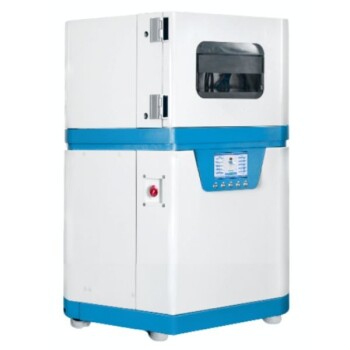
Precise temperature regulation is the single most critical factor in determining the mechanical strength of tungsten and copper joints. By strictly maintaining optimal thermal conditions, such as 950°C, the vacuum hot press furnace enables the necessary atomic diffusion between the metals. This control dictates whether the joint forms a robust metallurgical bond or remains a weak mechanical interface.
The temperature control system does not just heat the material; it engineers the microstructure of the joint. By stabilizing the environment for bidirectional diffusion, the system fosters the creation of specific Fe2W and Fe7W6 phases, which are the fundamental building blocks of a high-strength connection.
The Metallurgical Impact of Temperature
Driving Atomic Diffusion
The core challenge in bonding tungsten and copper lies in their distinct physical properties. The temperature control system overcomes this by providing the exact energy required to mobilize atoms.
At optimal temperatures (specifically 950°C), the system facilitates the bidirectional diffusion of iron atoms into the tungsten and copper structure. This movement is impossible without sustained, accurate heat application.
Creating the Transition Zone
The strength of the joint is defined by the chemical reaction that occurs at the interface. Precise heating allows for the formation of a transition zone.
Within this zone, intermetallic phases—specifically Fe2W and Fe7W6—are generated. These phases act as the "glue" at a molecular level, significantly enhancing the tensile strength and structural integrity of the final component.
How the Control System Achieves Precision
Intelligent PID Regulation
To achieve the metallurgical results described above, modern furnaces utilize PID intelligent program systems.
These controllers divide the heating process into segments, often offering up to 30 programmable stages. This allows for complex heating curves where temperature ramp-up, dwell times, and cooling rates are managed automatically to prevent thermal shock or incomplete bonding.
Real-Time Monitoring and Correction
The system relies on a feedback loop between thermocouples (sensors) and a PLC (Programmable Logic Controller).
The system collects real-time data every minute, comparing the actual furnace temperature against the target setpoint. If deviations occur, the controller adjusts the output immediately, ensuring the heating curve remains consistent with the programmed parameters.
Data Visibility and Traceability
Operators interact with the system via touch screens that display dynamic trend graphs.
Crucially, the system functions as a paperless recorder. It stores historical heating data, allowing engineers to verify that the specific temperature profile required for the Fe-W phase formation was actually achieved during the run.
Understanding the Trade-offs
The Cost of Thermal Deviation
The relationship between temperature and joint strength is non-linear. There is little room for error.
If the temperature is insufficient, the diffusion reaction is stifled. The iron atoms fail to penetrate the tungsten matrix effectively, preventing the formation of the Fe2W phases. This results in a "cold joint" with poor mechanical properties that will likely fail under stress.
Complexity vs. Control
While advanced PID systems offer superior control, they introduce complexity in programming.
Setting incorrect parameters across the 30 available stages can lead to inadvertent overheating or cooling lags. Operators must ensure the programmed curve aligns exactly with the material science requirements of the tungsten-copper diffusion process.
Making the Right Choice for Your Goal
Achieving the perfect bond requires aligning your equipment capabilities with your specific mechanical requirements.
- If your primary focus is Maximum Tensile Strength: Ensure your process allows for a sustained dwell time at exactly 950°C to maximize the formation of Fe2W and Fe7W6 phases.
- If your primary focus is Process Repeatability: Utilize the data logging and historical query functions of the control system to standardize the heating curve across every batch.
Ultimately, the mechanical reliability of your joint is a direct reflection of the stability and accuracy of your temperature control system.
Summary Table:
| Factor | Mechanism | Impact on Joint |
|---|---|---|
| Optimal Temperature (950°C) | Facilitates bidirectional atomic diffusion | Forms Fe2W and Fe7W6 intermetallic phases |
| PID Regulation | Segments heating into up to 30 programmable stages | Prevents thermal shock; ensures precise dwell times |
| Real-time Monitoring | Feedback loop between thermocouples and PLC | Maintains consistency with the target heating curve |
| Data Logging | Storage of historical heating profiles | Ensures process repeatability and quality traceability |
Elevate Your Material Bonding Precision with KINTEK
Achieving the perfect metallurgical bond between tungsten and copper requires more than just heat—it requires the absolute precision of KINTEK’s advanced vacuum hot press furnaces. Our systems are engineered with intelligent PID controllers and high-accuracy monitoring to ensure your components meet the highest tensile strength standards.
Whether you need specialized high-temperature furnaces, isostatic hydraulic presses, or crushing and milling systems, KINTEK provides the laboratory equipment and consumables essential for cutting-edge material science.
Ready to optimize your thermal processes? Contact our technical experts today to discover how our comprehensive solutions can enhance your lab's efficiency and product reliability.
Related Products
- Vacuum Hot Press Furnace Heated Vacuum Press Machine Tube Furnace
- 600T Vacuum Induction Hot Press Furnace for Heat Treat and Sintering
- Vacuum Hot Press Furnace Machine Heated Vacuum Press
- Vacuum Hot Press Furnace Machine for Lamination and Heating
- Vacuum Heat Treat and Pressure Sintering Furnace for High Temperature Applications
People Also Ask
- What advantages does a vacuum hot press furnace provide for LSLBO ceramic electrolytes? Achieve 94% Relative Density
- What role does a Vacuum Hot Press (VHP) furnace play in the densification of austenitic stainless steel 316 composites?
- What are the advantages of using a vacuum hot pressing furnace? Superior Densification for 2024Al/Gr/SiC Composites
- What are the advantages of a vacuum hot press furnace for LTPO solid electrolytes? Boost Density and Conductivity
- What core processing conditions does a vacuum hot press furnace provide? Achieve High-Density Cu-SiC/Diamond Composites