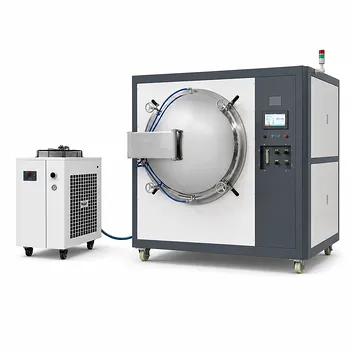
Vacuum hot pressing (VHP) fundamentally creates superior SiC/Al composites by introducing uniaxial mechanical pressure into the sintering equation, a variable absent in pressureless methods. This "thermo-mechanical coupling" physically forces powder particles to rearrange and eliminates internal voids, enabling the composite to reach nearly 100% of its theoretical density while remaining in a solid or semi-solid state.
Core Takeaway Pressureless sintering relies solely on thermal energy to bond particles, often leaving microscopic voids and weak interfaces. By combining heat with mechanical force, VHP physically drives densification and breaks down surface oxides, resulting in a stronger, non-porous composite with cleaner chemical bonding.
The Mechanics of Densification
Forcing Particle Rearrangement
In pressureless sintering, particles bond only where they naturally touch, often leaving gaps (pores) that thermal energy alone cannot close.
VHP applies continuous mechanical pressure (e.g., uniaxial force) throughout the heating process. This physically pushes the SiC and Aluminum particles into a tighter packing arrangement, mechanically closing the gaps that would otherwise remain as voids.
Inducing Plastic Deformation
At elevated temperatures, the Aluminum matrix enters a "thermoplastic" state, becoming soft and malleable.
The external pressure forces this softened metal to flow plastically. It squeezes the metal into the interstitial spaces between the harder SiC particles, ensuring a void-free internal structure that approaches 100% density.
Enhancing Interfacial Quality
Breaking the Oxide Barrier
Aluminum powder is naturally coated with a thin, stubborn oxide film that hinders bonding.
In a pressureless environment, this film can prevent the Aluminum from adhering to the SiC. The mechanical pressure in a VHP furnace helps physically rupture and destroy these oxide films, exposing clean metal surfaces for bonding.
Promoting Solid-State Diffusion
Once the oxide film is broken, the pressure brings the Al and SiC surfaces into intimate contact.
This proximity accelerates solid-state diffusion (the movement of atoms between materials). This creates a strong bond between the matrix and the reinforcement without requiring the high temperatures needed to melt the metal fully.
Inhibiting Brittle Phases
High temperatures in pressureless sintering can cause Aluminum to react chemically with SiC, forming Aluminum Carbide (Al4C3).
Al4C3 is a brittle phase that severely weakens the composite. Because VHP uses pressure to achieve density, it allows for processing at lower temperatures. This "low-temp" approach inhibits the formation of Al4C3, preserving the material's structural integrity.
Understanding the Trade-offs
Geometric Limitations
VHP typically applies pressure in one direction (uniaxial).
This limits the process to simple geometries, such as flat plates, discs, or cylinders. Producing complex, near-net-shape components is significantly more difficult with VHP than with pressureless sintering.
Throughput and Cost
VHP is generally a batch process requiring complex vacuum and hydraulic systems.
This makes it more expensive and time-consuming per unit than pressureless sintering, which can often process large volumes of parts continuously.
Making the Right Choice for Your Goal
The decision between VHP and pressureless sintering depends on your specific performance requirements.
- If your primary focus is Maximum Strength and Density: Choose Vacuum Hot Pressing to achieve near 100% density and inhibit brittle reaction products like Al4C3.
- If your primary focus is Complex Geometry: Recognize that VHP is limited to simple shapes; you may need to machine the part from a VHP billet or opt for pressureless sintering with post-processing.
- If your primary focus is Material Purity: Rely on VHP's vacuum environment to prevent high-temperature oxidation of the aluminum matrix during processing.
By substituting thermal intensity with mechanical force, VHP allows you to engineer a denser, stronger composite without compromising the chemical stability of the materials.
Summary Table:
| Feature | Pressureless Sintering | Vacuum Hot Pressing (VHP) |
|---|---|---|
| Densification Mechanism | Thermal energy only | Thermo-mechanical coupling |
| Porosity | Higher (residual voids) | Near 0% (theoretical density) |
| Interfacial Bonding | Hindered by oxide films | Stronger (oxide layers ruptured) |
| Brittle Phases (Al4C3) | Higher risk due to high heat | Minimized via lower-temp pressure |
| Geometric Flexibility | High (complex shapes) | Low (plates, discs, cylinders) |
| Production Cost | Lower (high throughput) | Higher (specialized batch process) |
Elevate Your Material Performance with KINTEK Advanced Furnaces
Ready to achieve near-theoretical density and superior interfacial bonding in your SiC/Al composites? KINTEK specializes in state-of-the-art laboratory equipment designed for precision material science. Our high-performance vacuum hot pressing furnaces and hydraulic hot presses provide the exact pressure and temperature control needed to eliminate brittle phases and maximize structural integrity.
Whether you are developing advanced composites, ceramics, or battery technologies, KINTEK offers a comprehensive range of solutions, including:
- High-Temperature Furnaces: Muffle, tube, vacuum, and atmosphere control.
- Precision Pressing: Pellet presses, hot presses, and isostatic systems.
- Material Processing: Crushing, milling, and sieving equipment.
Don't settle for porous results. Contact KINTEK today to discuss your specific research needs and let our experts help you select the perfect system for your lab.
Related Products
- Vacuum Hot Press Furnace Heated Vacuum Press Machine Tube Furnace
- 600T Vacuum Induction Hot Press Furnace for Heat Treat and Sintering
- Vacuum Hot Press Furnace Machine Heated Vacuum Press
- Vacuum Hot Press Furnace Machine for Lamination and Heating
- Vacuum Heat Treat and Pressure Sintering Furnace for High Temperature Applications
People Also Ask
- What advantages does a vacuum hot press furnace provide for LSLBO ceramic electrolytes? Achieve 94% Relative Density
- What role does a Vacuum Hot Press (VHP) furnace play in the densification of austenitic stainless steel 316 composites?
- What are the advantages of using a vacuum hot pressing furnace? Superior Densification for 2024Al/Gr/SiC Composites
- What are the advantages of a vacuum hot press furnace for LTPO solid electrolytes? Boost Density and Conductivity
- What core processing conditions does a vacuum hot press furnace provide? Achieve High-Density Cu-SiC/Diamond Composites