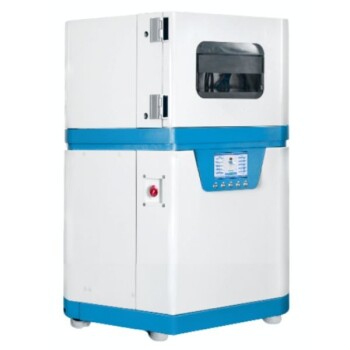
A vacuum hot pressing furnace facilitates densification by simultaneously applying high temperature, a vacuum environment, and axial mechanical pressure to the composite material. This synergistic approach prevents the oxidation of the 2009Al matrix, removes volatile impurities, and physically forces the softened aluminum to flow around the SiC particles, effectively eliminating internal pores.
Core Takeaway The vacuum hot pressing process replaces reliance on passive sintering with active mechanical compression in a pristine environment. By forcefully closing interstitial gaps while stripping away oxidation barriers, it allows SiCp/2009Al composites to achieve near-theoretical density and superior interfacial bonding.
The Critical Role of the Vacuum Environment
Prevention of Oxidation
The primary challenge in sintering aluminum alloys (like 2009Al) is their high affinity for oxygen. A high-vacuum environment significantly reduces the oxygen partial pressure within the furnace chamber. This prevents the formation of new oxide layers on the aluminum powder surfaces during the heating cycle, which would otherwise act as a barrier to diffusion and bonding.
Removal of Volatile Impurities
Powder metallurgy materials often contain adsorbed gases and volatile organic compounds. The vacuum system actively extracts these impurities from the interstitial spaces between powder particles before the material densifies. By removing these gases early, the furnace prevents gas entrapment, which is a leading cause of residual porosity and structural weakness in the final composite.
Mechanics of Pressure-Assisted Densification
Inducing Plastic Flow
While the heat softens the 2009Al matrix, it is the application of axial pressure that drives the densification. This external force pushes the semi-solid aluminum alloy to undergo plastic flow. The metal is mechanically forced to fill the voids and gaps between the hard Silicon Carbide (SiCp) particles, creating a solid, pore-free structure.
Enhancing Diffusion Bonding
Pressure does more than just move material; it improves atomic contact. By pressing the clean, oxide-free surfaces of the aluminum and SiC particles together, the furnace accelerates diffusion bonding. This formation of sintering necks occurs more rapidly and at lower temperatures than would be required in pressureless sintering.
Control of Microstructure and Interfaces
Managing Interfacial Reactions
The combination of controlled temperature and pressure allows for precise management of chemical reactions at the interface between the matrix and reinforcement. Specifically, the process helps control the formation of interfacial phases such as MgAl2O4 (spinel). Proper control of these reactions is essential for ensuring load transfer between the aluminum matrix and the SiC particles without degrading the material's ductility.
Understanding the Trade-offs
Geometry Limitations
Because the pressure is applied axially (uniaxially), this process is generally limited to simple shapes, such as plates, pucks, or cylinders. Creating complex, net-shape components often requires additional machining or alternative processing methods.
Cycle Time and Throughput
Vacuum hot pressing is a batch process that involves heating, holding, and cooling large thermal masses under vacuum. Consequently, production throughput is generally lower compared to continuous sintering methods, making it more suitable for high-performance, critical applications rather than high-volume commodity parts.
Making the Right Choice for Your Goal
To maximize the performance of your SiCp/2009Al composites, align your processing parameters with your specific material objectives:
- If your primary focus is Maximum Density: Prioritize the magnitude and timing of the axial pressure application, ensuring peak pressure is applied while the matrix is in its most plastic state to eliminate all residual porosity.
- If your primary focus is Interfacial Strength: Prioritize the quality of the vacuum level and the degassing stage to ensure particle surfaces are chemically clean before high-temperature bonding occurs.
By leveraging the vacuum hot press to mechanically close pores while chemically protecting the matrix, you transform a loose powder mixture into a high-performance structural composite.
Summary Table:
| Feature | Mechanism for SiCp/2009Al Densification | Benefit to Final Composite |
|---|---|---|
| High Vacuum | Prevents Al-oxide formation and removes volatile impurities. | Superior interfacial bonding and zero internal gas entrapment. |
| Axial Pressure | Forces plastic flow of softened 2009Al matrix into SiCp voids. | Elimination of residual porosity and achievement of near-theoretical density. |
| Precise Heat | Softens the aluminum matrix for enhanced diffusion. | Accelerates sintering necks formation at lower temperatures. |
| Interfacial Control | Manages chemical reactions like MgAl2O4 spinel formation. | Optimized load transfer between reinforcement and matrix. |
Elevate Your Composite Research with KINTEK
Are you looking to achieve superior densification and structural integrity in your high-performance materials? KINTEK specializes in advanced laboratory equipment and consumables designed for precision engineering. Our high-temperature vacuum hot pressing furnaces and isostatic presses provide the exact environment needed to eliminate porosity and optimize interfacial bonding in SiCp/2009Al composites and other metal-matrix materials.
From crushing and milling systems for powder preparation to high-temperature furnaces and hydraulic presses for consolidation, KINTEK offers a comprehensive range of tools to streamline your R&D and production workflows. Our portfolio also includes essential ceramics, crucibles, and cooling solutions tailored for demanding lab environments.
Ready to optimize your material performance? Contact KINTEK today to find the perfect technical solution for your laboratory!
Related Products
- Vacuum Hot Press Furnace Heated Vacuum Press Machine Tube Furnace
- 600T Vacuum Induction Hot Press Furnace for Heat Treat and Sintering
- Vacuum Hot Press Furnace Machine Heated Vacuum Press
- Vacuum Hot Press Furnace Machine for Lamination and Heating
- Vacuum Heat Treat and Pressure Sintering Furnace for High Temperature Applications
People Also Ask
- What advantages does a vacuum hot press furnace provide for LSLBO ceramic electrolytes? Achieve 94% Relative Density
- What role does a Vacuum Hot Press (VHP) furnace play in the densification of austenitic stainless steel 316 composites?
- What are the advantages of using a vacuum hot pressing furnace? Superior Densification for 2024Al/Gr/SiC Composites
- What are the advantages of a vacuum hot press furnace for LTPO solid electrolytes? Boost Density and Conductivity
- What core processing conditions does a vacuum hot press furnace provide? Achieve High-Density Cu-SiC/Diamond Composites