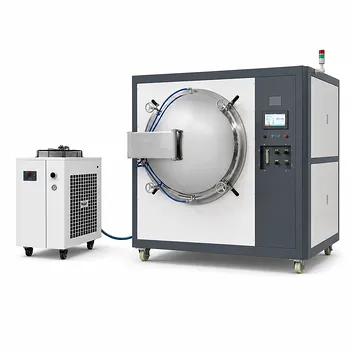
Pressure control acts as the decisive mechanical force that drives the 6061 aluminum matrix to achieve near-theoretical density. While high temperatures soften the alloy, it is the application of significant mechanical pressure (e.g., 70 MPa) that physically forces the plasticized metal to flow like a fluid, filling microscopic voids that thermal energy alone cannot eliminate.
The Core Insight Thermal sintering alone is often insufficient for composites because hard ceramic particles create rigid structures that resist shrinkage. Pressure control solves this by mechanically overcoming the "bridging effect," forcing the soft aluminum matrix to undergo rheological flow and fill the interstitial spaces between the hard SiCp reinforcement particles.
The Mechanics of Densification Under Pressure
Inducing Rheological Flow
In a vacuum hot press, the 6061 aluminum alloy is heated until it reaches a plastic or semi-solid state.
At this stage, the material is malleable but not fully liquid. By applying high uniaxial pressure, the equipment forces the matrix to undergo rheological flow. This means the metal physically moves and deforms to occupy available space, much like a viscous fluid under compression.
Overcoming the Bridging Effect
A primary challenge in sintering SiCp/Al composites is the bridging effect.
Hard Silicon Carbide (SiCp) particles tend to contact one another, creating a rigid network that supports the structure. This network creates "stress shielding," preventing the softer aluminum matrix from naturally shrinking into the gaps during sintering.
External mechanical pressure breaks or bypasses this resistance. It pushes the plastic aluminum matrix around and between the hard particles, effectively collapsing the bridges and eliminating large pores that would otherwise remain as structural defects.
Eliminating Residual Porosity
While temperature initiates the bonding process, pressure acts as the final densification driver.
The synergy of thermal energy and mechanical force crushes internal pores and closes sintering necks. This process allows the composite to achieve relative densities that are nearly 100% of the theoretical value, significantly higher than what is achievable through pressureless sintering.
Understanding the Process Dependencies
The Necessity of Vacuum Synergy
Pressure does not work in isolation; it relies heavily on the vacuum environment.
If the environment is not maintained at a high vacuum (e.g., 1.8 x 10^-2 Pa), the aluminum powder surfaces will oxidize. An oxide layer creates a barrier that hinders diffusion. Pressure is most effective only when the vacuum has removed adsorbed gases and prevented oxidation, ensuring the metal-to-ceramic interface is clean for bonding.
The Critical Timing of Pressure
Effective densification depends on applying pressure at the correct thermal window.
The matrix must be in a plastic state to flow without cracking or crushing the reinforcement particles. If pressure is applied too early (when the metal is cold and brittle) or too late, the rheological flow will be insufficient to fill the voids.
Making the Right Choice for Your Goal
To maximize the performance of your SiCp/6061 composites, tailor your pressure control strategy to your specific density and bonding requirements:
- If your primary focus is Maximum Density: Target higher pressure ranges (e.g., 70–100 MPa) to ensure the complete elimination of internal pores and the filling of all interstitial gaps between SiC particles.
- If your primary focus is Interface Strength: Prioritize the synchronization of vacuum levels with pressure application to ensure the aluminum flows over clean, oxide-free ceramic surfaces for optimal atomic diffusion.
Ultimately, pressure control transforms the 6061 matrix from a static binder into a dynamic filler, ensuring the composite is as solid and reliable as the theory predicts.
Summary Table:
| Mechanism | Action on SiCp/6061 Composite | Result |
|---|---|---|
| Rheological Flow | Forces plasticized 6061 Al matrix to flow like fluid | Fills microscopic voids between particles |
| Bridging Elimination | Overcomes rigid SiCp networks through mechanical force | Collapses gaps caused by stress shielding |
| Sintering Synergy | Combined thermal energy and uniaxial pressure | Closes sintering necks for theoretical density |
| Vacuum Integration | Prevents oxide layer formation on Al powder | Ensures clean metal-to-ceramic interfaces |
Elevate Your Materials Research with KINTEK
Achieving theoretical density in advanced composites like SiCp/6061 aluminum requires precision engineering. KINTEK specializes in high-performance laboratory equipment, offering state-of-the-art vacuum hot press systems designed for superior pressure control and thermal uniformity.
From high-temperature furnaces and isostatic hydraulic presses to advanced crushing and milling systems, our comprehensive portfolio supports every stage of your material development. Whether you are optimizing sintering cycles or exploring battery research and ceramics, KINTEK provides the reliable tools and consumables your lab needs.
Ready to achieve 100% density in your next project? Contact KINTEK today to discuss your equipment needs!
Related Products
- 600T Vacuum Induction Hot Press Furnace for Heat Treat and Sintering
- Vacuum Heat Treat and Pressure Sintering Furnace for High Temperature Applications
- Vacuum Heat Treat and Sintering Furnace with 9MPa Air Pressure
- Vacuum Hot Press Furnace Machine for Lamination and Heating
- Vacuum Hot Press Furnace Machine Heated Vacuum Press
People Also Ask
- What role does an induction vacuum hot pressing furnace play in sintering? Achieve 98% Density in Carbide Blocks
- What advantages does a vacuum hot press furnace provide for LSLBO ceramic electrolytes? Achieve 94% Relative Density
- What role does a Vacuum Hot Press (VHP) furnace play in the densification of austenitic stainless steel 316 composites?
- What role does mechanical pressure play during the vacuum diffusion bonding of tungsten and copper? Keys to Solid Bonding
- What are the advantages of a vacuum hot press furnace for W-50%Cu? Achieve 99.6% Density at Lower Temperatures