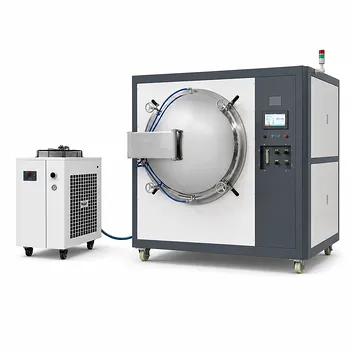
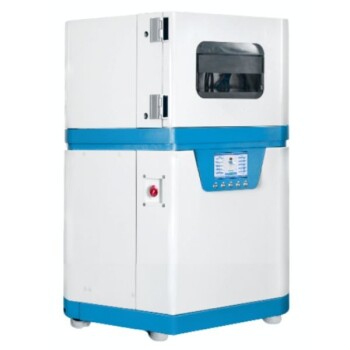
A vacuum hot-pressing furnace provides a distinct synergistic environment characterized by high temperatures (specifically 1660°C) and significant axial mechanical pressure (typically 30 MPa). This combination creates the necessary conditions to manufacture high-density TiB2-TiN-WC ceramic tools, achieving relative densities as high as 98.7%.
By introducing mechanical pressure as a second driving force alongside heat, this process accelerates densification through plastic flow and diffusion while simultaneously preventing the structural weaknesses caused by abnormal grain growth.
The Two Pillars of Process Control
The vacuum hot-pressing furnace operates by integrating two critical physical conditions that must work in tandem.
Precise Thermal Management
The furnace maintains a high-temperature environment, specifically reaching 1660°C for TiB2-TiN-WC materials.
This thermal energy is the primary activator for sintering, but for these complex ceramics, heat alone is often insufficient to remove porosity.
Axial Mechanical Pressure
The distinguishing feature of this process is the application of 30 MPa of axial pressure.
This pressure acts as an additional driving force, physically compressing the material during the heating phase. It compensates for the material's natural resistance to densification.
Mechanisms of Microstructural Improvement
The application of heat and pressure triggers specific physical mechanisms that improve the quality of the final ceramic tool.
Promoting Particle Rearrangement
The external pressure forces the ceramic particles to physically reorganize.
This particle rearrangement closes the gaps between granules more effectively than thermal sintering alone, reducing the volume of pores in the early stages of the process.
Facilitating Plastic Flow and Diffusion
For difficult-to-sinter materials like TiB2-TiN-WC, the combination of 1660°C and 30 MPa induces plastic flow.
It also promotes diffusion creep, a mechanism where material moves at the atomic level to fill voids. This is essential for eliminating the final, stubborn pores that compromise tool strength.
Inhibiting Abnormal Grain Growth
One of the most critical advantages of this environment is the control of grain size.
High temperatures usually pose a risk of grains growing too large (abnormal grain growth), which weakens the ceramic. The applied pressure allows for rapid densification before grains have time to grow excessively, ensuring a fine, strong microstructure.
Understanding the Trade-offs
While vacuum hot-pressing is superior for density, it is important to understand why it is necessary compared to other methods.
The Limitation of Pressureless Sintering
Without the 30 MPa of mechanical pressure, achieving 98.7% density would be nearly impossible for TiB2-TiN-WC.
Pressureless sintering would likely require significantly higher temperatures or longer hold times to achieve similar density.
The Risk of Microstructural Degradation
Attempting to sinter these materials without pressure often leads to a compromise.
To get the density without pressure, you would have to overheat the material. This would result in abnormal grain growth, rendering the tool brittle and less effective, despite being dense.
Making the Right Choice for Your Goal
When manufacturing TiB2-TiN-WC ceramic tools, the processing conditions must be aligned with your performance requirements.
- If your primary focus is maximizing density: Ensure your equipment can sustain 30 MPa of pressure to activate plastic flow and diffusion creep, aiming for that 98.7% relative density benchmark.
- If your primary focus is mechanical strength: Prioritize the balance of temperature (1660°C) and pressure to inhibit abnormal grain growth, which is the key to maintaining material toughness.
Ultimately, the vacuum hot-pressing furnace is not just a heater; it is a tool for forcing microstructural compliance in materials that resist conventional densification.
Summary Table:
| Process Parameter | Target Value | Functional Role in Manufacturing |
|---|---|---|
| Sintering Temperature | 1660°C | Activates thermal energy for sintering and atomic diffusion. |
| Axial Pressure | 30 MPa | Promotes particle rearrangement and plastic flow to close pores. |
| Vacuum Environment | High Vacuum | Prevents oxidation and ensures high-purity material bonding. |
| Achieved Density | 98.7% | Results in superior mechanical strength and tool longevity. |
Elevate Your Advanced Material Synthesis with KINTEK
Precision matters when engineering high-performance ceramics like TiB2-TiN-WC. KINTEK specializes in high-tier laboratory equipment, providing the vacuum hot-pressing furnaces and hydraulic presses necessary to achieve critical densification benchmarks.
Our solutions empower researchers and manufacturers with:
- Accurate Thermal Control: Achieve stable environments up to 1660°C and beyond.
- Optimized Pressure Systems: Precision axial mechanical pressure for uniform material microstructure.
- Comprehensive Lab Portfolio: From muffle and tube furnaces to crushing, milling, and specialized consumables like ceramics and crucibles.
Ready to eliminate porosity and inhibit abnormal grain growth in your samples? Contact KINTEK today to discuss your project requirements!
Related Products
- Vacuum Hot Press Furnace Heated Vacuum Press Machine Tube Furnace
- 600T Vacuum Induction Hot Press Furnace for Heat Treat and Sintering
- Vacuum Hot Press Furnace Machine Heated Vacuum Press
- Vacuum Hot Press Furnace Machine for Lamination and Heating
- Vacuum Heat Treat and Pressure Sintering Furnace for High Temperature Applications
People Also Ask
- What advantages does a vacuum hot press furnace provide for LSLBO ceramic electrolytes? Achieve 94% Relative Density
- What role does a Vacuum Hot Press (VHP) furnace play in the densification of austenitic stainless steel 316 composites?
- What are the advantages of using a vacuum hot pressing furnace? Superior Densification for 2024Al/Gr/SiC Composites
- What are the advantages of a vacuum hot press furnace for LTPO solid electrolytes? Boost Density and Conductivity
- What core processing conditions does a vacuum hot press furnace provide? Achieve High-Density Cu-SiC/Diamond Composites