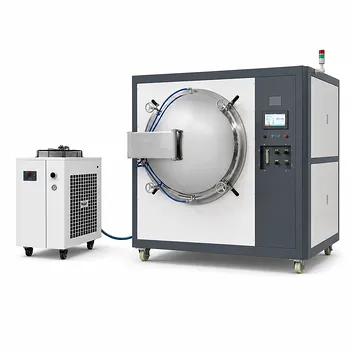
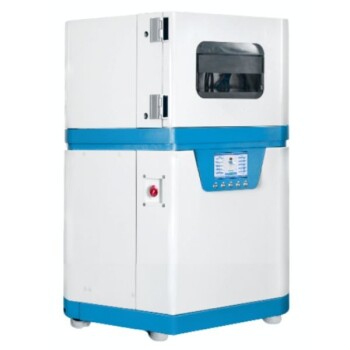
A vacuum hot pressing furnace facilitates the consolidation of (Cu–10Zn)-Al2O3 nanocomposites by subjecting the material to a simultaneous combination of high temperature (900°C) and constant uniaxial pressure (25 MPa) within a high-vacuum environment (10⁻³ torr). This specific process drives atomic diffusion and forces particle contact to eliminate porosity, resulting in a highly dense material while strictly preventing the oxidation of the metal matrix that would otherwise occur at these temperatures.
Core Takeaway The true power of this method is the synergy between mechanical force and thermal energy in an oxygen-free zone. It allows you to force non-wetting ceramic particles and metal powders into a dense, cohesive solid without compromising the chemical purity of the matrix.
The Critical Role of the Vacuum Environment
Preventing Matrix Oxidation
At 900°C, metals like copper and zinc are highly reactive to oxygen. In a standard furnace, this would lead to severe oxidation, degrading the material's properties.
Maintaining Interface Purity
The vacuum level of 10⁻³ torr removes atmospheric gases from the chamber. This ensures that the interface between the metal matrix and the alumina (Al2O3) nanoparticles remains clean, which is essential for strong bonding.
Driving Densification Through Heat and Force
Overcoming Interfacial Resistance
Composite materials often suffer from poor wettability between the metal matrix and ceramic reinforcements. Simple heating is often insufficient to close the gaps between these dissimilar materials.
Utilizing Uniaxial Pressure
By applying 25 MPa of constant pressure, the furnace mechanically forces the particles into intimate contact. This overcomes the natural resistance between the phases and physically closes voids that heat alone cannot eliminate.
Accelerating Atomic Diffusion
The temperature of 900°C provides the necessary kinetic energy for atoms to move. When combined with pressure, this environment significantly accelerates atomic diffusion across particle boundaries, leading to rapid and complete consolidation.
Understanding the Operational Trade-offs
The Risk of Component Loss
While high pressure is beneficial for density, it requires precise regulation. If the processing temperature induces a local liquid phase within the matrix, excessive pressure can squeeze the molten metal out of the mold.
Balancing Pressure and Temperature
You must maintain a delicate balance. The pressure must be high enough to induce plastic deformation and pore elimination, but controlled enough to retain the material composition within the mold geometry.
Optimizing Your Consolidation Strategy
To ensure the best results for your specific application, consider the following strategic adjustments:
- If your primary focus is Maximum Density: Prioritize the synchronization of peak temperature and pressure application to maximize plastic flow and fill micropores.
- If your primary focus is Material Purity: Ensure your vacuum system is fully stabilized at 10⁻³ torr or better before the heating ramp begins to prevent any initial oxidation.
By mastering the interplay of vacuum, heat, and pressure, you convert a loose powder mixture into a high-performance, structurally integral nanocomposite.
Summary Table:
| Process Parameter | Specification | Function in Consolidation |
|---|---|---|
| Temperature | 900°C | Provides kinetic energy for atomic diffusion and bonding. |
| Uniaxial Pressure | 25 MPa | Mechanically eliminates porosity and overcomes interfacial resistance. |
| Vacuum Level | 10⁻³ torr | Prevents oxidation and maintains high interface purity between phases. |
| Atmosphere | High Vacuum | Ensures chemical integrity of the Cu-Zn metal matrix. |
| Final Result | Nanocomposite | High-density, structurally integral material with clean interfaces. |
Elevate Your Advanced Material Synthesis with KINTEK
Precision is the difference between a failed sample and a high-performance nanocomposite. At KINTEK, we specialize in providing researchers and industrial labs with state-of-the-art vacuum hot pressing furnaces, isostatic presses, and high-temperature systems designed to handle the most demanding material consolidation workflows.
Whether you are developing (Cu–10Zn)-Al2O3 composites or exploring new ceramic-metal interfaces, our equipment offers the precise synchronization of temperature, pressure, and vacuum required for superior results. Beyond our furnaces, KINTEK provides a comprehensive range of high-purity ceramic crucibles, crushing and milling systems, and specialized consumables to support every stage of your material research.
Ready to achieve maximum density and purity in your lab? Contact our technical experts today to find the perfect solution for your application!
Related Products
- Vacuum Hot Press Furnace Heated Vacuum Press Machine Tube Furnace
- 600T Vacuum Induction Hot Press Furnace for Heat Treat and Sintering
- Vacuum Hot Press Furnace Machine Heated Vacuum Press
- Vacuum Hot Press Furnace Machine for Lamination and Heating
- Vacuum Heat Treat and Pressure Sintering Furnace for High Temperature Applications
People Also Ask
- What advantages does a vacuum hot press furnace provide for LSLBO ceramic electrolytes? Achieve 94% Relative Density
- What role does a Vacuum Hot Press (VHP) furnace play in the densification of austenitic stainless steel 316 composites?
- What are the advantages of using a vacuum hot pressing furnace? Superior Densification for 2024Al/Gr/SiC Composites
- What are the advantages of a vacuum hot press furnace for LTPO solid electrolytes? Boost Density and Conductivity
- What core processing conditions does a vacuum hot press furnace provide? Achieve High-Density Cu-SiC/Diamond Composites