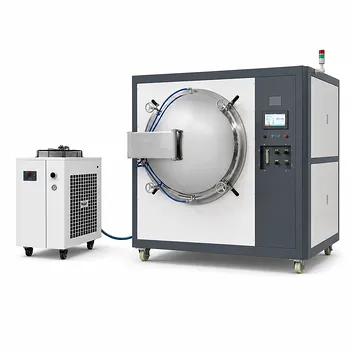
Knowledge How does the pressure loading system of a vacuum hot press furnace regulate CoCrCuFeNi alloy microstructure?
Author avatar

Tech Team · Kintek Solution

Updated 1 day ago

How does the pressure loading system of a vacuum hot press furnace regulate CoCrCuFeNi alloy microstructure?


The pressure loading system functions as a critical kinetic accelerator for microstructural evolution in high-entropy alloys. By applying continuous, adjustable mechanical pressure (typically ranging from 10 to 50 MPa) during sintering, it forces powder particles to rearrange and undergo plastic deformation. This process does not merely densify the material; it fundamentally alters atomic behavior to resolve segregation issues and optimize phase structure.

Core Takeaway While temperature provides the energy for sintering, the pressure loading system provides the driving force to overcome diffusion resistance. By introducing dislocations that serve as atomic "fast tracks," the system eliminates the separation of Cu-rich and Cu-poor phases, ensuring a homogenous and fully dense CoCrCuFeNi alloy.

Mechanisms of Microstructural Regulation

Densification via Particle Rearrangement

The most immediate function of the pressure system is to physically compress the alloy powder.

By applying uniaxial pressure, the system forces particles to slide past one another and fill interstitial voids.

This mechanical rearrangement significantly reduces porosity, allowing the alloy to achieve a near-fully dense bulk structure at temperatures lower than those required for pressure-less sintering.

Accelerating Diffusion through Plastic Deformation

The application of high mechanical load (e.g., 30 MPa) induces plastic deformation at the contact points between particles.

This deformation generates a high density of crystal defects, specifically dislocations.

These dislocations act as accelerated diffusion channels, significantly lowering the resistance for atoms to move and mix.

This enhanced diffusivity is critical for high-entropy alloys, where the complex mix of five or more elements naturally creates "sluggish diffusion" effects that otherwise hinder homogenization.

Eliminating Elemental Segregation

In CoCrCuFeNi alloys specifically, elemental segregation is a major challenge, particularly the tendency for Copper (Cu) to separate from the matrix.

The pressure loading system directly combats this by forcing atomic integration.

Research indicates that increasing the hot-pressing pressure effectively eliminates the separation of Cu-rich and Cu-poor phases.

This results in a uniform distribution of elements and an optimized phase structure, which is essential for consistent mechanical performance.

Understanding the Operational Trade-offs

Uniaxial Constraints

The pressure in a vacuum hot press is typically uniaxial (applied from one direction).

While effective for flat or simple shapes, this can lead to density gradients in thicker samples if friction between the powder and the die is too high.

Balancing Pressure and Mold Integrity

There is a practical limit to the pressure that can be applied, often dictated by the strength of the graphite dies used in these systems.

Excessive pressure (beyond 50-60 MPa) can fracture the tooling, while insufficient pressure fails to close residual porosity or generate the necessary dislocations for homogenization.

Making the Right Choice for Your Goal

To maximize the benefits of the pressure loading system for your specific CoCrCuFeNi application, consider the following:

  • If your primary focus is Phase Homogeneity: Prioritize higher pressures (approaching 30-50 MPa) to maximize plastic deformation and dislocation density, which drives the mixing of Cu-rich regions.
  • If your primary focus is Density without Distortion: Use a stepped pressure approach, applying moderate force during the initial heating to rearrange particles, and peak force only at the sintering temperature to seal porosity.

Ultimately, the pressure system is the control lever that transforms a porous, segregated powder compact into a solid, high-performance structural alloy.

Summary Table:

Mechanism Impact on Microstructure Key Benefit
Particle Rearrangement Forces particles into voids Achieves near-theoretical density at lower temperatures
Plastic Deformation Generates high-density dislocations Creates atomic 'fast tracks' to overcome sluggish diffusion
Mechanical Forcing Integrates Cu-rich and Cu-poor phases Eliminates elemental segregation for phase homogeneity
Uniaxial Load Compresses powder along a single axis Ensures structural integrity and uniform bulk properties

Unlock Advanced Material Performance with KINTEK Precision

Are you struggling with elemental segregation or density gradients in your high-entropy alloy research? KINTEK specializes in high-performance vacuum hot press furnaces and hydraulic presses designed to provide the precise mechanical control required for complex metallurgical evolution.

Our comprehensive portfolio supports your lab's mission with:

  • High-Temperature Hot Presses: Engineered for precise pressure loading (10–50+ MPa) to optimize alloy homogeneity.
  • Complete Material Solutions: From graphite dies and high-temperature ceramics to crushing, milling, and sieving equipment for powder preparation.
  • Research Consumables: A wide range of crucibles, PTFE products, and electrolytic cells for post-sintering analysis.

Don't let 'sluggish diffusion' slow your innovation. Contact KINTEK today to discuss your vacuum hot pressing needs and see how our laboratory expertise can transform your material processing outcomes.

Related Products

People Also Ask

Related Products

Vacuum Hot Press Furnace Heated Vacuum Press Machine Tube Furnace

Vacuum Hot Press Furnace Heated Vacuum Press Machine Tube Furnace

Reduce forming pressure & shorten sintering time with Vacuum Tube Hot Press Furnace for high-density, fine-grain materials. Ideal for refractory metals.

Vacuum Hot Press Furnace Machine Heated Vacuum Press

Vacuum Hot Press Furnace Machine Heated Vacuum Press

Discover the advantages of Vacuum Hot Press Furnace! Manufacture dense refractory metals & compounds, ceramics, and composites under high temp and pressure.

600T Vacuum Induction Hot Press Furnace for Heat Treat and Sintering

600T Vacuum Induction Hot Press Furnace for Heat Treat and Sintering

Discover the 600T Vacuum Induction Hot Press Furnace, designed for high-temperature sintering experiments in vacuum or protected atmospheres. Its precise temperature and pressure control, adjustable working pressure, and advanced safety features make it ideal for nonmetal materials, carbon composites, ceramics, and metal powders.

Vacuum Heat Treat Furnace with Ceramic Fiber Liner

Vacuum Heat Treat Furnace with Ceramic Fiber Liner

Vacuum furnace with polycrystalline ceramic fiber insulation liner for excellent heat insulation and uniform temperature field. Choose from 1200℃ or 1700℃ max. working temperature with high vacuum performance and precise temperature control.

High Pressure Laboratory Vacuum Tube Furnace Quartz Tubular Furnace

High Pressure Laboratory Vacuum Tube Furnace Quartz Tubular Furnace

KT-PTF High Pressure Tube Furnace: Compact split tube furnace with strong positive pressure resistance. Working temp up to 1100°C and pressure up to 15Mpa. Also works under controller atmosphere or high vacuum.

Molybdenum Vacuum Heat Treat Furnace

Molybdenum Vacuum Heat Treat Furnace

Discover the benefits of a high-configuration molybdenum vacuum furnace with heat shield insulation. Ideal for high-purity, vacuum environments like sapphire crystal growth and heat treatment.

Vacuum Heat Treat Sintering Brazing Furnace

Vacuum Heat Treat Sintering Brazing Furnace

A vacuum brazing furnace is a type of industrial furnace used for brazing, a metalworking process that joins two pieces of metal using a filler metal that melts at a lower temperature than the base metals. Vacuum brazing furnaces are typically used for high-quality applications where a strong, clean joint is required.

2200 ℃ Graphite Vacuum Heat Treat Furnace

2200 ℃ Graphite Vacuum Heat Treat Furnace

Discover the power of the KT-VG Graphite Vacuum Furnace - with a maximum working temperature of 2200℃, it's perfect for vacuum sintering of various materials. Learn more now.

Ultra-High Temperature Graphite Vacuum Graphitization Furnace

Ultra-High Temperature Graphite Vacuum Graphitization Furnace

The ultra-high temperature graphitization furnace utilizes medium frequency induction heating in a vacuum or inert gas environment. The induction coil generates an alternating magnetic field, inducing eddy currents in the graphite crucible, which heats up and radiates heat to the workpiece, bringing it to the desired temperature. This furnace is primarily used for graphitization and sintering of carbon materials, carbon fiber materials, and other composite materials.

1700℃ Muffle Oven Furnace for Laboratory

1700℃ Muffle Oven Furnace for Laboratory

Get superior heat control with our 1700℃ Muffle Furnace. Equipped with intelligent temperature microprocessor, TFT touch screen controller & advanced insulation materials for precise heating up to 1700C. Order now!

1800℃ Muffle Oven Furnace for Laboratory

1800℃ Muffle Oven Furnace for Laboratory

KT-18 muffle furnace with Japan Al2O3 polycrystalline fibe and Silicon Molybdenum heating element, up to 1900℃, PID temperature control and 7" smart touch screen. Compact design, low heat loss, and high energy efficiency. Safety interlock system and versatile functions.

1400℃ Muffle Oven Furnace for Laboratory

1400℃ Muffle Oven Furnace for Laboratory

Get precise high-temperature control up to 1500℃ with KT-14M Muffle furnace. Equipped with a smart touch screen controller and advanced insulation materials.

1700℃ Laboratory High Temperature Tube Furnace with Alumina Tube

1700℃ Laboratory High Temperature Tube Furnace with Alumina Tube

Looking for a high-temperature tube furnace? Check out our 1700℃ Tube Furnace with Alumina Tube. Perfect for research and industrial applications up to 1700C.

Horizontal High Temperature Graphite Vacuum Graphitization Furnace

Horizontal High Temperature Graphite Vacuum Graphitization Furnace

Horizontal Graphitization Furnace: This type of furnace is designed with the heating elements placed horizontally, allowing for uniform heating of the sample. It's well-suited for graphitizing large or bulky samples that require precise temperature control and uniformity.

Vertical High Temperature Graphite Vacuum Graphitization Furnace

Vertical High Temperature Graphite Vacuum Graphitization Furnace

Vertical high temperature graphitization furnace for carbonization and graphitization of carbon materials up to 3100℃.Suitable for shaped graphitization of carbon fiber filaments and other materials sintered in a carbon environment.Applications in metallurgy, electronics, and aerospace for producing high-quality graphite products like electrodes and crucibles.

2200 ℃ Tungsten Vacuum Heat Treat and Sintering Furnace

2200 ℃ Tungsten Vacuum Heat Treat and Sintering Furnace

Experience the ultimate refractory metal furnace with our Tungsten vacuum furnace. Capable of reaching 2200℃, perfect for sintering advanced ceramics and refractory metals. Order now for high-quality results.

Vacuum Heat Treat and Molybdenum Wire Sintering Furnace for Vacuum Sintering

Vacuum Heat Treat and Molybdenum Wire Sintering Furnace for Vacuum Sintering

A vacuum molybdenum wire sintering furnace is a vertical or bedroom structure, which is suitable for withdrawal, brazing, sintering and degassing of metal materials under high vacuum and high temperature conditions. It is also suitable for dehydroxylation treatment of quartz materials.

Mesh belt controlled atmosphere furnace

Mesh belt controlled atmosphere furnace

Discover our KT-MB mesh belt sintering furnace - perfect for high-temperature sintering of electronic components & glass insulators. Available for open air or controlled atmosphere environments.

1700℃ Controlled Atmosphere Furnace Nitrogen Inert Atmosphere Furnace

1700℃ Controlled Atmosphere Furnace Nitrogen Inert Atmosphere Furnace

KT-17A Controlled atmosphere furnace: 1700℃ heating, vacuum sealing technology, PID temperature control, and versatile TFT smart touch screen controller for laboratory and industrial use.

Graphite Vacuum Continuous Graphitization Furnace

Graphite Vacuum Continuous Graphitization Furnace

High-temperature graphitization furnace is a professional equipment for graphitization treatment of carbon materials. It is a key equipment for the production of high-quality graphite products. It has high temperature, high efficiency and uniform heating. It is suitable for various high-temperature treatments and graphitization treatments. It is widely used in metallurgy, electronics, aerospace, etc. industry.


Leave Your Message